Now's your chance, if you live locally, to come to an evening Mass on the Feast of the Sacred Heart of Jesus, this Friday at Assumption Grotto on 13770 Gratiot Avenue, Detroit, MI 48205 . Click here for a map if you need one, or put the address in mapquest:
The choir will be singing at the 7:00pm Mass, and it is likely the last you'll hear of the full ensemble until the Feast of the Assumption.
Other Events from the Grotto News:
You are invited to a reception
introducing the new Catholic College in
Michigan, The College of Saints Peter
and Paul, on the beautiful grounds of the
home of Mr. Edmund Miller, 67919 Eight
Mile Rd., South Lyon, MI. The college is
completely faithful to the Magisterium,
featuring a solid Liberal Arts Core
Curriculum. Guest Speaker: Fr. Eduard
Perrone, Pastor of Assumption Grotto
Church, Sunday, June 25th, 7-9:00 p.m.
For further information: 734-239-3476.
...……………********………………….
Prayer Vigil for Life-Helpers of God
Precious Infants, Saturday, June 24th,
7:30 am Mass at St. Raymonds, celebrated
by Bishop Schoenherr, Rosary in front of
two abortion clinics on 8 Mile,
Benediction and refreshments at
Assumption Grotto after.
...……………********………………….
If you have never been to such a prayer vigil, come to the Mass and check it out. Not only is it "non-confrontational", but encourages the power of prayer, love and mercy. We simply process praying all decades of all mysteries of the rosary, singing song versus in bewteen. The first time I went, it was later reported at the luncheon that two women decided against aborting, and one went home to reconsider.
We can win more hearts with love, compassion and prayer, than with all of the confrontation that could be thrown at women, and those with them, entering a clinic.
Join us. I hope to be there myself, but its proving to be a full weekend.
Tuesday, June 20, 2006
Corpus Christi 2006 - Photos from Grotto - Post 4
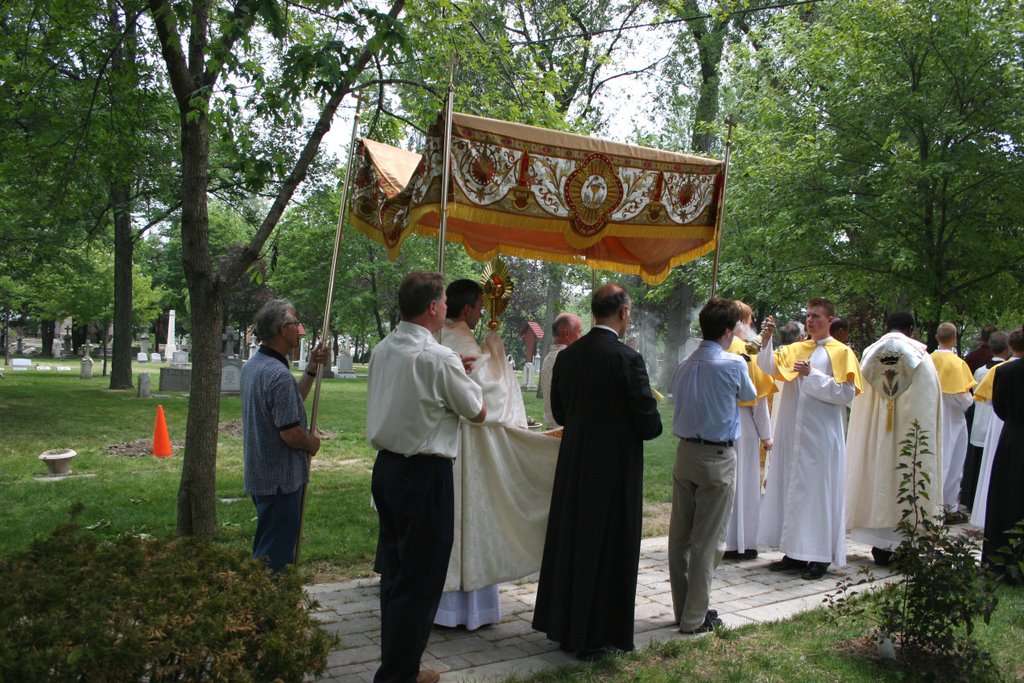
Continuing with our series of photographs of Corpus Christi 2006 at Assumption Grotto in Detroit, the Blessed Sacrament is leaving the third altar, and is heading towards the fourth, which is the last outdoor stop before going back into the Church. The fourth altar was profiled as the first photo, in my first post on this event.
As you can see throughout these photos, there is no shortage of priests or religious at such events. There are at least six or seven priests and one bishop. More on that tomorrow.
If you look carefully, you will see the altar boy on the far side swinging the thurible towards the Blessed Sacrament. He will bow after three swings, then turn, at which time the altar boy closest to us will turn and swing the thurible three times. They continued alternating all allong the route.
As you can see throughout these photos, there is no shortage of priests or religious at such events. There are at least six or seven priests and one bishop. More on that tomorrow.
If you look carefully, you will see the altar boy on the far side swinging the thurible towards the Blessed Sacrament. He will bow after three swings, then turn, at which time the altar boy closest to us will turn and swing the thurible three times. They continued alternating all allong the route.
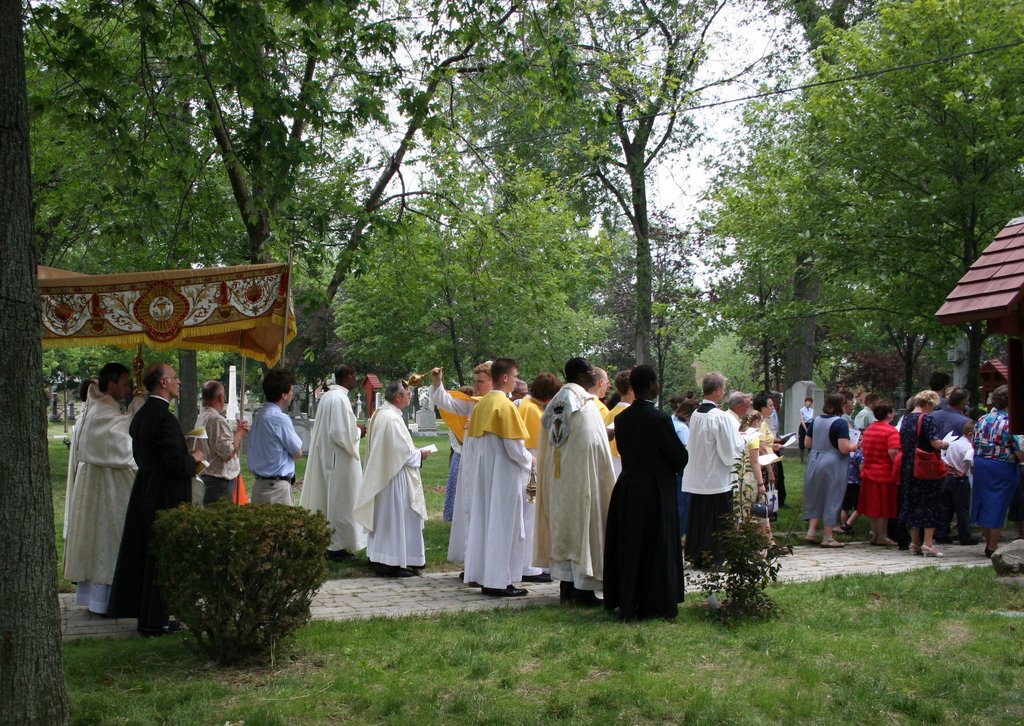
Another picture of one of the Missionaries of Charity, holding a song sheets handed out earlier.

This photograph shows Our Lord being brought through the cemetary gates as they head across the parking lot to where the fourth altar resides. I'll bring you more photos tomorrow at the fourth altar.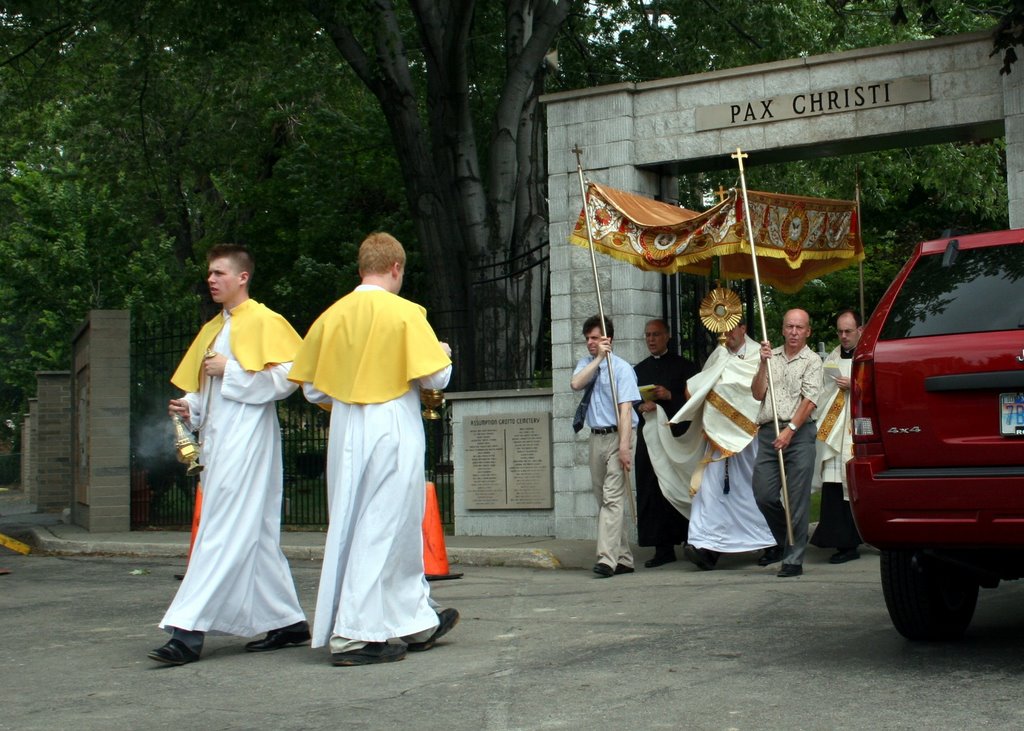
If you've ever wondered about the canopy, you can get a little insight from New Advent. There are several. The baldichinum of the altar, a baldacchino (seen in the photos), and an ombrellino seen below used on Assumption Day last year.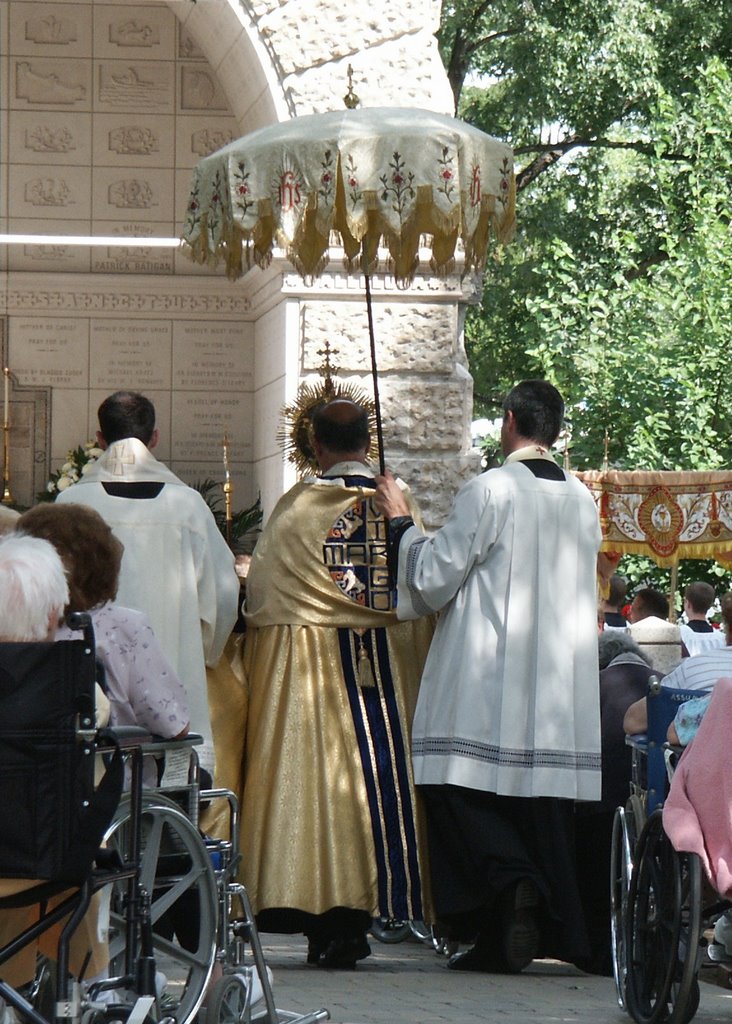
Previous Posts on Corpus Christi 2006


Off Topic: Baby Sparrow update
Sorry folks, no new pictures yet. However, I did stop in to see "Slick" and he is doing great. He is fully feathered, his wings are nice and long and in good working order, his tail is about half as long as it will get when fully grown, and he's eating three full syringes of baby bird formula now.
Unfortunately, the splayed leg is definitely splayed. Denise had been working with it to try to straighten it, but he gets out of anything she tries to tie it down with. It's a muscular thing. Everything works, and he moves the leg and all digits on the claw, but its all just going the wrong way. If it were fractured or dislocated, that would be impossible.
As a result, he likely won't be able to go back into the wild. She said that he would likely get picked on to death because he is different. In nature, I suppose a community of sparrows probably can't tell the difference between an illness, which could threaten the community, and a handicap.
He props himself up on that one leg, while the other hangs out behind him. She is now teaching him each day how to perch and introduced him to millet seed the yesterday, but its still too soon. She says it will take a little time for him to start getting curious enough to peck at it.
As soon as she sends me pictures, i'll upload.
Unfortunately, the splayed leg is definitely splayed. Denise had been working with it to try to straighten it, but he gets out of anything she tries to tie it down with. It's a muscular thing. Everything works, and he moves the leg and all digits on the claw, but its all just going the wrong way. If it were fractured or dislocated, that would be impossible.
As a result, he likely won't be able to go back into the wild. She said that he would likely get picked on to death because he is different. In nature, I suppose a community of sparrows probably can't tell the difference between an illness, which could threaten the community, and a handicap.
He props himself up on that one leg, while the other hangs out behind him. She is now teaching him each day how to perch and introduced him to millet seed the yesterday, but its still too soon. She says it will take a little time for him to start getting curious enough to peck at it.
As soon as she sends me pictures, i'll upload.
Devotion to the Sacred Heart - Part 2
As we await Thursday to resume the Twenty-One Days of Prayers for Priests series, I'll bring you more excerpts from the article written by Fr. William Wagner, ORC, on the Devotion to the Sacred Heart of Jesus. See Post-1 here.
Continuing on in his article, we leave the topic of devotion and enter more deeply into Sacred Heart. There are three bullets in this next section and I will provide just a glimpse here and you can continue reading each at the orginal site. All three links below lead to the same page, so you can flow through all three bullets there.
Truly, the best thing to do with this article, is to print it out in full, then go off somewhere and read it slowly and meditate on it. It is really loaded with references, so take at least your bible with you. Sacred Heart is this Friday!!!
1. Its Source
Since devotion is about the loving service of God, and since our access to the love and service of God is in and through Christ, it follows that our devotion must be principally focused on Christ. The seed of the devotion to the Sacred Heart is planted in Sacred Scripture. Jesus invites us to come to Him and learn from Him who is "meek and humble of heart" (Mt 11,29). St. John reclines upon the breast of Jesus at the Last Supper (cf. Jn 13,22) and beneath the Cross witnesses the piercing of the Sacred Heart by the soldier's lance (cf. Jn 19,34ff).
This seed germinated at the beginning of the present millennium and began to thrive in the late Middle Ages.......continued
2. Its Reasons
Christ is the image, the icon of the Father, the manifestation of the eternal Godhead, of the merciful love of God. Now the symbol for this love is the heart. Hence, the Sacred Heart of Jesus stands: 1) for His Person and for His love; 2) for His Divinity and for His humanity; 3) for His love for the Father and for us; 4) for His divine and His human love. In a word, devotion to the Sacred Heart embraces the entire mystery of the Hypostatic Union, in virtue of which the man, Jesus, is the very Son of God. Pope Pius XII writes:
"The Heart of Jesus is the Heart of a Divine Person, the Word Incarnate, and by it is represented and, as it were, placed before our gaze, all the love with which He has embraced and even now embraces us. Consequently, the honor to be paid to the Sacred Heart is such as to raise it to the rank -- so far as external practice is concerned -- of the highest expression of Christian piety. For this is the religion of Jesus which is centered on the mediator Who is God and Man, and in such a way that we cannot reach the heart of God save through the Heart of Christ, as He Himself says: 'I am the way, the truth and the life; no one comes to the Father save through Me' (Jn 14,6)."
Let us now consider the key ideas which motivated St. John Eudes in his great love for the Sacred Heart....continued
3. Its Fruits
At the Incarnation the Son of God not only sought a single humanity for Himself, but He aspired to unite all of humanity into Himself as into one 'mystical person', as Pope Pius XII terms it in His encyclical on the Mystical Body. At the Last Supper He prayed for all who would believe in Him: "[I pray] that all may be one, even as Thou, Father, art in Me and I in Thee; that they also may be one in us and that they may be one, even as we are one" (Jn 17,21. 22). Evidently, the principal glorification of God in creation is this love of Jesus Christ. Accordingly, we ought to recognize that this is the principal reason why God incorporates men and angels into the Mystical Body of Christ, so that we all as one can love and glorify the Father with the infinitely pleasing love and power of the Sacred Heart. Truly, the Heart belongs to the entire Body. However humble we may be, as members of the Mystical Body, as members of Christ, His Divine Heart with all its fire and affection is wholly and entirely ours.....continued
Continuing on in his article, we leave the topic of devotion and enter more deeply into Sacred Heart. There are three bullets in this next section and I will provide just a glimpse here and you can continue reading each at the orginal site. All three links below lead to the same page, so you can flow through all three bullets there.
Truly, the best thing to do with this article, is to print it out in full, then go off somewhere and read it slowly and meditate on it. It is really loaded with references, so take at least your bible with you. Sacred Heart is this Friday!!!
1. Its Source
Since devotion is about the loving service of God, and since our access to the love and service of God is in and through Christ, it follows that our devotion must be principally focused on Christ. The seed of the devotion to the Sacred Heart is planted in Sacred Scripture. Jesus invites us to come to Him and learn from Him who is "meek and humble of heart" (Mt 11,29). St. John reclines upon the breast of Jesus at the Last Supper (cf. Jn 13,22) and beneath the Cross witnesses the piercing of the Sacred Heart by the soldier's lance (cf. Jn 19,34ff).
This seed germinated at the beginning of the present millennium and began to thrive in the late Middle Ages.......continued
2. Its Reasons
Christ is the image, the icon of the Father, the manifestation of the eternal Godhead, of the merciful love of God. Now the symbol for this love is the heart. Hence, the Sacred Heart of Jesus stands: 1) for His Person and for His love; 2) for His Divinity and for His humanity; 3) for His love for the Father and for us; 4) for His divine and His human love. In a word, devotion to the Sacred Heart embraces the entire mystery of the Hypostatic Union, in virtue of which the man, Jesus, is the very Son of God. Pope Pius XII writes:
"The Heart of Jesus is the Heart of a Divine Person, the Word Incarnate, and by it is represented and, as it were, placed before our gaze, all the love with which He has embraced and even now embraces us. Consequently, the honor to be paid to the Sacred Heart is such as to raise it to the rank -- so far as external practice is concerned -- of the highest expression of Christian piety. For this is the religion of Jesus which is centered on the mediator Who is God and Man, and in such a way that we cannot reach the heart of God save through the Heart of Christ, as He Himself says: 'I am the way, the truth and the life; no one comes to the Father save through Me' (Jn 14,6)."
Let us now consider the key ideas which motivated St. John Eudes in his great love for the Sacred Heart....continued
3. Its Fruits
At the Incarnation the Son of God not only sought a single humanity for Himself, but He aspired to unite all of humanity into Himself as into one 'mystical person', as Pope Pius XII terms it in His encyclical on the Mystical Body. At the Last Supper He prayed for all who would believe in Him: "[I pray] that all may be one, even as Thou, Father, art in Me and I in Thee; that they also may be one in us and that they may be one, even as we are one" (Jn 17,21. 22). Evidently, the principal glorification of God in creation is this love of Jesus Christ. Accordingly, we ought to recognize that this is the principal reason why God incorporates men and angels into the Mystical Body of Christ, so that we all as one can love and glorify the Father with the infinitely pleasing love and power of the Sacred Heart. Truly, the Heart belongs to the entire Body. However humble we may be, as members of the Mystical Body, as members of Christ, His Divine Heart with all its fire and affection is wholly and entirely ours.....continued
Monday, June 19, 2006
Translation Commentaries: Fr. Z - to dew or not to dew?
Fr. Z is in rare form over there in his blog, "What Does the Prayer Really Say?".
In a post entitled, "A Review: Chalices and Dew", he is not mincing words over the translation news.
Why have I posted entries about "dew" in the writings of the Fathers of the Church?There are many disputed points in the new draft translation the USCCB has now approved and is sending (with suggested adaptations and emendations) back to Rome for review and, if deemed opportune, a recognitio (old ICEL was of saying "okeydokey"). While I think the most important issue is how to render pro multis ("for many, for the many, for the multitude") the choice of "dew" in the draft, rejected by the bishops, merits attention.
[continue reading WDPRS - Dew]
In a post entitled, "A Review: Chalices and Dew", he is not mincing words over the translation news.
Why have I posted entries about "dew" in the writings of the Fathers of the Church?There are many disputed points in the new draft translation the USCCB has now approved and is sending (with suggested adaptations and emendations) back to Rome for review and, if deemed opportune, a recognitio (old ICEL was of saying "okeydokey"). While I think the most important issue is how to render pro multis ("for many, for the many, for the multitude") the choice of "dew" in the draft, rejected by the bishops, merits attention.
[continue reading WDPRS - Dew]
Corpus Christi 2006 - Photos from Grotto - Post 3
The holy Angels are working overtime, keeping Blogger in a photo-receptive mood.
All of these pictures were taken from behind the third outdoor altar.
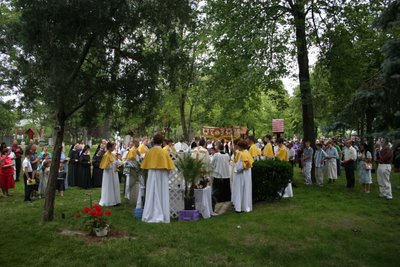

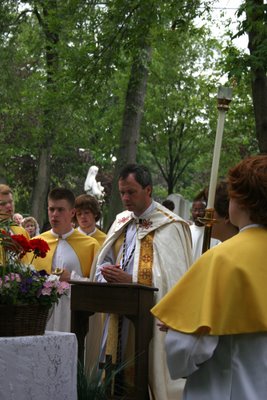

Corpus Christi 2006 Photos - Post 1
Corpus Christi 2006 Photos - Post 2
All of these pictures were taken from behind the third outdoor altar.

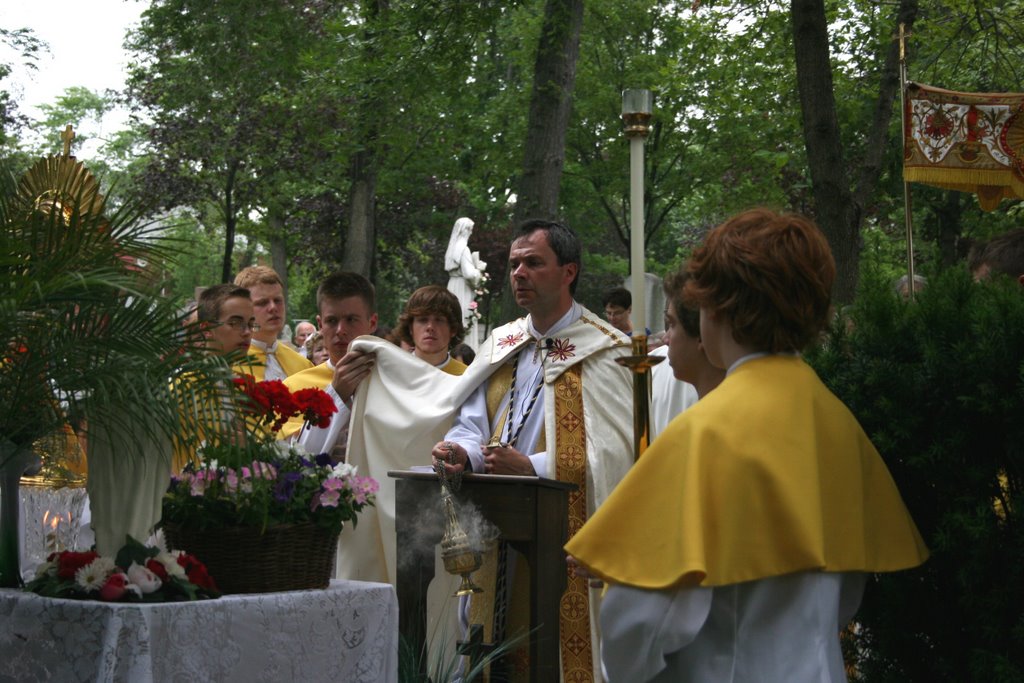
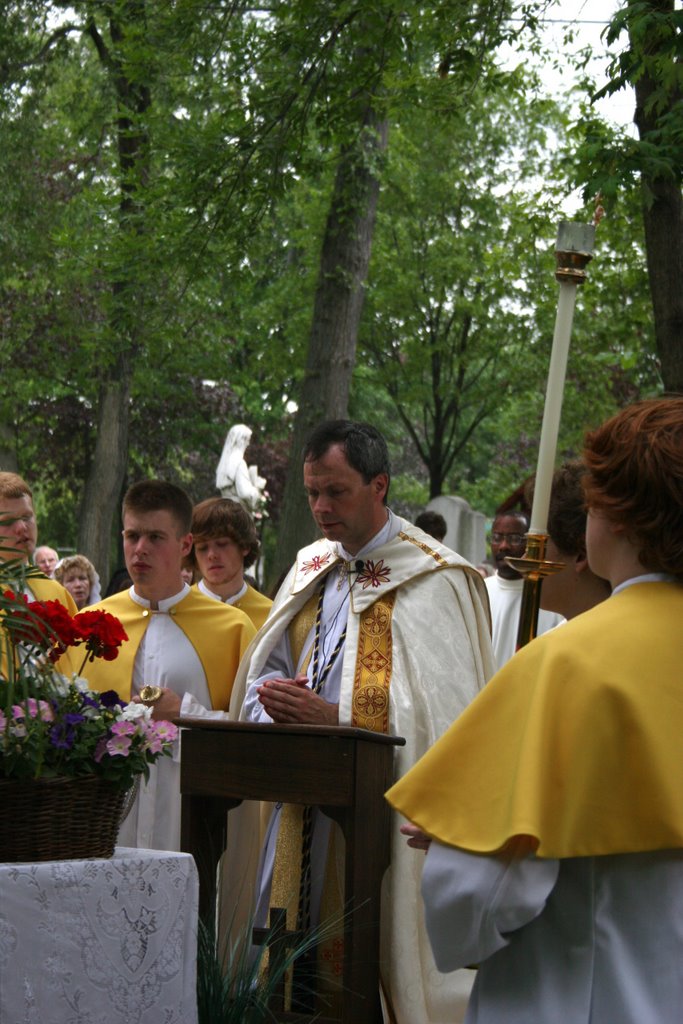
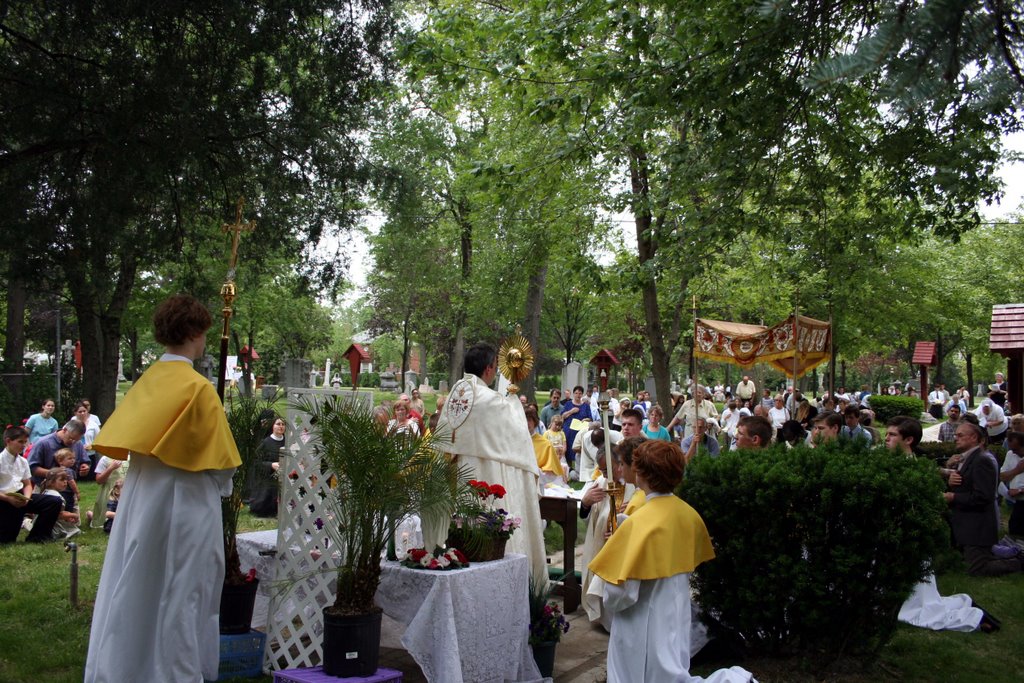
Corpus Christi 2006 Photos - Post 1
Corpus Christi 2006 Photos - Post 2
Corpus Christi 2006 - Photos from Grotto - Post 2
Blogger was cooperative this morning so I can bring you a few more pictures.
In these first three pictures, I am backing up to the second altar before taking you to the third.
In these first three pictures, I am backing up to the second altar before taking you to the third.

Altar boys await at the second altar.


This is one of only a few shots I have of the Missionaries of Charity as we sang, and awaited the arrival of the Blessed Sacrament at the third altar within the parish cemetary.

Jesus arrives! Two shots from behind the third altar.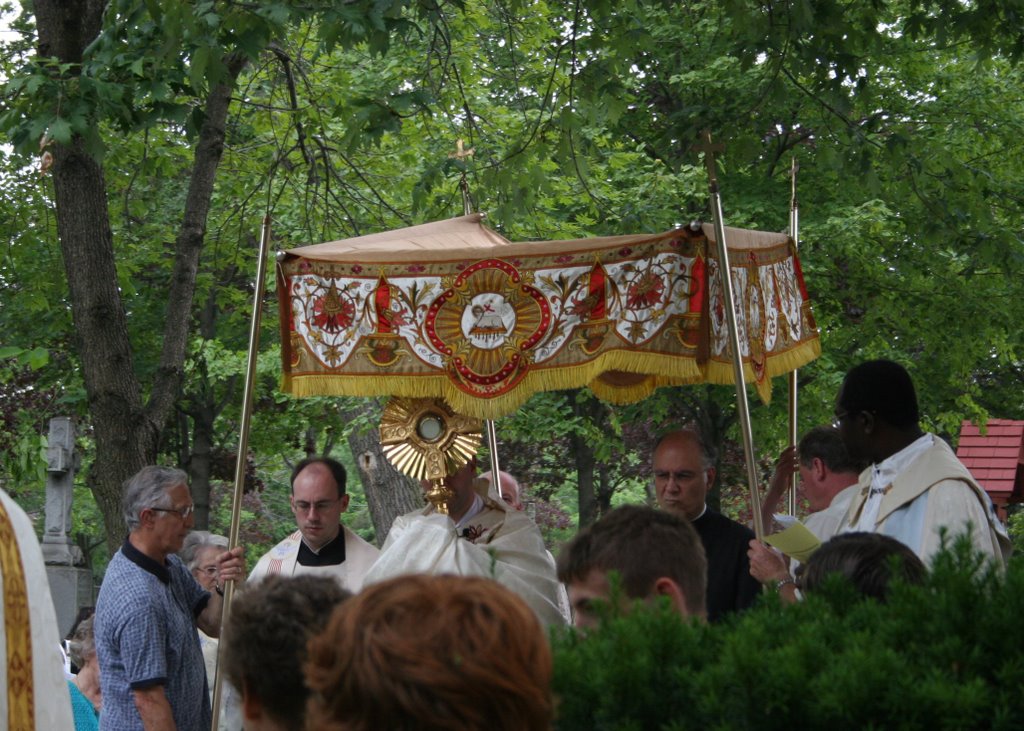

More pictures from behind the third altar and fourth outdoor altar when I get a little time to go through and edit them.
For now, enjoy this post, and post 1.
Eucharistic Congress in Atlanta
Follow this link in the blog of Gerald Augustinus to see pictures from the Eucharistic Congress in Atlanta where 20,000 gathered.
Sunday, June 18, 2006
Corpus Christi 2006 - Photos from Grotto - Post 1
Blogger was humming tonite and let me upload a total of 9 pictures before finally crashing! However, I'm more inclined to think it was Divine intervention.
Here is a sampling of some of the 55 photos edited this evening from todays Corpus Christi Procession on the grounds of Assumption Grotto in Detroit.
The noon Mass was full and the vast majority of those in attendance were in the procession which didn't end until nearly 3pm. They spilled out from a very hot church (no air - we just "offer it up"), into the very hot and humid air. The pastor, Fr. Perrone must have had special help from many angels to hold the "80% chance of rain and storms" off until long after the procession ended.
The Holy Cross sisters worked hard from the wee hours of the morning to set up this altar - the fourth outdoor stop. I caught them working at around 11:00 when I showed up for choir practice. The photo doesn't do it justice!
Here is a sampling of some of the 55 photos edited this evening from todays Corpus Christi Procession on the grounds of Assumption Grotto in Detroit.
The noon Mass was full and the vast majority of those in attendance were in the procession which didn't end until nearly 3pm. They spilled out from a very hot church (no air - we just "offer it up"), into the very hot and humid air. The pastor, Fr. Perrone must have had special help from many angels to hold the "80% chance of rain and storms" off until long after the procession ended.
The Holy Cross sisters worked hard from the wee hours of the morning to set up this altar - the fourth outdoor stop. I caught them working at around 11:00 when I showed up for choir practice. The photo doesn't do it justice!

The altar boys, dressed in white cassocks and gold shoulder-capes led the way with plenty of "smells and bells". In fact, there were two thuribles being used, pumping incense into the air, alternating with three swings each towards the Blessed Sacrament.
It is not uncommon for several sisters of the Missionaries of Charity to appear, as they work within Detroit. They minister through a soup kitchen and clothing distribution center, provide temporary shelter for women and their children, conduct tutorial classes and visit shut-ins. Today, some joined us quietly for a day of prayer and adoration. They are a welcome site to all of us, and enable us to reflect back in awe at the work initiated by Mother Teresa.
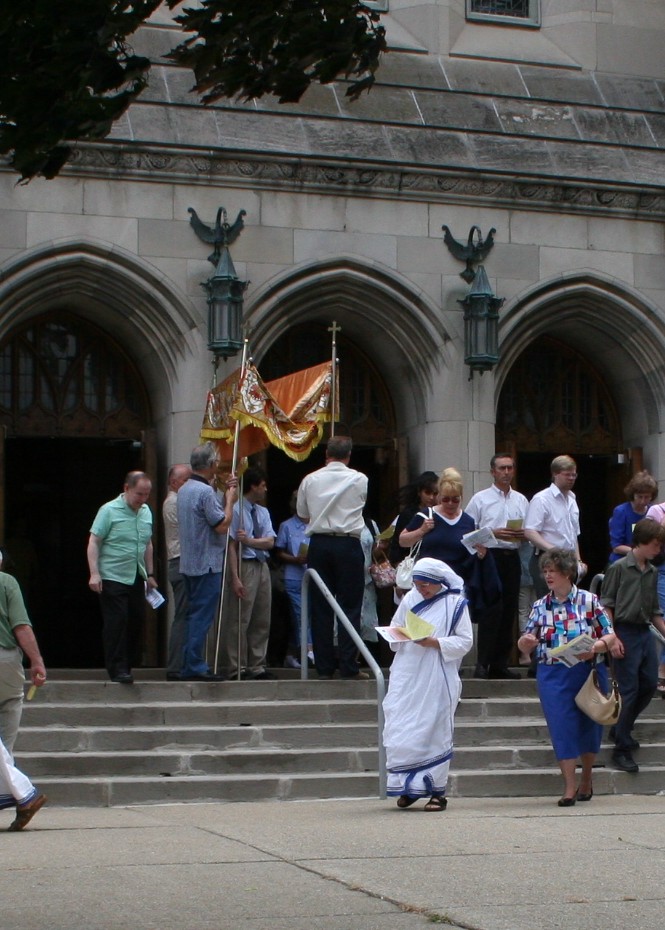
Associate Pastor of Assumption Grotto, Fr. John Bustamante, carries Our Lord in the Blessed Sacrament. I know our brothers and sisters at Sts. Cyril & Methodius, Fr. John's former parish, will appreciate photos taken this day, as well.

I'm going to roughly estimate about 300 in the procession. My camera did not have a wide angle and there were still quite a few on either side. This was the first outdoor altar.

Processing to the second altar, one set of altar boys leads the way.....

...while our organist and singer, Ray, brings up the rear, along with the priests, and the Blessed Sacrament.

Fr. John Bustamante at the second outdoor altar.

As the bells ring, and the thurible swings, Benediction takes place!
More pictures tomorrow, if Blogger is cooperative.
Putting Christ at the Center of Worship!
The only way I've been able to post any photos, is to copy the code from a previous post. So, I will do that with this post again because the picture is appropriate to the topic.
I have to comment, intermittently (in brackets and in black type), on the article below, which deals with the orientation of the priest during the liturgy. I consider myself somewhat of an authority on the topic because of just how much I resisted, interiorly, the ad orientem posture used by the priests at Assumption Grotto.
The first day I went there - Pentecost of 2005 - there was an orchestral Mass I seen posted on their website and because I had planned on going for other reasons, I figured why not for the orchestral Mass. When I seen the way the priest was facing - east, and away from us, I first felt awkward and it was actually disturbing that I could not see his face. The atmosphere was also very different from any other Catholic parish I had attended - and there were many over the years. I had grown accustomed to the contemporary Masses so often seen today, but can't say that they did anything for me. I grew up with them, having been born in 1962.
As I had stated earlier, half of me wanted to go, but half of me wanted to stay and explore as the place seemed chock-full-of-mysteries, a few of which included:
With that background given, lets dissect this article and remember, I could not see the point of the ad orientem posture, and within a matter of days, God unlocked the mystery, while at the same time pulling me deeply into a spiritual ride I had no idea was coming - all of which was prompted, in part, by the priest celebrating ad orientem.
If you click on the photo below, it will give you one of the original posts in which it appeared, along with an explanation.
Once again - my remarks will be in black type, and in brackets.
 Conference: Priest facing east at Mass won't ensure focus on Jesus
By Cindy Wooden
Catholic News Service
VATICAN CITY (CNS) -- Having the priest face east, usually away from the people, when celebrating Mass is not a magic way to ensure that both the priest and the congregation focus on Jesus, said participants at a conference in northern Italy. [If the faithful continue in a belief that the Mass is about community, this is true, but for me, it prompted a realization that the Mass is about worshiping God, placing Him at the center - removing the person of the priest as he put on Christ!]
I spent a life time catering to my own feelings about the Mass - whether I liked the music, the homily, the priest, etc. I looked for all kinds of stimuli to keep me interested, and "expert" liturgists obliged. In the end, I realized I had never truly worshiped GOD in the Mass.....until I went to Assumption Grotto where all of the stimuli were removed. This completely changed my life to one that was built on relativism and self-satisfaction, to one that is fully rooted in respect for God's commandments, as such. Gone are the excuses to do unvirtuous, and even sinful things that God would just ignore come judgment day because "I was generally a good person". My good works would save me, would they not? Putting God at the center of my Mass led to a desire to create a God-pleasing life. This meant far less TV, among other things, and much more prayer.
Seeing the priest's face is a subtle stimulus, and when he looks up around at the congregation, especially during the words of Consecration, it is a huge stimulus - one, I no longer need to fight interiorly in order to focus fully on Christ - thanks to Grotto!
It took going to Mass at some of the former parishes I use to frequent after 6 months of Grotto-style worship, to see just how distracting versus populum can be. One exception I have found is the Mass at Sts. Cyril & Methodius, where the priests do not look around at the congregation during any part of the Eucharistic Prayer. I can focus more fully on Christ during the Consecration because the priest is not looking up around at everyone - something I find distracting from the One on whom I should be focused.
I now look at how many well-intentioned, fine priests look into the congregation during conscretion and can only imagine how the "expert" liturgists in the seminary must have passed on business speech practices where eye-contact with the crowd is the rule. This has led to the liturgy becoming more of a theatrical production, than worship. This is one reason why I believe we must be patient with priests who do this because many were taught to do so in the seminary. Time, and proper training, will cure this.
HEY! WHAT ABOUT THE OTHER 6 "MYSTERIES?"
I've only touched on point 1 in my list. I will unlock the other 6 "mysteries" in future posts.
I have to comment, intermittently (in brackets and in black type), on the article below, which deals with the orientation of the priest during the liturgy. I consider myself somewhat of an authority on the topic because of just how much I resisted, interiorly, the ad orientem posture used by the priests at Assumption Grotto.
The first day I went there - Pentecost of 2005 - there was an orchestral Mass I seen posted on their website and because I had planned on going for other reasons, I figured why not for the orchestral Mass. When I seen the way the priest was facing - east, and away from us, I first felt awkward and it was actually disturbing that I could not see his face. The atmosphere was also very different from any other Catholic parish I had attended - and there were many over the years. I had grown accustomed to the contemporary Masses so often seen today, but can't say that they did anything for me. I grew up with them, having been born in 1962.
As I had stated earlier, half of me wanted to go, but half of me wanted to stay and explore as the place seemed chock-full-of-mysteries, a few of which included:
- Why would the priest have his back to us?
- Why were people walking around with their heads down?
- Why was there such a deafening silence?
- What were those smells?
- How could so many young children, in one family, be so still and quiet for nearly an hour-and-a-half?
- What is with all the genuflecting and bowing?
- Why receive Communion at a rail - wasn't that done away with years ago?
With that background given, lets dissect this article and remember, I could not see the point of the ad orientem posture, and within a matter of days, God unlocked the mystery, while at the same time pulling me deeply into a spiritual ride I had no idea was coming - all of which was prompted, in part, by the priest celebrating ad orientem.
If you click on the photo below, it will give you one of the original posts in which it appeared, along with an explanation.
Once again - my remarks will be in black type, and in brackets.
Conference: Priest facing east at Mass won't ensure focus on JesusBy Cindy Wooden
Catholic News Service
VATICAN CITY (CNS) -- Having the priest face east, usually away from the people, when celebrating Mass is not a magic way to ensure that both the priest and the congregation focus on Jesus, said participants at a conference in northern Italy. [If the faithful continue in a belief that the Mass is about community, this is true, but for me, it prompted a realization that the Mass is about worshiping God, placing Him at the center - removing the person of the priest as he put on Christ!]
Enzo Bianchi, prior of the Bose ecumenical community and host of the conference, summarized the discussion in the June 14 edition of L'Osservatore Romano, the Vatican newspaper.
The conference brought together Catholic liturgists, theologians and church architects from Europe, North and South America and liturgical experts from Orthodox, Anglican and Protestant churches.
The theme "Liturgical Space and Its Orientation" was chosen because of renewed research and debate about the placement of the altar in churches and the direction the priest and people face.
Bianchi said participants agreed that something must be done to help celebrants and congregations focus more firmly on Jesus and recover dimensions of the liturgy that have weakened since the Second Vatican Council.
In the old liturgy, when the priest faced east during the eucharistic prayer, not only was he not the focus of people's attention, but his posture was meant to evoke the Christian expectation of Christ coming again -- the Book of Revelation says he will come from the east -- and the "cosmological symbolism" of Christ being the sun that rises in the east, Bianchi said. [Bingo! That is what I learned, very abruptly, without having read a word in any book, the web, or any place else - infused, a la whammo!!! - God is the center of the Mass, not the priest, or the community gathered!]
To recover those dimensions, he said, "that which appears urgent today is a profound rethinking of the position of the priest in respect to the faithful." [agreed - to get people to understand that the Mass is not about us, it is about giving God due worship and in doing that, we gain true unity]
One of the speakers at the conference was Father Uwe Michael Lang, whose book "Turning Towards the Lord: Orientation in Liturgical Prayer," presents arguments for returning to the practice of having the celebrant facing east with his back to the congregation.
The book includes a foreword written in 2003 by then-Cardinal Joseph Ratzinger supporting Father Lang's thesis, but suggesting a more thorough, calmer discussion is needed.
In his own book, "The Spirit of the Liturgy," the cardinal, now pope, suggested that to avoid creating further disruption and confusion by changing the direction the priest faces, a crucifix placed on the altar or suspended above it could be an appropriate alternative. [We need to go back and read this in context because this would lead one to believe the Pope is not in favor of celebrants using the ad orientem posture - something that first requires catechesis in order to avoid "the disruption" - something that was not bothered with in the 60's and 70's when altar rails were being jack-hammered out of place overnight]
Msgr. Stefano Russo, an official of the Italian bishops' conference, told participants that different aspects of the liturgy are highlighted by the direction the priest is facing; when the priest and people are looking at each other and at the altar, it emphasizes the communal aspect of the Mass, while the sacrificial nature of the Eucharist is emphasized by the priest and people facing the same direction.
He said having the priest face the people "is not better or more correct" than having them face the same direction, "but is only more appropriate and coherent with the faith lived by believers today." [I grew up with versus populum Msgr. Russo, but exposure to the priest facing ad orientem forced me to stop seeing the physically communal aspect only to gain the mystical communal aspect.]
People must be honest enough to admit that either position "by itself is insufficient to convey the totality of the mystery celebrated," Msgr. Russo said. "No ritual form, no text or liturgical gesture could ever exhaust the richness of the mystery of God." [Agreed. Catechesis is the key, not avoidance. As long as priests and liturgists hold a belief that "community is God", we will never fully have God at the center exclusively. Authentic worship of God puts Him at the center and nothing or no one else. God-centered worship leads to authentic love of neighbor, not community-centered worship]
U.S. Jesuit Father Keith Pecklers, a professor of liturgy at Rome's Pontifical Gregorian University, said the conference was important for bringing balance to a discussion that has been used to polarize or label Catholics. [Yes, and from all I've experienced since becoming enthusiastically in favor of the ad orientem posture, is that many well-intended Catholics believe I have latched on to a schismatic community, or that Assumption Grotto is somehow "holding the Church back". "Tolerance" is the buzzword of the day as long as it does not have to include Catholics who favor a more traditional Novus Ordo, Latin, or a life rich in distinctly Catholic devotion. I point you to the 7 points I raised at the beginning of this post as an example of my own bias before God grabbed me by my ear and taught me some very important lessons about the liturgy. ]
He told Catholic News Service that a key conclusion of the discussion was that priests need to be trained "to preside with grace, ease and transparency, drawing people to Christ and not focusing attention on themselves."
END
Why is this all so important - the way the priest faces?
Ponder this: lex orandi, lex credendi - the law of prayer is the law of belief.I spent a life time catering to my own feelings about the Mass - whether I liked the music, the homily, the priest, etc. I looked for all kinds of stimuli to keep me interested, and "expert" liturgists obliged. In the end, I realized I had never truly worshiped GOD in the Mass.....until I went to Assumption Grotto where all of the stimuli were removed. This completely changed my life to one that was built on relativism and self-satisfaction, to one that is fully rooted in respect for God's commandments, as such. Gone are the excuses to do unvirtuous, and even sinful things that God would just ignore come judgment day because "I was generally a good person". My good works would save me, would they not? Putting God at the center of my Mass led to a desire to create a God-pleasing life. This meant far less TV, among other things, and much more prayer.
Seeing the priest's face is a subtle stimulus, and when he looks up around at the congregation, especially during the words of Consecration, it is a huge stimulus - one, I no longer need to fight interiorly in order to focus fully on Christ - thanks to Grotto!
It took going to Mass at some of the former parishes I use to frequent after 6 months of Grotto-style worship, to see just how distracting versus populum can be. One exception I have found is the Mass at Sts. Cyril & Methodius, where the priests do not look around at the congregation during any part of the Eucharistic Prayer. I can focus more fully on Christ during the Consecration because the priest is not looking up around at everyone - something I find distracting from the One on whom I should be focused.
I now look at how many well-intentioned, fine priests look into the congregation during conscretion and can only imagine how the "expert" liturgists in the seminary must have passed on business speech practices where eye-contact with the crowd is the rule. This has led to the liturgy becoming more of a theatrical production, than worship. This is one reason why I believe we must be patient with priests who do this because many were taught to do so in the seminary. Time, and proper training, will cure this.
HEY! WHAT ABOUT THE OTHER 6 "MYSTERIES?"
I've only touched on point 1 in my list. I will unlock the other 6 "mysteries" in future posts.
Opus Angelorum: Devotion to the Sacred Heart
I decided we would break, until next Thursday, on the prayers for priest series because the next prayer is intended for a Thursday.
Also, I am still having significant problems uploading any pictures in blogger. I upload, and nothing happens. Until this works itself out, or until I switch services, enjoy some news and spiritual articles.
Today, I would like to bring forward again, this article on the Devotion to the Sacred Heart of Jesus by Fr. William Wagner, ORC. During this break I will bring extracts from this nice article as we approach the Feast of the Sacred Heart. Fr. Wagner opens by discussing devotion itself and it is a nice primer leading into an explanation of the devotion surrounding the Sacred Heart. Many of us born after Vatican 2 have not received catechesis on these devotions. Now's your chance if you never had a clue, or if you simply want to revisit something with which you were familiar years ago.
Devotion to the Sacred Heart of Jesus
The spiritual life is more than a spiritual doctrine, but if it were, it would be about Jesus: "I am the truth!", "in Him are hidden all the treasures of wisdom and knowledge" (Col 2,3), and Jesus would be our teacher, "We know that you are a teacher come from God" (Jn 3,2), "one only is your master, the Christ" (Mt 23, 10). The spiritual life is more than the practice of virtue; but if it were, Jesus presents Himself as our model: "Learn from Me for I am meek and humble of heart" (Mt 12, 29). Not only is Jesus the model but the source of our virtue, for "from His fullness, we have all received grace upon grace" (Jn 1, 16), and He assures us, "My grace is sufficient to you" (2 Cor 12, 9). The spiritual life is more than a pilgrimage, a journey towards heaven, but if it were, Christ is the way and the guide: "I am the way, ...no one comes to the Father but through Me" (Jn 14,6), and, "Come, follow Me!" (Mt 19, 21). The spiritual life is about eternal life, and therefore, about loving union and the knowledge (vision) of God. The development of the spiritual life, therefore, is inseparable from the development of devotion to Jesus. We hear, of course, about many different devotions based on different prayer practices. These are not our present concern; here we want to reflect upon the virtue of devotion and its chief expression, which is devotion to the Sacred Heart.
In order to better appreciate devotion to the Sacred Heart, we need to understand the true nature of devotion. What is meant by devotion? 'Devotion' derives from the Latin word meaning to make a vow. Accordingly, "devotion", Faber explains, "means a particular propension of the soul to God, whereby it devotes itself ['dedicates' would be a better word], commits itself, binds itself over, consecrates itself, to the worship and service of God. This it may do by vow, by oath or by simple sentiment."By its very nature devotion tends towards permanent commitment. Devotion, therefore, is a virtue most pleasing to God. After the theological virtues it belongs to the most important virtue of the spiritual life, to the virtue of religion. St. Francis de Sales warns that those who do not know the nature of true devotion will easily be deceived and led astray by their own proclivities. We need something greater than our own personal likes and dislikes to guide our spiritual life.
St. Thomas shows that devotion is not just an emotion ("feeling devotion") but that it is a virtue and act of the will whereby we readily dedicate ourselves to those things that have to do with the service of God.... [continue reading - Sacred Heart]
Also, I am still having significant problems uploading any pictures in blogger. I upload, and nothing happens. Until this works itself out, or until I switch services, enjoy some news and spiritual articles.
Today, I would like to bring forward again, this article on the Devotion to the Sacred Heart of Jesus by Fr. William Wagner, ORC. During this break I will bring extracts from this nice article as we approach the Feast of the Sacred Heart. Fr. Wagner opens by discussing devotion itself and it is a nice primer leading into an explanation of the devotion surrounding the Sacred Heart. Many of us born after Vatican 2 have not received catechesis on these devotions. Now's your chance if you never had a clue, or if you simply want to revisit something with which you were familiar years ago.
Devotion to the Sacred Heart of Jesus
The spiritual life is more than a spiritual doctrine, but if it were, it would be about Jesus: "I am the truth!", "in Him are hidden all the treasures of wisdom and knowledge" (Col 2,3), and Jesus would be our teacher, "We know that you are a teacher come from God" (Jn 3,2), "one only is your master, the Christ" (Mt 23, 10). The spiritual life is more than the practice of virtue; but if it were, Jesus presents Himself as our model: "Learn from Me for I am meek and humble of heart" (Mt 12, 29). Not only is Jesus the model but the source of our virtue, for "from His fullness, we have all received grace upon grace" (Jn 1, 16), and He assures us, "My grace is sufficient to you" (2 Cor 12, 9). The spiritual life is more than a pilgrimage, a journey towards heaven, but if it were, Christ is the way and the guide: "I am the way, ...no one comes to the Father but through Me" (Jn 14,6), and, "Come, follow Me!" (Mt 19, 21). The spiritual life is about eternal life, and therefore, about loving union and the knowledge (vision) of God. The development of the spiritual life, therefore, is inseparable from the development of devotion to Jesus. We hear, of course, about many different devotions based on different prayer practices. These are not our present concern; here we want to reflect upon the virtue of devotion and its chief expression, which is devotion to the Sacred Heart.
In order to better appreciate devotion to the Sacred Heart, we need to understand the true nature of devotion. What is meant by devotion? 'Devotion' derives from the Latin word meaning to make a vow. Accordingly, "devotion", Faber explains, "means a particular propension of the soul to God, whereby it devotes itself ['dedicates' would be a better word], commits itself, binds itself over, consecrates itself, to the worship and service of God. This it may do by vow, by oath or by simple sentiment."By its very nature devotion tends towards permanent commitment. Devotion, therefore, is a virtue most pleasing to God. After the theological virtues it belongs to the most important virtue of the spiritual life, to the virtue of religion. St. Francis de Sales warns that those who do not know the nature of true devotion will easily be deceived and led astray by their own proclivities. We need something greater than our own personal likes and dislikes to guide our spiritual life.
St. Thomas shows that devotion is not just an emotion ("feeling devotion") but that it is a virtue and act of the will whereby we readily dedicate ourselves to those things that have to do with the service of God.... [continue reading - Sacred Heart]
Domenico Bettinelli Jr: Bishops Punt on Pro-Abortion Pol Quesiton
Along with the post below, we have comment from Catholic World Report editor, Domenico Bettinelli Jr.
The US bishops took care of other business yesterday, in addition to voting on the new translations of the Mass. They also voted on recommendations on what to do about pro-abortion Catholic politicians who present themselves to receive Communion. After working for three years, including a massive public debate during the height of the 2004 presidential election, what did the task force led by Cardinal Theodore McCarrick finally come up with?
After years of “soul searching,” the best they could come up with was to punt?
Let’s get one thing straight: The decision always belonged to local bishops..... [continue reading]
The US bishops took care of other business yesterday, in addition to voting on the new translations of the Mass. They also voted on recommendations on what to do about pro-abortion Catholic politicians who present themselves to receive Communion. After working for three years, including a massive public debate during the height of the 2004 presidential election, what did the task force led by Cardinal Theodore McCarrick finally come up with?
U.S. Catholic bishops on Thursday ended years of soul searching over whether Catholic politicians who support abortion rights should be denied communion, leaving the decision with local bishops.
After years of “soul searching,” the best they could come up with was to punt?
Let’s get one thing straight: The decision always belonged to local bishops..... [continue reading]
Friday, June 16, 2006
Pols receiving Holy Communion - USCCB committee "passes-up" their chance to deal!
A recent quote from Cardinal Arinze when Rayond Arroyo of EWTN asked him for his position on whether politicians who publicly support abortion should be permitted to receive Holy Communion:
Do you need any Cardinal from the Vatican to answer that?...........“Simple, ask the children for First Communion, they'll give you the answer.”
But, the bishops forming a committee led by retiring Cardinal Theodore McCarrick decided to play it safe and simply put the decision back into the hands of each individual bishop.......after two years of study!!!
Hat-tip to Diogenes who had this to say on the matter:
A Definite Maybe
After months of intensive study, the "McCarrick committee" has delivered a final report to the US bishops.
Back during the 2004 election campaign, the American bishops were troubled by disagreements regarding whether or not pro-abortion Catholic politicians should be denied Communion. The McCarrick committee was asked to devise a policy that could be adopted uniformly by diocesan bishops, thus averting the potential for division and confusion.
So now the committee suggests that each diocesan bishop should decide for himself. Uncle Ted explains that there is "no substitute for the local bishop's pastoral judgment and his vital relationships with Catholic public officials in his own diocese." We're right back where we started.
The McCarrick committee has now been disbanded. Their work will be sorely missed, and their achievement loudly praised, by anyone who recognizes how difficult it is to scratch your head for two years, then finally decide: "Gee, I dunno."
Do you need any Cardinal from the Vatican to answer that?...........“Simple, ask the children for First Communion, they'll give you the answer.”
But, the bishops forming a committee led by retiring Cardinal Theodore McCarrick decided to play it safe and simply put the decision back into the hands of each individual bishop.......after two years of study!!!
Hat-tip to Diogenes who had this to say on the matter:
A Definite Maybe
After months of intensive study, the "McCarrick committee" has delivered a final report to the US bishops.
Back during the 2004 election campaign, the American bishops were troubled by disagreements regarding whether or not pro-abortion Catholic politicians should be denied Communion. The McCarrick committee was asked to devise a policy that could be adopted uniformly by diocesan bishops, thus averting the potential for division and confusion.
So now the committee suggests that each diocesan bishop should decide for himself. Uncle Ted explains that there is "no substitute for the local bishop's pastoral judgment and his vital relationships with Catholic public officials in his own diocese." We're right back where we started.
The McCarrick committee has now been disbanded. Their work will be sorely missed, and their achievement loudly praised, by anyone who recognizes how difficult it is to scratch your head for two years, then finally decide: "Gee, I dunno."
Fr. Cantalamessa speaks about Corpus Christi
Before I bring you the subject of this post, I want to point out that there will be an Orchestral Mass at the noon Mass at Assumption Grotto this Sunday. Following that Mass, will be processions to the outdoor altars on the grounds.
On to the topic:
The more I hear Fr. Cantalamessa talk through his writings, the more I understand why Pope Benedict would want him to be the "Preacher of the Pontifical Household".
Zenit.org brings us his address regarding the Feast of Corpus Christi. I cannot find a way to link directly to this article at Zenit, so I am pasting it all here. You can go to their website and click on the 6/16/06 date. I don't know how long it will be there. But, if you bookmark the link associated to his name above, you'll be able to probably follow his writings and talks there.
I have highlighted key parts in a different color that struck me as rare to hear many pulpits today. Perhaps if it were, the confession lines would be as long as the Communion lines!
Father Cantalamessa on Corpus Christi
Pontifical Household Preacher on the Day's Gospel Reading
ROME, JUNE 16, 2006 (Zenit.org).- Here is a translation of a commentary by Capuchin Father Raniero Cantalamessa, preacher to the Pontifical Household, on the Gospel reading of the liturgy of the feast Corpus Christi.
* * *
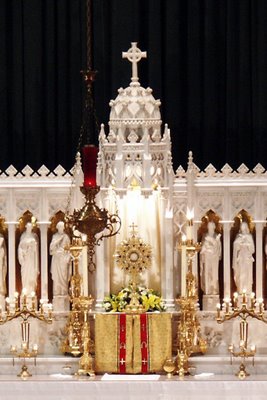
In Your Midst Stands One Whom You Do Not Know!
I believe that the most necessary thing to do on the feast of Corpus Christi is not to explain some aspect of the Eucharist, but to revive wonder and marvel before the mystery.
The feast was born in Belgium, in the early 13th century; Benedictine monasteries were the first to adopt it. Urban IV extended it to the whole Church in 1264; it seems that he was also influenced by the Eucharistic miracle of Bolsena, venerated today in Orvieto.
Why was it necessary to institute a new feast? Doesn't the Church recall the institution of the Eucharist on Holy Thursday? Doesn't she celebrate it every Sunday and, more than that, every day of the year?
In fact, Corpus Christi is the first feast whose object is not an event of the life of Christ, but a truth of faith: His real presence in the Eucharist. It responds to a need: to solemnly proclaim such faith.
It is needed to avoid the danger of getting used to such a presence and no longer pay attention to it, thus meriting the reproach that St. John the Baptist made to his contemporaries: "In your midst stands one whom you do not know!"
This explains the extraordinary solemnity and visibility that this feast acquired in the Catholic Church. For a long time, the Corpus Christi procession was the only procession in the whole of Christendom, and also the most solemn.
Today processions have given way to manifestations and sit-ins (generally of protest); but although the exterior form has declined, the profound sense of celebration and the motive that inspired it remain intact: to keep alive the wonder before the greatest and most beautiful of the mysteries of the faith.
The liturgy of the feast faithfully reflects this characteristic. All its texts (readings, antiphons, songs, prayers) are suffused with a sense of wonder.
Many of them end with an exclamation: "O sacred banquet in which Christ is received!" (O sacrum convivium). "O victim of salvation!" (O salutaris hostia).
If the feast of Corpus Christi did not exist, it would have to be invented. If there is a danger that believers face at present in regard to the Eucharist, it is to trivialize it.
There was a time when it was not received so frequently, and fasting and confession had to precede it. Today virtually everyone approaches it. Let us understand one another. It is progress; it is normal that participation in Mass also implies Communion; that is why it exists. But all this entails a mortal risk.
St. Paul says: Whoever eats the bread or drinks the cup of the Lord unworthily, will be guilty of the Body and Blood of the Lord. Let each one examine himself and then eat the bread and drink the cup, because he who eats and drinks without discerning the body, eats and drinks judgment unto himself.
I believe it is a salutary grace for a Christian to go through a period in which he fears to approach Communion, that he tremble before the thought of what is about to occur and not cease to repeat, as John the Baptist: "And you come to me?" (Matthew 3:14).
We cannot receive God except as "God," that is, respecting all his holiness and majesty. We cannot domesticate God!
The preaching of the Church should not fear -- now that communion has become something so habitual and "easy" -- to use every now and then the language of the letter to the Hebrews and to tell the faithful: "But you have come ... to a judge who is God of all ... and to Jesus, the mediator of the new covenant, and to the sprinkled blood that speaks more graciously than the blood of Abel" (Hebrews 12:22-24).
In the early times of the Church, at the moment of communion a cry resounded in the assembly: "Let him who is holy approach, let him who is not repent!"
One who did not get used to the Eucharist and spoke of it with overwhelming wonder was St. Francis of Assisi. "Let humanity fear, let the entire universe tremble, and the heavens exult, when on the altar, in the hands of the priest, is Christ, son of the living God. ... O admirable rapture and amazing designation! O sublime humility! O humble sublimity, that the Lord of the universe, God and son of God, so humbles himself as to hide under the small appearance of bread!"
However, it must not be so much the grandeur and majesty of God which causes wonder before the Eucharistic mystery, but rather his condescension and love. The Eucharist above all is this: memorial of the love of which there is no greater: to give one's life for ones' friends.
[Translation by ZENIT]
ZE06061602
On to the topic:
The more I hear Fr. Cantalamessa talk through his writings, the more I understand why Pope Benedict would want him to be the "Preacher of the Pontifical Household".
Zenit.org brings us his address regarding the Feast of Corpus Christi. I cannot find a way to link directly to this article at Zenit, so I am pasting it all here. You can go to their website and click on the 6/16/06 date. I don't know how long it will be there. But, if you bookmark the link associated to his name above, you'll be able to probably follow his writings and talks there.
I have highlighted key parts in a different color that struck me as rare to hear many pulpits today. Perhaps if it were, the confession lines would be as long as the Communion lines!
Father Cantalamessa on Corpus Christi
Pontifical Household Preacher on the Day's Gospel Reading
ROME, JUNE 16, 2006 (Zenit.org).- Here is a translation of a commentary by Capuchin Father Raniero Cantalamessa, preacher to the Pontifical Household, on the Gospel reading of the liturgy of the feast Corpus Christi.
* * *
In Your Midst Stands One Whom You Do Not Know!
I believe that the most necessary thing to do on the feast of Corpus Christi is not to explain some aspect of the Eucharist, but to revive wonder and marvel before the mystery.
The feast was born in Belgium, in the early 13th century; Benedictine monasteries were the first to adopt it. Urban IV extended it to the whole Church in 1264; it seems that he was also influenced by the Eucharistic miracle of Bolsena, venerated today in Orvieto.
Why was it necessary to institute a new feast? Doesn't the Church recall the institution of the Eucharist on Holy Thursday? Doesn't she celebrate it every Sunday and, more than that, every day of the year?
In fact, Corpus Christi is the first feast whose object is not an event of the life of Christ, but a truth of faith: His real presence in the Eucharist. It responds to a need: to solemnly proclaim such faith.
It is needed to avoid the danger of getting used to such a presence and no longer pay attention to it, thus meriting the reproach that St. John the Baptist made to his contemporaries: "In your midst stands one whom you do not know!"
This explains the extraordinary solemnity and visibility that this feast acquired in the Catholic Church. For a long time, the Corpus Christi procession was the only procession in the whole of Christendom, and also the most solemn.
Today processions have given way to manifestations and sit-ins (generally of protest); but although the exterior form has declined, the profound sense of celebration and the motive that inspired it remain intact: to keep alive the wonder before the greatest and most beautiful of the mysteries of the faith.
The liturgy of the feast faithfully reflects this characteristic. All its texts (readings, antiphons, songs, prayers) are suffused with a sense of wonder.
Many of them end with an exclamation: "O sacred banquet in which Christ is received!" (O sacrum convivium). "O victim of salvation!" (O salutaris hostia).
If the feast of Corpus Christi did not exist, it would have to be invented. If there is a danger that believers face at present in regard to the Eucharist, it is to trivialize it.
There was a time when it was not received so frequently, and fasting and confession had to precede it. Today virtually everyone approaches it. Let us understand one another. It is progress; it is normal that participation in Mass also implies Communion; that is why it exists. But all this entails a mortal risk.
St. Paul says: Whoever eats the bread or drinks the cup of the Lord unworthily, will be guilty of the Body and Blood of the Lord. Let each one examine himself and then eat the bread and drink the cup, because he who eats and drinks without discerning the body, eats and drinks judgment unto himself.
I believe it is a salutary grace for a Christian to go through a period in which he fears to approach Communion, that he tremble before the thought of what is about to occur and not cease to repeat, as John the Baptist: "And you come to me?" (Matthew 3:14).
We cannot receive God except as "God," that is, respecting all his holiness and majesty. We cannot domesticate God!
The preaching of the Church should not fear -- now that communion has become something so habitual and "easy" -- to use every now and then the language of the letter to the Hebrews and to tell the faithful: "But you have come ... to a judge who is God of all ... and to Jesus, the mediator of the new covenant, and to the sprinkled blood that speaks more graciously than the blood of Abel" (Hebrews 12:22-24).
In the early times of the Church, at the moment of communion a cry resounded in the assembly: "Let him who is holy approach, let him who is not repent!"
One who did not get used to the Eucharist and spoke of it with overwhelming wonder was St. Francis of Assisi. "Let humanity fear, let the entire universe tremble, and the heavens exult, when on the altar, in the hands of the priest, is Christ, son of the living God. ... O admirable rapture and amazing designation! O sublime humility! O humble sublimity, that the Lord of the universe, God and son of God, so humbles himself as to hide under the small appearance of bread!"
However, it must not be so much the grandeur and majesty of God which causes wonder before the Eucharistic mystery, but rather his condescension and love. The Eucharist above all is this: memorial of the love of which there is no greater: to give one's life for ones' friends.
[Translation by ZENIT]
ZE06061602
Yes, Fr. Cantalamessa, and that is why we love the Mass at Assumption Grotto so well. It reminds us that Jesus is not just a friend, but he is God - the same God before Whom Moses removed his sandals. If we only spent a little more time with the Blessed Sacrament - leaving behind, if only for a moment, our petitions in favor of pure adoration just because.....He is God!
The "domestication" this fine priest speaks of is visible in so many parishes today, where you feel out of place if you dare to genuflect, knee to the floor.
How simple can it be to say "...and my soul shall be healed"?
Since we don't fully know what changes have been made, we can only watch as they trickle out.
Gerald Augustinus covers more at his blog.
I'm very disappointed in some things I'm reading. We can only hope Cardinal Arinze takes his pen to it. The purpose was to align the English with the Latin, not to make it comfortable for those who don't want to remember we have souls and that there truly are four last things: Death, Justice, Heaven and Hell.
Editor of Catholic World Report, Dominic Bettinelli has this to say on his blog.
Bishops approve new translation
The US bishops’ conference approved the new translations of the Mass proposed by the International Committee on English in the Liturgy (ICEL), something that bishops in the rest of the English-speaking world had already done, but the US bishops also included a number of adaptations and amendments that will need to be scrutinized by the Vatican. Nevertheless the bulk of the changes required by the Liturgiam Authenticam and other Vatican directives have been approved.
The vote was 173-29 for the translation itself, and 184-8 for the adaptations for use in the United States. A 2/3 majority of 168 votes had been needed. Contrary to some predictions, the vote was not “thisclose”. Nor did the debate take more than the allotted one hour, which the same person also predicted. In fact, it took about 45 minutes.
From the coverage in the New York Times, you’d think the bishops had just voted to translate the Mass into Elizabethan English.
How is that awkward? Then it says traditionalists “longed for” an English version more true to the Tridentine Mass’s Latin. Actually traditionalist long for the Tridentine Mass’s Latin itself.
What advocates of the new translation want is a translation that is faithful to the actual normative texts. To be honest, I think the “upset Catholics who have committed the current prayer book to heart and to memory and who take comfort in its more conversational cadences” is a figment of someone’s imagination because, while I’m sure a few must exist somewhere, I doubt there are very many people who will pine for the pre-2006, post-Vatican II Mass.
You also once again have the standard New York Times tactic of quoting on conservative and a whole raft of liberals on an issue. Leon Suprenant of Catholics United for the Faith is the token conservative, while the lineup for the other team includes Father Lawrence Madden of the Georgetown Center for Liturgy, Father Thomas Reese formerly of America, and Father Robert Silva of the National Federation of Priests Councils. Also note that clericalism works in the other direction, too.
I’m just so amused at all the “progressives” who have suddenly become conservatives, standing athwart the liturgy and yelling “Stop.” Where were all their concerns about stripping people of a Mass to which they had become accustomed 30-40 years ago when they stripped the people of the Tridentine Mass and gave them the Novus Ordo? Ah, but now it’s different, isn’t it? It always is when the shoe’s on the other foot.
Gerald Augustinus covers more at his blog.
I'm very disappointed in some things I'm reading. We can only hope Cardinal Arinze takes his pen to it. The purpose was to align the English with the Latin, not to make it comfortable for those who don't want to remember we have souls and that there truly are four last things: Death, Justice, Heaven and Hell.
Editor of Catholic World Report, Dominic Bettinelli has this to say on his blog.
Bishops approve new translation
The US bishops’ conference approved the new translations of the Mass proposed by the International Committee on English in the Liturgy (ICEL), something that bishops in the rest of the English-speaking world had already done, but the US bishops also included a number of adaptations and amendments that will need to be scrutinized by the Vatican. Nevertheless the bulk of the changes required by the Liturgiam Authenticam and other Vatican directives have been approved.
The vote was 173-29 for the translation itself, and 184-8 for the adaptations for use in the United States. A 2/3 majority of 168 votes had been needed. Contrary to some predictions, the vote was not “thisclose”. Nor did the debate take more than the allotted one hour, which the same person also predicted. In fact, it took about 45 minutes.
From the coverage in the New York Times, you’d think the bishops had just voted to translate the Mass into Elizabethan English.
Some of the changes they did adopt are minor, but in other cases Catholics will
have to learn longer and more awkward versions of familiar prayers. For example,
instead of saying, “Lord, I am not worthy to receive you,” in the prayer before
Communion, they will say, “Lord, I am not worthy that you should enter under my
roof."
How is that awkward? Then it says traditionalists “longed for” an English version more true to the Tridentine Mass’s Latin. Actually traditionalist long for the Tridentine Mass’s Latin itself.
What advocates of the new translation want is a translation that is faithful to the actual normative texts. To be honest, I think the “upset Catholics who have committed the current prayer book to heart and to memory and who take comfort in its more conversational cadences” is a figment of someone’s imagination because, while I’m sure a few must exist somewhere, I doubt there are very many people who will pine for the pre-2006, post-Vatican II Mass.
You also once again have the standard New York Times tactic of quoting on conservative and a whole raft of liberals on an issue. Leon Suprenant of Catholics United for the Faith is the token conservative, while the lineup for the other team includes Father Lawrence Madden of the Georgetown Center for Liturgy, Father Thomas Reese formerly of America, and Father Robert Silva of the National Federation of Priests Councils. Also note that clericalism works in the other direction, too.
I’m just so amused at all the “progressives” who have suddenly become conservatives, standing athwart the liturgy and yelling “Stop.” Where were all their concerns about stripping people of a Mass to which they had become accustomed 30-40 years ago when they stripped the people of the Tridentine Mass and gave them the Novus Ordo? Ah, but now it’s different, isn’t it? It always is when the shoe’s on the other foot.
Subscribe to:
Posts (Atom)