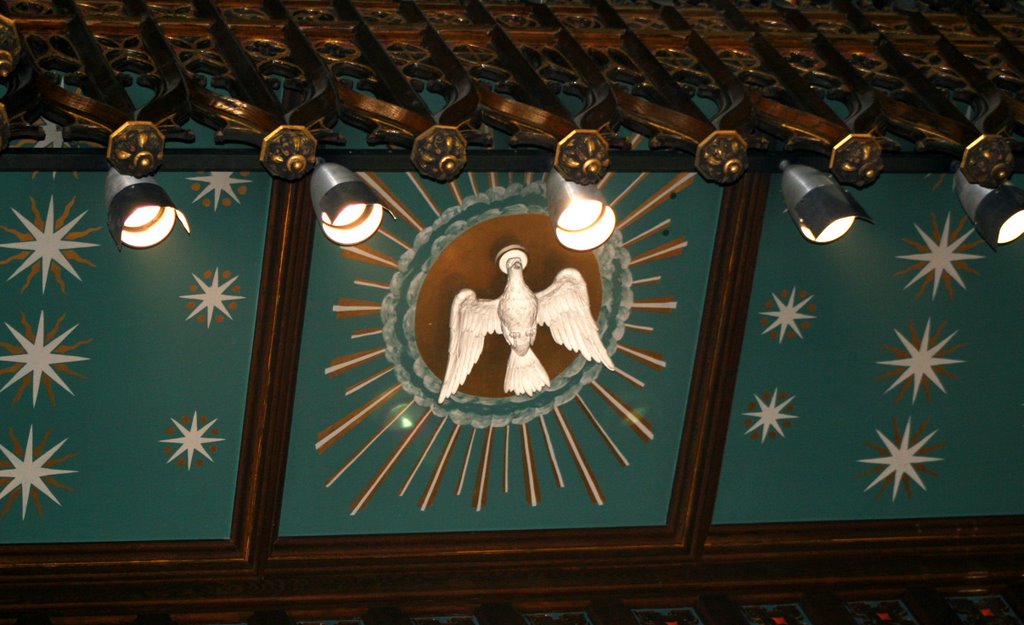
I'll bet there are a good many Grotto-goers who don't know what is under the canopy that is over the tabernacle. It can barely be seen from the altar rail when kneeling.
I had a higher powered lens on my camera and did not bring the shorter one with me, otherwise, I would have included a wider shot to give you perspective. I'll get it perhaps next week.
New Advent - an online version of the Catholic Encyclopedia, gives us a little background in the canopy of the altar, or Baldachinum of the Altar
New Advent gives us similar information under "Altar Canopy":
The "Caeremoniale Episcoporum (I, xii, 13), treating of the ornaments of the altar, says that a canopy (baldachinum) should be suspended over the altar. It should be square in form, sufficiently large to cover the altar and the predella on which the celebrant stands, and if it can easily be done, the colour of the material, silk velvet or other cloth, with which it is covered, should vary with the colour of the ornaments of the altar. It is either suspended from the ceiling by a movable chain, so that it may be lowered or raised when necessary, or it may be attached to the wall, or to the reredos at the back of the altar. It may also be a stationary structure, and this is usually the case in large churches, and then it is made of marble, stone, metal, or wood beautifully carved and overlaid with gold or silver, in the form of a cupola erected on four pillars.
In liturgy it is called the ciborium. The canopy or ciborium is, according to the decision of the Cong. Sac. Rit., to be erected over the altar of the Blessed Sacrament (23 May, 1846), and over the other altars of the church (27 April, 1697), but as contrary custom has so far prevailed that even in Rome it is usually erected only over the high altar, and the altar of the Blessed Sacrament.
The purpose of this canopy is to protect the altar from dust or other matter falling upon it from the ceiling, which, being usually very high, cannot be conveniently or easily cleaned. On solemn festivals, or at special solemnities, a temporary canopy is sometimes placed over an altar in or outside the church. The framework on which such a canopy is erected is called the "altar-herse", a word probably derived from hearse, a frame covered with cloth, and formerly set up over a corpse in funeral solemnities.
And more basic information on Canopies from New Advent - including the ombrellino, seen when the monstrance is carried around outdoors.
There is a connection to the old testament, and I have to study it further. We will look at the Old Testament connection another day