Showing posts with label Liturgical Calendar. Show all posts

Sunday, March 22, 2009

The Fourth Sunday in Lent: Laetare Sunday


From Intermerifica.org:

The fourth Sunday in Lent (Mid-Lent) derives its Latin name from the first word of the Mass text, "Laetare Jerusalem" (Rejoice, O Jerusalem). It is a day of joy within the mourning season. The altars may be decorated with flowers, organ playing is permitted, and the priests may wear rose-colored vestments instead of purple. The reason for such display of joy is explained in a sermon by Pope Innocent III (1216):

"On this Sunday, which marks the middle of Lent, a measure of consoling
relaxation is provided, so that the faithful may not break down under the severe strain of Lenten fast but may continue to bear the restrictions with a refreshed and easier heart."[31]

As a symbol of this joy the popes used to carry a golden rose in their right hand when returning from the celebration of Mass. Pope Leo IX (1051) calls this custom an "ancient institution." Originally it was a single rose of natural size, but since the fifteenth century it has consisted of a cluster or branch of roses wrought of pure gold and set with precious stones in brilliant workmanship by famous artists. The popes bless it every year, and often they confer it upon churches, shrines, cities, or distinguished persons as a token of esteem and paternal affection. In case of such a bestowal, a new rose is made during the subsequent year. The meaning and symbolism of the golden rose is expressed in the prayer of blessing. It represents Christ in the shining splendor of His majesty, the "flower sprung from the root of Jesse." From this ecclesiastical custom Laetare Sunday acquired its German name, Rosensonntag (Sunday of the Rose).

In this country Laetare Sunday receives much publicity in the papers because of Notre Dame's bestowal each year (since 1883) of the Laetare Medal on an American lay Catholic distinguished in literature, art, science, philanthropy, sociology, or other field of achievement. It is an adaptation of the papal custom of the golden rose, and the medal is made of heavy gold and black enamel tracings bearing the inscription "Magna est veritas et praevalebit" (Truth is mighty and shall prevail). It is suspended from a bar on which is lettered "Laetare Medal."


Since I had to go to 6:30 am Mass today (and was glad to hear another great sermon by Fr. Perrone which I will try to get for the blog), I have no fresh pics of Laetare Sunday. Those shown here are from 2008. If you would like to see more, click the link below:

- More Photos from Laetare Sunday 2008 at Assumption Grotto

Te Deum Laudamus! Home

The obedient are not held captive by Holy Mother Church; it is the disobedient who are held captive by the world!

Monday, February 4, 2008

Tridentine Site - with Calendar Projections

Someone has made a pretty good reference for the Tridentine Mass. It not only has the propers, but it has a liturgical calendar, which goes out quite a few years.

Granted, if you have a 1962 missal, this kind of thing should be in there, but if you have an old missal, the projections may not be available. The site was last updated in January 2008 as of this posting.

Go to the site: Tridentine Latin Rite Missal Project

Of course, we know now, through Summorum Pontificum, that there are not two rites, but one rite in two forms: ordinary and extraordinary. Albeit, "extraordinary form of the Roman rite" is such a mouthful to say.

Te Deum Laudamus! Home

Monday, April 16, 2007

Petition to restore Holy Days of Obligation to Appropriate Days

H/T to Catholic bloggers Mac McLernon at Mulier-Fortis and Fr. Tim Finigan - both in the UK, for drawing attention to this petition asking Cardinal Cormac Murphy O'Connor and The Bishops' Conference of England and Wales to restore certain holy days back to their rightful place with regards to when they are celebrated. It pains me all the more when Assumption is shifted to Sunday as that is our feast day. We still celebrate it on the 15th of August each year.

I've been saying for some time that instead of our bishops enabling us to fluff-off these things, they should be challenging us to unbusy ourselves for them. This kind of pampering is one of many factors which has led many to place God second, third, fourth, or wherever.

Perhaps we should start out own petition here in the US. We could use the same form for the letter they are in the UK.

Here is the letter they are suggesting for use....

It might be wise to CC your own Ordinary if you send one to the USCCB.

Sunday, April 1, 2007

Palm Sunday and more on Holy Week at Assumption Grotto

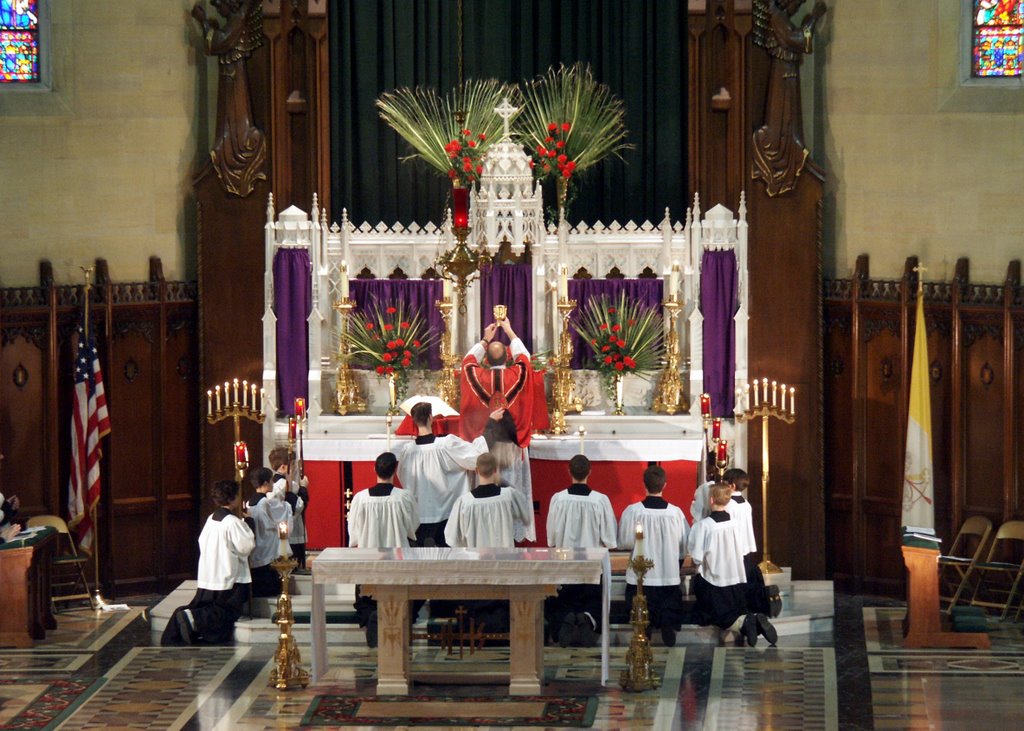
This photo was taken last year during Palm Sunday's Latin Novus Ordo. Fr. Perrone is seen in elevation. I regret that I won't be able to get any photos this year as the sanctuary is beautifully decorated with palms, even moreso than seen here.


Anyone who is new to Assumption Grotto, or recalls when they first came, can relate to what I am saying here.

There is something about being new to Grotto and the "surprise factor". Each week, and each holiday would bring more surprises - just in the manner of how things are celebrated in contrast to the casual atmosphere typical in modern Catholicism.

I'm now seeing things for the second time, and I can say that nothing beats the climax of Holy Week at Assumption Grotto. With each day that went by from Holy Thursday to the Easter Vigil, the intensity grew. I never felt more exhausted trying to capture in photos all that I was experiencing and I had no idea what was going to happen next.

Holy Thursday is awesome, and well attended even though it is not an obligation to go to Mass. This day is special to all priests as it marks the Lord instituted the Eucharist and the priesthood. At Assumption Grotto, only the feet of males are washed, just as in the Lord's time. Last year, I made an error when transferring photos from my camera and lost the first half of the Mass when the foot-washing took place.

The solemn Good Friday service is something well worth commuting to Grotto for. I don't want to call it opera style, but it's nearly that as the entire passion is sung, and there is chanting, and polyphony. I can't count the times I got choked up because I have NEVER seen anything so beautiful, much less for Good Friday (see Good Friday 2006 photos here). Three hours never seemed so short as I stood nearly the entire time capturing photos from the balcony. I am going to attempt to capture video this year, but since I am an amateur, I'll have to leave the quality in the hands of the Blessed Mother, just as I did my liturgical photography when I first began taking photos on August 15, 2005.

The Easter Vigil caught me off guard too. I had been to them at other parishes over the years and particularly enjoyed watching catechumens being received into the Church. However, once again, Assumption Grotto outdid anything I had ever seen. It was pure majesty - something that took the casual God and man relationship into something in which God's greatness is magnified before us.

Easter Sunday features the Orchestral Mass at the 9:30am Latin Novus Ordo. Last year, the noon Mass featured the Assumption Schola. This is a group of men who periodically sing at Grotto. Fr. Perrone belongs to this schola and there are several photos of him, along with them in that previous link. I haven't confirmed they will be there this year, but if any are reading, I'd ask them to email me or place the info in the combox. I've lost the website they had so I need that again too.

Reverence should flow with awe for the majesty of God and the liturgies I experience at Assumption Grotto just lift my soul to the one who said, "I AM"


More photos of Easter Season 2005, and more, can be found in this post. I was new to blogging and had not come up with a system yet of collecting events as I have now, in my sidebar (See Photo Post Collections).

Sunday, March 18, 2007

Laetare Sunday


It's the middle of Lent. Laetare Sunday falls around the middle of Lent and it is known as a day of rejoicing. From New Advent - the online Catholic Encyclopedia:

Strictly speaking, the Thursday before Laetare Sunday is the middle day of Lent, and it was at one time observed as such, but afterwards the special signs of joy permitted on this day, intended to encourage the faithful in their course through the season of penance, were transferred to the Sunday following. They consist of (like those of Gaudete Sunday in Advent) in the use of flowers on the altar, and of the organ at Mass and Vespers; rose-coloured vestments also allowed instead of purple, and the deacon and subdeacon wear dalmatics, instead of folded chasubles as on the other Sundays of Lent. The contrast between Laetare and the other Sundays is thus emphasized, and is emblematical of the joys of this life, restrained rejoicing mingled with a certain amount of sadness.


Note it says the vestments are Rose - not pink!!!

I'm cheating in the photos above, but they are hard to beat when it comes to showing Rose vestments. I did not have my camera with me this morning, so I am using photos from Gaudete Sunday, this past Advent. In these photos, Fr. Eduard Perrone is shown during elevation wearing what is known as a Roman chasuble. It is sometimes referred to as a "fiddleback" chasuble, but the fiddle shape is actually on the front.

Today, Fr. Perrone wore the Rose-colored Gothic chasuble, seen here on a priest we all respected during his time at the Grotto, who is now serving in the Philippines. While you are at it, say a prayer for him and all those in his new mission.