Showing posts with label Advent. Show all posts

Saturday, December 17, 2011

Advent "O" antiphons begin: Pray Vespers with the Church!


While the world has already been celebrating a very secular "christmas" since before the Thanksgiving holiday, Christians ought not get caught up in the emptiness of it all.  Easter is now about bunnies and Christmas about buying and giving extravagant, and sometimes mountains of gifts for others.  Some will give to God what little time is left over, and other believers will give Him virtually not time at all.  Wtihin moderation, there is nothing wrong with gift giving.  But that should come secondary to something else..... 

We must all ask ourselves if the practice of our faith revolves around our lives or whether our lives are revolving around the practice of our faith.  If we truly believe that there is a God who created us, and that Jesus Christ is the Son of God, Savior of mankind, who truly was concieved by the Holy Spirit, born of a woman, and died on a cross for us, then ought not life revolve around the practice of our faith?

If so, then remember that it is still Advent, and we are anticipating Christmas which is about the birth of Our Lord and Savior. 


Pray Vespers During Advent

There are two liturgies and the one most known to Catholics is the Mass (or Divine Liturgy for Catholics not of the Latin rite).  There is also the Liturgy of the Hours (LotH), more commonly referred to as the breviary or divine office.   The main prayers of the day are Lauds (morning) and Vespers (evening).  Most secular orders, like secular Franciscans, Carmelites, etc., are required to pray these at a minimum with Compline (night prayer) often recommended.  Many voluntarily read the Office of Readings, which is longer, but quite rich with it's two, more lengthy readings.  Most often, the first reading comes from the Old Testament, following on a theme pertinent to the season.  The second reading very often involves the wirtings of the Church Fathers, Doctors and Saints, as well as other writers.  Sometimes the second reading is from an important Church document.  That is what makes the Office of Readings one of my favorite parts of the LotH.

Many lay people are finding the beautfy of praying the LotH, or parts of it, and some organizations have made it easy for anyone to follow.  For example, you can go to DivineOffice.org and click on the different hours of the day. 

As with any prayer, it should never be about what we get out of it, or how it makes us feel.  That is making prayer conditional on our comfort.  Prayer is most precious to God when we pray, even when we just cannot get into it, or are tired, or quite busy and stop to give Him ten minutes.   With that, I would encourage you to use what remains of Advent and pray some of the LotH, especially Vespers.  Make it a family thing.  It takes a mere 10 minutes, especially without having to jump from one section to another in the online version, as you would have to in the book itself.


The beautiful "O" Antiphons begin tonight.  Father Z has up an excellent post on this, with an indepth look at today's antiphon: "O Sapientia" (O Wisdom, who came from on High...).


The Christmas Novena is also, already underway.  It's never too late to join in. 


Info recently posted about Assumption Grotto and the Christmas Season

For interesting news items I don't have time to blog on, check out my Twitter Feed: @TeDeumBlog

Te Deum Laudamus! Home


The obedient are not held captive by Holy Mother Church; it is the disobedient who are held captive by the world!
Note: The recommended links below are automatically generated by the tool, so they are not necessarily related content.

Monday, December 5, 2011

Pope Benedict: Prepare for Christmas with a sober lifestyle and self-assessment


Another reminder to not celebrate Christmas before it gets here.  The Advent season is loaded with material for spiritual reflection.  The Holy Father brings the message home...


Vatican City (AsiaNews) - "Choose a sober lifestyle," and “make an honest assessment your life: they are the exhortations of John the Baptist to Christians during Advent, a period of preparation for Christmas. This is the invitation that Benedict XVI addressed today to 20 thousand people present for the Angelus in St Peter's Square where the Christmas tree, this year from Ukraine has arrived.

His appointment for the recitation of the Marian prayer with the faithful was also an opportunity for the Pope to recall the plight of migrants and refugees. Benedict XVI recalled that "in the coming days, in Geneva and other cities, we will celebrate the 50th anniversary of the World Organization for Migration, the 60th anniversary of the Convention on the Status of Refugees and the 50th anniversary of the Convention on the Reduction of Statelessness. I entrust to the Lord all those who, often forcibly, must leave their homeland, or who are stateless. While I encourage solidarity for them, I pray for all those who are doing their utmost to protect and assist these brothers and sisters in emergency situations, even if it means exposing themselves to serious hardships and dangers "


[snip]

The style of John the Baptist - he continued was meant to call all Christians to choose a sober lifestyle, especially in preparation for the feast of Christmas, when the Lord - as Saint Paul would say - "became poor although he was rich, so that by his poverty you might become rich"(2 Cor 8.9).


With regard to the John’s mission, it was an extraordinary appeal to conversion: his baptism "is tied to a fiery invitation to a new way of thinking and acting, it is above all linked to the announcement of God's justice" (Jesus of Nazareth I, Milan 2007, p. 34) and the imminent appearance of the Messiah, defined as "he who is mightier than I" and who will "baptize with the Holy Spirit" (Mk 1,7.8)”.

" Therefore, John’s appeal - concluded the Pope - goes far beyond and deeper than a call to a sober lifestyle: it is a call for inner change, starting with the recognition and confession of our sins. As we prepare for Christmas, it is important that we find time for self contemplation and carry out an honest assessment of our lives. May we be enlightened by a ray of the light that comes from Bethlehem, the light of He who is "the Greatest" and made himself small, he who is "the Strongest" but became weak".


For interesting news items I don't have time to blog on, check out my Twitter Feed: @TeDeumBlog

Te Deum Laudamus! Home

The obedient are not held captive by Holy Mother Church; it is the disobedient who are held captive by the world!
Note: The recommended links below are automatically generated by the tool, so they are not necessarily related content.

Wednesday, November 30, 2011

Advent Parish Mission at Assumption Grotto December 1-4


Each year the ORC priests offer a parish mission during Advent. This year it is taking place December 1st - 4th. It begins Thursday with holy Mass an ends on Sunday.  It is open to all.

See details in the flyer for conference times and other events, such as opportunities for Confession and Adoration.


For interesting news items I don't have time to blog on, check out my Twitter Feed: @TeDeumBlog

Te Deum Laudamus! Home

The obedient are not held captive by Holy Mother Church; it is the disobedient who are held captive by the world!
Note: The recommended links below are automatically generated by the tool, so they are not necessarily related content.

Tuesday, November 29, 2011

Fr. Perrone: Greatest danger isn't attack from the world, but accommodation to it


As the world already celebrates it's secular "christmas", completely bi-passing Advent, Fr. Perrone encourages us to reflect on some spiritual realities that can easily be overlooked.  This is his homily for last Sunday, the First Sunday of Advent, and it was delivered at the 9:30 am Mass using the 1962 Missal.
1st Sunday of Advent 2011

Two words that define Advent appear and reappear in the liturgy of this Mass: the first is the verb ‘to await’ (expectare) and the second is the verb ‘to draw near’ (appropinquare). Advent is so short a season that we cannot afford to dillydally and slowly get ourselves acclimated to the season. Before you know it, it will be gone and it would be a shame and a great disadvantage to us if we were to forfeit its advantages. The Epistle is, in the literal sense, a wake up call, like the sounding of an alarm over someone asleep. The disturbance of being roused from slumber is for good purpose: the Lord is near (one of the two words I mentioned). In order for Advent to be especially useful to us we need to enter into its spirit in a way like that of Christians of the early times. They were not awaiting the day of Christmas with its holiday delights; they were awaiting the second coming of the Judge and Savior, Christ. Not only will He certainly come again but, in the liturgy, He is summoned to come soon: “stir up Your power”–we address Him thus in the Collect–“and come.” We are in the mode of ‘waiting’ (the other word of the day) for His arrival as the all-Just Rewarder and Punisher. Our living in anticipation of the final day of the world (that ‘awaiting’) can bring two different responses: one is waiting in hope for redemption and the other is the frightful anticipation of punishment. Both things are indeed coming, and the Church is trying to prepare us to meet them.

The nearness of the coming of Christ is often not taken with the urgency that we find expressed in the New Testament and in the Church’s liturgy. We don’t live ‘on the edge’ as if Christ might drop down upon us at any moment. And while we may rightly be amused over some Christian sects for their calculations and recalculations about the day of Christ’s return, we ought to admire and emulate them for the vigilance over themselves which ought to be the accompaniment of Christian hope. We are not meant so to settle ourselves in this world as to be made friends with it. We Catholic Christians are always in a precarious relationship to the world. It simply hates us and must do so necessarily since God’s word condemns its pursuits and purposes. The danger that we face every day is not so much the attack from the world (although this is happening ever more as the Church is being throttled by social pressures and by government strictures). The danger for us is accommodation to the world, that cozy alliance with the world whose spirit is antithetical, opposed and aggressive, towards Christ. The ‘nearness’ of Christ’s advent is not to be taken only in terms of time, of years, but of proximity of His Presence. It is our nearness to Him through decent living (the subject of the Epistle, that ‘sobriety’ mentioned by St. Paul) that should characterize our daily life. This is a manner of living in the world that keeps us distant from its charms and seductions. It’s a sequestering of ourselves from the noxiousness of sins which are indeed attractive. These are the concupiscences, the lusts, the “draws” of the world from which we must run away, close the eyes and ears and keep jealously enclosed within us our innocence. That’s what it means to be ‘expecting’ the coming of the Lord. It is a vigilance over ourselves, keeping guard over the movement of our senses, the curiosities of our lower nature. “No one who waits for You will be confounded” we say in this Mass. We need that wakefulness of mind, that quickness of recognition that there are dangers we have to avoid: first, by being keenly aware of their menace and their attractiveness. The moment we let down our guard, we are lost and the comforting bath of the world’s filth will find agreement with our lower nature.

Slinking into this worldly and sensual life requires a seduction of the mind, that is to say, a deception. There must be a plausible, attractive invitation to abandon all one’s upbringing and training to convince one that it’s alright to be accommodating to the spirit of the age, to the lure of the times. It is in this regard that I want to read for you a few passages often overlooked in the New Testament epistles that are fair warning about these sly suggestions that would carry us away from Christ and from salvation.

The first Pope, Saint Peter, wrote his epistles with a view of tipping us off in regard to being duped. He tells us that in being Christians we have “fled a world corrupted by lust” so that we might share God’s nature. The difficulty is not only that there is this evil in the world, but that there are teachers in the Church those who ‘smuggle in’ false teachings. And the secret to their success in convincing people towards sin is this: “their lustful ways will lure many away.” Heresy, in other words, comes out of lustful passion and not from mere intellectual mistakes.

I continue to quote him: “Through these false teachers, the true ‘way’ will be subject to contempt. (That is to say, that Catholic truth will be ridiculed, and its followers will be belittled for holding to its truth.) Saint Peter is speaking about men who (quote) “live for the flesh in their desire for whatever corrupts and who despise authority. They pour abuse on things of which they are ignorant. They act like creatures of instinct, brute animals born to be caught and destroyed. They too will be destroyed, suffering the reward of their wickedness. Thinking daytime revelry a delight, they are a stain and defilement as they share in your feasts in a spirit of seduction...Theirs is a never-ending search for sin. They lure the weaker types. Their hearts are trained in greed. An accursed lot they are!These men are waterless springs, mists whipped up by the gale. The darkest gloom has been reserved for them. They talk empty bombast while baiting their hooks with passion, with the lustful ways of the flesh, to catch those who have just come free of a life of errors. They promise freedom though they themselves are slaves of corruption. .. When men have fled a polluted world by recognizing the Lord and Savior Jesus Christ, and then are caught up and overcome in pollution once more, their last condition is worse than their first. It would have been better for them not to have recognized the road to holiness than to have turned their backs on the holy law handed on to them, once they had known it. How well the proverb fits them: 'The dog returns to its vomit’ and ‘A sow bathes by wallowing in the mire.’”

This is all from the Second Epistle of Saint Peter. Though I have quoted him at some length, he is not yet finished speaking in this vein. Certainly you will have recognized how relevant his words are to us who have had to contend not only with our own weakness in being inclined towards sin, but have had the scandals of heresies and sin served to us by those in positions of authority, even in the holy Church of God, things which have tended to destablize us and make us questioning!

And so, the Apostle continues, so relevant to our day as to his: “In the last days, mocking, sneering men who are ruled by their passions will arrive on the scene. They will ask: ‘Where is that promised coming (the advent) of Christ? Everything stays just as it is.’ This point must not be overlooked... The day of the Lord will come like a thief, and on that day the heavens will vanish with a ro (an echo of our Lord words in today’s Gospel); the elements will be destroyed by fire, and the earth and its deeds will be made manifest. Since everything is to be destroyed in this way, what sort of men must you not be! How holy your conduct and devotion, looking for the coming of the day of God and trying to hasten it! So, while waiting for this, make every effort to be found without stain or defilement, and at peace in His sight. You are forewarned, beloved brothers. Be on your guard lest you be led astray by the error of the wicked, and forfeit the security you enjoy. Grow rather in grace and in the knowledge of our Lord and Savior Jesus Christ.”

Better words could not be found for an Advent sermon than these by Saint Peter. They alert you to false guides in the Church, they show you how to identify them by their impure ways, and they goad you to keep on the original way of the Catholic faith in all its integrity. The Lord will come again and give everybody exactly what he deserves.

Two words: waiting and nearness. We are awaiting the justice of God while we are conscious of just how near He is.


For interesting news items I don't have time to blog on, check out my Twitter Feed: @TeDeumBlog

Te Deum Laudamus! Home

The obedient are not held captive by Holy Mother Church; it is the disobedient who are held captive by the world!
Note: The recommended links below are automatically generated by the tool, so they are not necessarily related content.

Thursday, December 23, 2010

As Advent comes to a close...


As Advent comes to a close, I am suspending news and general topic posts in order to shift focus to the birth of Our Lord.   Here are some worthy reads for the occassion (with a brief lead-in or excerpt).

Over at First Things - On the Square, William Doino Jr. posts: Meditations for the End of Advent:
Advent is the season of hope and reflection. It is a time of prayerful expectation for Christians who await the Second Coming of the Lord, just as they celebrate his birth at Christmas. Many, however, do not really appreciate its significance, or see Advent as a dramatic call upon their lives..... One man who did was Fr. Alfred Delp.


Terry Nelson at Abbey-Roads reminds us of the 8th day of the Christmas Novena, and shares a beautiful piece of art.

Father Z tells us about a couple to be beatified.  What could be more appropriate as we await the Christ Child than to read about a mother and father who lived a life of both joy and sacrifice to raise their 21 children.  Says Father Z:

In a time when families are being called upon to tighten the belt, in a time when the decline of the number of children being brought into families with a loving father and mother in the home, in a time when more and more children are being exposed less and less to a life of Christian faith well-lived, this beatification takes on its own importance, much as did the beatifications of Bl. Luigi Quattrocchi and Maria Corsini, or that of St. Gianna Beretta Molla.


A few days ago, Father Z also wrote this informative post: Reminders about Christmas and Holy Communion


Today, Father Stephen Leake, SDB is blogging the Pope Benedict and the star of Bethlehem in: Let Us Be Amazed, Exhorts Pope Benedict XVI
 
Let us remember persecuted Christians around the world, and offer thanks to God for the freedoms we have with these examples


Please Pray!
On a final note, please remember in your prayers the sick and the dying, and those who have departed us as we approach Christmas.  I ask you to pray for the repose of the soul of Doris and keep her family and friends in your prayers.  She is the mother of parishioner Mark Simpson and passed away suddenly early yesterday.  Several of Mark's family members - his wife, daughter and two sons are in the choir, Matthew being our organist for the 9:30am Mass and orchestral Masses.   Despite their sudden loss and sadness, they came to the dress rehearsal last night. Keep them and all families suffering such a loss in your prayers, as well.  Requiescat in pace, Doris.


For interesting news items I don't have time to blog on, check out my Twitter Feed: @TeDeumBlog

Te Deum Laudamus! Home
The obedient are not held captive by Holy Mother Church; it is the disobedient who are held captive by the world!
Note: The recommended links below are automatically generated by the tool, so they are not necessarily related content.

Thursday, December 16, 2010

December 17th and the start of the "O" Antiphons


Tomorrow, December 17th - those of us who pray the breviary will be praying the "O Antiphons" of Advent before we pray the Magnificat in Evening Prayer.  This should serve as a beautiful meditation.  Also, today we begin the Christmas Novena.  Don't worry about jumping in late!

If you pray the breviary, this may have escaped your notice.  If you don't pray the breviary, perhaps you can follow Vespers (Evening Prayer) for the next 7 days at divineoffice.org.  This is a good, free site to use if you want to see what the breviary/divine office is all about. 

Fr. William Saunders explains the "O Antiphons" of Advent"...

The “O Antiphons” refer to the seven antiphons that are recited (or chanted) preceding the Magnificat during Vespers of the Liturgy of the Hours. They cover the special period of Advent preparation known as the Octave before Christmas, Dec. 17-23, with Dec. 24 being Christmas Eve and Vespers for that evening being for the Christmas Vigil.
The exact origin of the “O Antiphons” is not known. Boethius (c. 480-524) made a slight reference to them, thereby suggesting their presence at that time. At the Benedictine abbey of Fleury (now Saint-Benoit-sur-Loire), these antiphons were recited by the abbot and other abbey leaders in descending rank, and then a gift was given to each member of the community. By the eighth century, they are in use in the liturgical celebrations in Rome. The usage of the “O Antiphons” was so prevalent in monasteries that the phrases, “Keep your O” and “The Great O Antiphons” were common parlance. One may thereby conclude that in some fashion the “O Antiphons” have been part of our liturgical tradition since the very early Church.


The importance of “O Antiphons” is twofold: Each one highlights a title for the Messiah: O Sapientia (O Wisdom), O Adonai (O Lord), O Radix Jesse (O Root of Jesse), O Clavis David (O Key of David), O Oriens (O Rising Sun), O Rex Gentium (O King of the Nations), and O Emmanuel. Also, each one refers to the prophecy of Isaiah of the coming of the Messiah. Let’s now look at each antiphon with just a sample of Isaiah’s related prophecies : [follow the link to read details of each of these by Fr. Saunders at CERC]


For interesting news items I don't have time to blog on, check out my Twitter Feed: @TeDeumBlog

Te Deum Laudamus! Home
The obedient are not held captive by Holy Mother Church; it is the disobedient who are held captive by the world!
Note: The recommended links below are automatically generated by the tool, so they are not necessarily related content.

Saturday, December 11, 2010

Guadete Sunday - Rejoice!

Photo of 2008 Gaudete Sunday at Assumption Grotto - in the Extraordinary Form
From the Introit for the 3rd Sunday of Advent, also referred to as "Gaudete Sunday".  This comes from the first word in the Introit (INTROIT ¤ Phil. 4. 4-6): Gaudete in Domino semper: iterum dico gaudete.
Rejoice in the Lord always: again I say, rejoice. Let your modesty be known to all men: for the Lord is nigh. Be nothing solicitous: but in every thing by prayer let your petitions be made known to God. -- (Ps. 84. 2). Lord, Thou hast blessed Thy land: Thou hast turned away the captivity of Jacob. V.: Glory to the Father and to the Son and to the Holy Ghost. As it was in the beginning, is now, and ever shall be, world without end. Amen. Rejoice in the Lord always: again I say, rejoice. Let your modesty be known to all men: for the Lord is nigh. Be nothing solicitous: but in every thing by prayer let your petitions be made known to God.
See also:

WDTPRS 3rd Sunday of Advent (1962MR) – Collect: illumination of our darkness


For interesting news items I don't have time to blog on, check out my Twitter Feed: @TeDeumBlog

Te Deum Laudamus! Home
The obedient are not held captive by Holy Mother Church; it is the disobedient who are held captive by the world!
Note: The recommended links below are automatically generated by the tool, so they are not necessarily related content.

Friday, December 10, 2010

Under Candlepower: An Unexpected Advent Rorate Mass at Grotto...

The Elevation of the Chalice during a 7:00pm Rorate Mass in the ordinary form on December 11, 2007 at Assumption Grotto


I had wanted to make the 7:30am Mass this morning, but could not be there.  So, I went to the 7:00pm Mass and was blessed to find that an Advent Rorate Mass was going to be celebrated. It was a Latin Novus Ordo which kicked off the start of an Altar Boy retreat.  The photo above is of the only Rorate Mass I captured at Assumption Grotto.  I don't always have the luxury of a camera on hand.  From what I understand the decision was made at the last minute today. 

Here is a post I made in 2007, which contains an explanation of this tradition, which traditionally took place in the morning.


This is a Mass done entirely under candlepower. It is a custom that originated in German-speaking countries. A brief overview is given by one of the German priests who works out of Assumption Grotto.

There is a desire to do this Mass early in the morning as a TLM, but making it happen has been a challenge. Since it is happening on Tuesday nights at 7:00pm, it must be in the Novus Ordo, or ordinary form of the Mass. This is when the priests of the Holy Cross celebrate weekly.


What is a Rorate Mass and why is it celebrated with white vestments and by candlelight?
The Rorate Mass got its proper name from the first word of the Introit (Entrance antiphon): "Rorate caeli désuper et nubes pluant justum". "Shower, O heavens, from above, and let the skies rain down righteousness". We know Gaudete and Laetare Sunday which also got their names from the Introit.

Before the liturgical changes after Vatican II this Mass was celebrated very early in the morning on all Saturdays. In some areas it was celebrated on several or even all weekdays during Advent.


ORIGINS

The Rorate Mass has a long tradition in the Church, especially in German-speaking countries. It is a Votive Mass in honor of the Blessed Mother for the season of Advent. Our Lady shows herself in a special way as our leader through Advent to Christmas. The celebration by candle light had originally a more practical reason. According to the Missal of 1570 no Mass could be said after 12.00 Noon. On the other hand, people had to go to work in the morning. Also the Rorate Masses were celebrated in a more solemn form and therefore would last longer. For these reasons the Masses had to begin relatively early in the morning when it was still dark due to winter-time.


SYMBOLISM

There is a beautiful symbolism associated with the Rorate Mass. Through the snow and cold and darkness of early morning the faithful would trudge with lanterns and candles in their hands to the then brightly lit Church (no electric light!) where the Mass was celebrated.


MARIAN DIMENSION

In Advent we live spiritually between the Annunciation and the birth of Christ. Mary teaches us the spirit of Advent and inner attitude we should have during Advent. During the nine month of pregnancy Mary lived a hidden life, in the spirit of silence and intense intimacy with Christ she carried in her womb. This spirit of intimacy with God the faithful are to cultivate during the season of Advent more intensely by listening attentively to God's message and by obedience to His word.


RORATE MASSES TODAY

Today this Mass with candlelight can either be celebrated in the morning or in the evening when it is dark, because there is no restriction any more with regard to the hours Mass can be said. In fact it is frequently celebrated in German-speaking countries because of its popularity). Popular piety attributed to these Masses a special efficacy and they were held in great esteem. People would ask these Masses to be said for their intentions far in advance.


USE OF CANDLES

What we see so often in Church history: certain things have been done first for practical reasons, but then in the course of time there was also attributed a spiritual meaning. And the use of candles during Advent belongs into this category. The symbolism of the candle matches very well with the spirit of Advent. Advent is dawn. It is still not the bright light of Christmas. Advent is a time of preparation for something exceedingly joyful that will be going to happen. The Church and the soul are still struggling through the darkness toward the Light. There is a longing and expectancy of Advent. The light of our candles is a symbol for our longing for the coming of our Savior Whose light is already dawning. On Christmas Eve we will enter the Church in procession by candlelight. When the Gloria is sung all the lights will be turned on meaning that Christ is now born.


For interesting news items I don't have time to blog on, check out my Twitter Feed: @TeDeumBlog

Te Deum Laudamus! Home

The obedient are not held captive by Holy Mother Church; it is the disobedient who are held captive by the world!
Note: The recommended links below are automatically generated by the tool, so they are not necessarily related content.

Saturday, December 4, 2010

Second Sunday of Advent


What is below is taken from the Second Reading in the Office of Readings of the Breviary.  The First Reading was Isaiah 228b-23.
From commentary on Isaiah by Eusebius of Caesarea
(Cap. 40: PG 24, 366-367)


The voice in the wilderness


"The voice of one crying in the wilderness: Prepare the way of the Lord, make straight the paths of our God." The prophecy makes clear that it is to be fulfilled, not in Jerusalem but in the wilderness: it is there that the glory of the Lord is to appear, and God’s salvation is to be made known to all mankind.
It was in the wilderness that God’s saving presence was proclaimed by John the Baptist, and there that God’s salvation was seen. The words of this prophecy were fulfilled when Christ and his glory were made manifest to all: after his baptism the heavens opened, and the Holy Spirit in the form of a dove rested on him, and the Father’s voice was heard, bearing witness to the Son: "This is my beloved Son, listen to him."


The prophecy meant that God was to come to a deserted place, inaccessible from the beginning. None of the pagans had any knowledge of God, since his holy servants and prophets were kept from approaching them. The voice commands that a way be prepared for the Word of God: the rough and trackless ground is to be made level, so that our God may find a highway when he comes. "Prepare the way of the Lord": the way is the preaching of the Gospel, the new message of consolation, ready to bring to all mankind the knowledge of God’s saving power.


"Climb on a high mountain, bearer of good news to Zion. Lift up your voice in strength, bearer of good news to Jerusalem." These words harmonise very well with the meaning of what has gone before. They refer opportunely to the evangelists and proclaim the coming of God to men, after speaking of the voice crying in the wilderness. Mention of the evangelists suitably follows the prophecy on John the Baptist.


What does Zion mean if not the city previously called Jerusalem? This is the mountain referred to in that passage from Scripture: Here is mount Zion, where you dwelt. The Apostle says: You have come to mount Zion. Does not this refer to the company of the apostles, chosen from the former people of the circumcision?


This is the Zion, the Jerusalem, that received God’s salvation. It stands aloft on the mountain of God, that is, it is raised high on the only-begotten Word of God. It is commanded to climb the high mountain and announce the word of salvation. Who is the bearer of the good news but the company of the evangelists? What does it mean to bear the good news but to preach to all nations, but first of all to the cities of Judah, the coming of Christ on earth?


Te Deum Laudamus! Home
The obedient are not held captive by Holy Mother Church; it is the disobedient who are held captive by the world!
Note: The recommended links below are automatically generated by the tool, so they are not necessarily related content.

Tuesday, November 30, 2010

Bishop puts brakes on Christmas...


I learned many things about the Catholic faith when I first got to Assumption Grotto, that I had not known before.

The priests have discouraged the playing of Christmas music and celebrations prior to December 24th. Many at the parish wait until the final days before Christmas to put up their trees. While Christmas trees are parked out by curbsides days after the end of the holiday in neighborhoods, the trees of these Catholics remain up until after Epiphany. This follows the Christian cycle of Christmas, not the secular cycle which begins to play Christmas music before Thanksgiving. Lest Christmas go the way of the Easter with the Easter Bunny in Christiam homes, I hope more bishops and priests will speak out on this.

Deacon Greg Kandra blogs about Bishop Wester of Salt Lake City, Utah and his pastoral letter: Waiting in Joyful Hope! A Pastoral Letter to the Church of Salt Lake City on the season of Advent

This is just an excerpt. You need to follow the link to the Intermountain Catholic to see the full pastoral letter. I recommend you read it in full to understand the catechesis behind what he is asking of Catholics.

This Advent, I call on every Catholic in the diocese of Salt Lake City to strive to enter into the spirit of the season. As we move forward, I strongly encourage our schools, parishes, and each individual household to celebrate the four weeks of Advent with rich prayer. We must practice and model what we preach in order to instill the rich traditions of our faith in young and old alike.


Here are some particular examples of what this will entail. Schools should not decorate for Christmas, but can decorate with simple wreaths and greenery. They might celebrate “Gaudete parties” before departing for Christmas break. I encourage each home to display and bless an Advent wreath where the family can gather for prayer either in the morning, at dinner, or some other practical time. I urge you to hold-off on displaying a decorated Christmas tree until the season of Christmas begins. You may want to incorporate a Jesse Tree in your family’s observance of the season. (More information on Jesse Trees can be found at: http://www.catholicculture.org/culture/liturgicalyear/activities/view.cfm?id=545 or http://www.loyolapress.com/our-jesse-tree-advent-activity.htm.) As the season draws to its close, I also invite you to discover the beauty of the O Antiphons, which are sung as part of evening prayer from December 17th to 23rd, and are most familiar to most of us in the hymn O Come, O Come, Emmanuel.


Once Christmas comes, the season stretches far beyond the 25th of December. It continues until the celebration of the Baptism of the Lord on January 9, 2011. We should leave the decorations which are testimonies to our joy up for the entire season. There is plenty of time for us to celebrate our joy at Christ’s birth and we should make the most of it. You might consider having a Christmas gathering in the parish, or at home with family and friends during this time.


First, though, before we celebrate, comes a necessary time of waiting and of preparation. The season of Advent refocuses us and reminds us that Christ has changed the world. Darkness has covered this hemisphere, and the world itself is quiet. Because we know that Christ reigns over all of creation, we strain in the darkness to see the light of Christ, our coming King. May our observance of this season renew us and be an example of patience, silence, and joy to our hurried and anxious society.


Te Deum Laudamus! Home
The obedient are not held captive by Holy Mother Church; it is the disobedient who are held captive by the world!
Note: The recommended links below are automatically generated by the tool, so they are not necessarily related content.

Saturday, November 27, 2010

Advent begins; Holy Hour for Nascent Human Life followed 4pm Mass at Grotto


Fr. Perrone leads a Holy Hour for Nascent Human Life at Assumption Grotto after the 4:00pm Saturday Mass
 A new liturgical year begins with Advent. 

After the 4:00pm Mass today, Fr. Perrone held a Holy Hour in response to the Holy Father's requests for bishops, pastors, religious orders, to offer prayer for all nascent (developing) human life.  Archbishop Allen H. Vigneron held a prayer vigil in Canton, Michigan at St. John Neumann.  Many could not make it out to Canton, so it was good that several area parishes were able to hold vigils, including Grotto.

During his homily at the 4:00pm Mass, Fr. Perrone expressed regret that it came together too late to allow for better advertising.  Announcements were made at the Thanksgiving Day Masses and a note appeared on the Grotto homepage, as well as on my blog.  I sent out a email, and posted it to my facebook account, also.

Fr. Perrone also would like to have held a Vespers service, but here again - some of us considered putting booklets together, but there just wasn't time and we had no idea if we would need a dozen or 60, or 100.  Instead, we did the post-Mass Rosary, and that was followed by an hour of silent Adoration during Exposition.  I'll be honest, the silence was profound and beautiful.  You wouldn't have known that anyone was in Church.  About 50-60 people were present including all of the sisters.  Finally back from a long round of giving retreats the Canons were also present in the pews.  A welcome surprise was seeing, among them, the newly arrived Fr. Ludwig Maria.  He assisted with distributition of Holy Communion at the 4:00pm Mass. 

I should mention how special it was that a baby was being baptized following the 4:00pm Mass in the back of the church by Fr. John as Exposition got underway.  On a night that we prayed for all unborn human life, it was a blessing for the Sacrament of Baptism to be taking place. How many lives were terminated today in the womb or in a petri dish rather than have an opportunity to be born and baptized where they could give glory to their Creator?

Click here for full text of Pope Benedict XVI's homily for 1st Vespers at Vatican Radio

With the start of Advent, Fr. Z has some posts and links up to articles he has written in the past. 
Te Deum Laudamus! Home
The obedient are not held captive by Holy Mother Church; it is the disobedient who are held captive by the world!
Note: The recommended links below are automatically generated by the tool, so they are not necessarily related content.

Thursday, December 17, 2009

The "O Antiphons" of Advent


You will hear talk about the "O Antiphons" of Advent.  Antiphons precede the recitation of the Magnificat each evening when Vespers is prayed.  However, the Great Antiphons from December 17th through the 23rd begin with the interjection, "O". 

These antiphons are good to reflect on as we come closer to Christmas. 

Here is the antiphon for December 17th:
O Sapientia, quae ex ore Altissimi prodiisti, attingens a fine usque ad finem fortiter, suaviterque disponens omnia: veni ad docendum nos viam prudentiae

And one translation of it:
O Wisdom, who proceeds from the mouth of the Most High, reaching out mightily from end to end, and sweetly arranging all things: come to teach us the way of prudence.

This is what is in my breviary:
O Wisdom, O holy Word of God, you govern all creation with your strong yet tender care. Come and show your people the way to salvation.
That last translation doesn't even come close to the Latin.  Based on what I am seeing in this online lectionary, both correspond to the same Latin.  Perhaps some day....

Even if you don't pray the Divine Office every day, you might consider praying the Magnificat.  And, if you would like to pray the Office and don't have a breviary, you can use Universalis (click on Evening Prayer at the top).  The translation comes from the New Jerusalem Bible, I believe, and so it may not be proper for those who are required to pray the Office, such as priests, to use this particular translation. What makes it nice, especially for those who don't know how to pray it, is that the electronic versions flow well without having to flip around to different parts of a book, which is what people struggle with when learning.

Further reading and reflections on the O Antiphons:

Te Deum Laudamus! Home

The obedient are not held captive by Holy Mother Church; it is the disobedient who are held captive by the world!

Sunday, December 13, 2009

Gaudete in Domino semper: iterum dico gaudete.


The third Sunday of Advent is also known as Gaudete Sunday. It is so named after the first word in the Introit: Gaudete (Rejoice!).

INTROIT ¤ Phil. 4. 4-6
Rejoice in the Lord always: again I say, rejoice. Let your modesty be known to all men: for the Lord is nigh. Be nothing solicitous: but in every thing by prayer let your petitions be made known to God. -- (Ps. 84. 2). Lord, Thou hast blessed Thy land: Thou hast turned away the captivity of Jacob. V.: Glory to the Father and to the Son and to the Holy Ghost. As it was in the beginning, is now, and ever shall be, world without end. Amen. Rejoice in the Lord always: again I say, rejoice. Let your modesty be known to all men: for the Lord is nigh. Be nothing solicitous: but in every thing by prayer let your petitions be made known to God.
This is one of only two Sunday's where Rose colored vestments may be worn.  The other is Laetare Sunday in Lent.  Read more in a Q&A about the use of rose-colored vestments: Liturgy: Rose-Colored Vestments on Gaudete Sunday

Ember Days of Advent are coming upon us, as well - this Wednesday, Friday, and Saturday.  These are pentitential days in the Extraordinary Form.

Further reading:


The obedient are not held captive by Holy Mother Church; it is the disobedient who are held captive by the world!

Saturday, December 5, 2009

Isaiah 7:14


When I first started taking my faith seriously again in May of 2005, I recall how amazed for the first time in my life with the words emphasized slowly, and several times in succession by my pastor in a homily:

"God.....became.....Man!"

Christmas would never be the same for me after that.  Gone was the secular notion of the holiday with it's emphasis on excessive gift giving and lack of emphasis on Christ.

Every weekend of my life I went to Mass unless I was sick, and I listened to the Old and New Testament readings, as well as the psalm.  Unfortunately, I never "heard" them.   Over these past four years, I have paid even closer attention.  One of the things that still amazes me is how something could be prophesied so many centuries earlier in the Old Testament and be fulfilled so precisely in the New.  People look for miraculous signs and wonders all the time, yet Sacred Scripture contains many.

With Advent now here, pay close attention to the readings at Mass, and in the breviary if you read it.  In particular, follow the psalms and readings in the Office of Readings (OOR). This part of the breviary takes on themes, such as Advent (with a shift in the 2nd reading, if there is a feast day).  If you don't have a breviary, or if you have the shorter version without the OOR, you can use Universalis which updates daily.  While the translation makes it ineligible for those who are required to recite the OOR, like priests, it is just fine for most of us. It has come a long way from where I recall it years ago, when it didn't even have Lauds and Vespers complete.

This post was prompted by an early morning viewing of a rerun of Fr. Pablo Straub's Advent reflections on EWTN.  As soon as I turned on the television, I was met with Isaiah 7:10-14.  As Father suggested, commit Isaiah 7:14 to memory.  Keep in mind Isaiah lived in the 8th century B.C.

Isaiah 7:10-14 (RSV-Catholic Edition)

Matthew 1:20-25
10 Again the LORD spoke to Ahaz, 11 "Ask a sign of the LORD your God; let it be deep as Sheol or high as heaven." 12 But Ahaz said, "I will not ask, and I will not put the LORD to the test." 13 And he said, "Hear then, O house of David! Is it too little for you to weary men, that you weary my God also? 14* Therefore the Lord himself will give you a sign. Behold, a young woman* shall conceive and bear a son*, and shall call his name Immanu-el. *


20 But as he considered this, behold, an angel of the Lord appeared to him in a dream, saying, "Joseph, son of David, do not fear to take Mary your wife, for that which is conceived in her is of the Holy Spirit; 21* she will bear a son, and you shall call his name Jesus, for he will save his people from their sins." 22 All this took place to fulfil what the Lord had spoken by the prophet: 23* "Behold, a virgin shall conceive and bear a son, and his name shall be called Emmanuel" (which means, God with us). 24 When Joseph woke from sleep, he did as the angel of the Lord commanded him; he took his wife, 25 but knew her not until she had borne a son; and he called his name Jesus.

* Note on "a young woman" in the Isaiah passage....in some translations the word used is "virgin".  The Ignatius Bible which is RSV-CE uses a footnote at the bottom to indicate the alternative translation.

There are some arguments out there which challenge the messianic nature of Isaiah 7:14.  Fr. William G. Most, writing for EWTN, goes very deep into this issue in, "The Problem of Isaiah 7:14".

If that document is too deep for you, Fr. Echert offers a more simple explanation, for those wanting it.

Now is a good time to point out the nice resource page that EWTN has on Advent.  The USCCB site has also put together an Advent page.

Te Deum Laudamus! Home

The obedient are not held captive by Holy Mother Church; it is the disobedient who are held captive by the world!

Sunday, November 29, 2009

The First Sunday of Advent


"See the fig tree and all the trees: when they now shoot forth their fruit you know that summer is nigh; so you also, when you shall see these things come to pass, know that the kingdom of God is at hand"


MISSA: Ad te levavi

Introit (Ps. 24. 1-3)
To Thee have I lifted up my soul: in Thee, O my God, I put my trust, let me not be ashamed: neither let my enemies laugh at me: for none of them that wait on Thee shall be confounded. -- (Ps. 24. 4). Show, O Lord, Thy ways to me: and teach me Thy paths. V.: Glory to the Father and to the Son and to the Holy Ghost, as it was in the beginning, is now, and ever shall be, world without end. Amen. -- To Thee have I lifted up my soul: in Thee, O my God, I put my trust, let me not be ashamed: neither let my enemies laugh at me: for none of them that wait on Thee shall be confounded.

Epistle (Rom. 13. 11-14)
Brethren, knowing that is is now the hour for us to rise from sleep. For now our salvation is nearer than when we believed. The night is past and the day is at hand. Let us therefore cast off the works of darkness, and put on the armor of light. Let us walk honestly, as in the day: not in rioting and drunkenness, not in chambering and impurities, not in contention and envy: but put ye on the Lord Jesus Christ.
Gospel (Luke 21. 25-33)
At that time Jesus said to His disciples: There shall be signs in the sun, and in the moon, and in the stars; and upon the earth distress of nations, by reason of the confusion of the roaring of the sea and of the waves: men withering away for fear and expectations of what shall come upon the whole world. For the powers of heaven shall be moved. And then they shall see the Son of Man coming in a cloud with great power and majesty. But when these things begin to come to pass, look up and lift up your heads, because your redemption is at hand. And He spoke to them a similitude: See the fig tree and all the trees: when they now shoot forth their fruit, you know that summer is nigh. So you also, when you shall see these things come to pass, know that the kingdom of God is at hand. Amen, I say to you, this generation shall not pass away till all things be fulfilled. Heaven and earth shall pass away: but My words shall not pass away.


The obedient are not held captive by Holy Mother Church; it is the disobedient who are held captive by the world!

Sunday, December 21, 2008

Photopost of the Extraordinary Form on 4th Sunday in Advent


Today was the Fourth Sunday of Advent. The pews were a little shy of usual numbers due to the fresh coating of snow at Mass time that made driving difficult (especially since municipalities are conserving road salt). You will see the fourth candle of the Advent wreath now lit in many of the pictures.


Introit: Drop Down dew, O heavens, from above, and let the clouds rain the Just One: let the earth open and germinate a Savior. {v} The heavens dclare the glory of God: and the firmament proclaims the works of His hands. Glory to the Father...


Gospel: Luke 3:1-6

1* In the fifteenth year of the reign of Tiberi-us Caesar, Pontius Pilate being governor of Judea, and Herod being tetrarch of Galilee, and his brother Philip tetrarch of the region of Ituraea and Trachonitis, and Lysani-as tetrarch of Abilene, 2* in the high-priesthood of Annas and Caiaphas, the word of God came to John the son of Zechariah in the wilderness; 3* and he went into all the region about the Jordan, preaching a baptism of repentance for the forgiveness of sins. 4* As it is written in the book of the words of Isaiah the prophet, "The voice of one crying in the wilderness: Prepare the way of the Lord, make his paths straight. 5 Every valley shall be filled, and every mountain and hill shall be brought low, and the crooked shall be made straight, and the rough ways shall be made smooth; 6* and all flesh shall see the salvation of God."


POST MASS ROSARY CONTINUES
Preceding the National Election in 2008, Fr. Perrone and the priests celebrating Masses knelt down with those serving or concelebrating following the Liturgy and prayed the Holy Rosary for the nation. They continued this practice after the election and will do so for an unspecified amount of time. If the good Fathers go by participation, I would estimate that it is around 98%. Very few people leave before the Rosary is done and the recessional hymn sung. There is something very powerful to hearing a full, or even half-full church praying a Rosary. How much Our Lady must be pleased. Below is a shot taken during today's Rosary, of one of the sisters, with the altar boys in the background, all in prayer.


One more parting shot was the throne basking in sunlight cutting through the stained glass. This photo doesn't do it justice. It had a multi-color hue.


See the Assumption Grotto Orchestra Mass Schedule:

Christmas Season Mass & Confession Schedule and Fr. Hardon Remembrance


Te Deum Laudamus! Home


The obedient are not held captive by Holy Mother Church; it is the disobedient who are held captive by the world!

Wednesday, December 17, 2008

The "O Antiphons" ....

The beautiful "O Antiphons" start today. They are among the most beautiful antiphons of the year and come in the final days of Advent starting on the 17th of December.

To get some background and explanation see this excerpt by Fr. William Saunders:

What are the "O Antiphons"?

Here is the translation he provides of today's antiphon:

O Sapientia: “O Wisdom, O holy Word of God, you govern all creation with your strong yet tender care. Come and show your people the way to salvation.” Isaiah had prophesied, “The spirit of the Lord shall rest upon him: a spirit of wisdom and of understanding, a spirit of counsel and of strength, a spirit of knowledge and fear of the Lord, and his delight shall be the fear of the Lord.” (11:2-3), and “Wonderful is His counsel and great is His wisdom.” (28:29).


Fr. Tim Finigan, in his blog The Hermeneutic of Continuity, posted this YouTube video containing the chant for this antiphon:


Te Deum Laudamus! Home

The obedient are not held captive by Holy Mother Church; it is the disobedient who are held captive by the world!

Sunday, December 14, 2008

Gaudete Sunday - Rejoice!

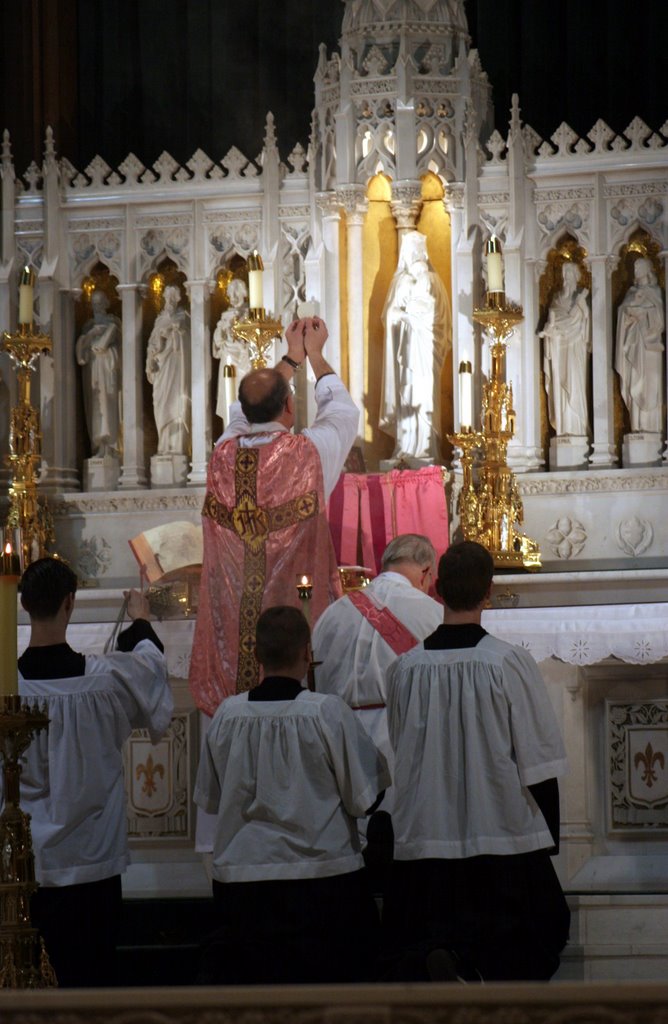
Fr. Perrone is seen elevating the Chalice at the 9:30am Gaudete Sunday Mass (Latin Novus Ordo) in 2006. It was prior to Summorum Pontificum when I was last able to capture this particular chasuble on Gaudete Sunday.


The third Sunday in Advent is known as Gaudete Sunday. The name is taken from the first word of the Introit - Gaudete (Rejoice):

Rejoice in the Lord always: again I say, rejoice. Let your moderation be known to all men: for the Lord is near. Have no anxiety, but in everything, by prayer let your petitions be made known to God. (Philippians 4: 4, 5)Psalm ~ You have favored, O Lord, Your land; You have restored the wellbeing of Jacob. (Psalm 84:2)


The online Catholic Encyclopedia offers some history on Gaudete Sunday.

Fr. Z examines the Collect for Gaudete Sunday (2002 MR). Here is an excerpt (click the link to read the entire post):

Now for the 3rd Sunday of Advent, also nicknamed Gaudete.... the plural imperative of gaudeo, “Rejoice!”. Today, there is a relaxation of the penitential aspect of Advent. In the first week of Advent we begged God for the grace of the proper approach and will for our preparation. In the second week, we ask God for help and protection in facing the obstacles the world raises against us. This Sunday we have a glimpse of the joy that is coming in our rose colored (rosacea) vestments, some use of the organ, flowers. Christmas is near at hand.


Visit EWTN's page for Advent Reflections


Fr. Edward McNamara answers a readers question about Rose Vestments. Was the practice abandoned? Should priests wear Rose? Read his response to see what the General Instruction of the Roman Missal says, and to read his interpretation.


Te Deum Laudamus! Home

The obedient are not held captive by Holy Mother Church; it is the disobedient who are held captive by the world!

Thursday, December 4, 2008

Advent Rorate Masses

The Elevation of the Chalice during a 7:00pm Rorate Mass in the ordinary form on December 11, 2007 at Assumption Grotto


As we have had the last few Advents, Rorate Masses will again take place on Tuesday nights until Christmas. I was unable to pass along the news of this past Tuesday's Mass because it all came together abruptly the night before.

This is a Mass done entirely under candlepower. It is a custom that originated in German-speaking countries. A brief overview is given by one of the German priests who works out of Assumption Grotto.

There is a desire to do this Mass early in the morning as a TLM, but making it happen has been a challenge. Since it is happening on Tuesday nights at 7:00pm, it must be in the Novus Ordo, or ordinary form of the Mass. This is when the priests of the Holy Cross celebrate weekly.


What is a Rorate Mass and why is it celebrated with white vestments and by candlelight?

The Rorate Mass got its proper name from the first word of the Introit (Entrance antiphon): "Rorate caeli désuper et nubes pluant justum". "Shower, O heavens, from above, and let the skies rain down righteousness". We know Gaudete and Laetare Sunday which also got their names from the Introit.

Before the liturgical changes after Vatican II this Mass was celebrated very early in the morning on all Saturdays. In some areas it was celebrated on several or even all weekdays during Advent.


ORIGINS

The Rorate Mass has a long tradition in the Church, especially in German-speaking countries. It is a Votive Mass in honor of the Blessed Mother for the season of Advent. Our Lady shows herself in a special way as our leader through Advent to Christmas. The celebration by candle light had originally a more practical reason. According to the Missal of 1570 no Mass could be said after 12.00 Noon. On the other hand, people had to go to work in the morning. Also the Rorate Masses were celebrated in a more solemn form and therefore would last longer. For these reasons the Masses had to begin relatively early in the morning when it was still dark due to winter-time.


SYMBOLISM

There is a beautiful symbolism associated with the Rorate Mass. Through the snow and cold and darkness of early morning the faithful would trudge with lanterns and candles in their hands to the then brightly lit Church (no electric light!) where the Mass was celebrated.


MARIAN DIMENSION


In Advent we live spiritually between the Annunciation and the birth of Christ. Mary teaches us the spirit of Advent and inner attitude we should have during Advent. During the nine month of pregnancy Mary lived a hidden life, in the spirit of silence and intense intimacy with Christ she carried in her womb. This spirit of intimacy with God the faithful are to cultivate during the season of Advent more intensely by listening attentively to God's message and by obedience to His word.


RORATE MASSES TODAY

Today this Mass with candlelight can either be celebrated in the morning or in the evening when it is dark, because there is no restriction any more with regard to the hours Mass can be said. In fact it is frequently celebrated in German-speaking countries because of its popularity). Popular piety attributed to these Masses a special efficacy and they were held in great esteem. People would ask these Masses to be said for their intentions far in advance.


USE OF CANDLES

What we see so often in Church history: certain things have been done first for practical reasons, but then in the course of time there was also attributed a spiritual meaning. And the use of candles during Advent belongs into this category. The symbolism of the candle matches very well with the spirit of Advent. Advent is dawn. It is still not the bright light of Christmas. Advent is a time of preparation for something exceedingly joyful that will be going to happen. The Church and the soul are still struggling through the darkness toward the Light. There is a longing and expectancy of Advent. The light of our candles is a symbol for our longing for the coming of our Savior Whose light is already dawning. On Christmas Eve we will enter the Church in procession by candlelight. When the Gloria is sung all the lights will be turned on meaning that Christ is now born.


The obedient are not held captive by Holy Mother Church; it is the disobedient who are held captive by the world!


Te Deum Laudamus! Home

Saturday, December 15, 2007

Gaudete Sunday - Winter Weather Blow-out


Anyone with even a little experience with the usus antiquior, can readily tell that this is not a Tridentine. Weather has caused this photographer to play it cautious so, you get a picture from a Novus Ordo last year, showing off one of the Gaudete Sunday chasubles - in this case the roman chasuble, affectionally called a fiddleback (or shall we say, a fiddle-front).


Well, I had planned since Summorum Pontificum to capture the rose-colored, Roman chasuble, on Guadete Sunday during the extraordinary form of the Roman rite. But, weather predictions as of yesterday were for 6-10 inches, and this afternoon that changed to 8-12 inches. At around 8:30pm, the weather channel said, "Buffalo, NY about 20 inches, Chicago about 6 inches AND,.......Detroit - about a foot to a foot-and-a-half!!!!

Normally, the 4:00 Mass is pretty thin crowdwise, except for the first Saturday of the month, at which time we have our St. Monica Sodality Mass.

It was odd to see so many people - typical Sunday people, at the 4:00pm Saturday Mass. In fact, rumor has it that I saw myself. That's right. I chickened out and figured I would assist today rather than deal with the snow on Sunday.

I'll try to capture that Roman chasuble at a Tridentine on Laetare Sunday in Lent when it will be used next. Until then, you may admire the rose-colored vestment used at a Latin Novus Ordo last year.

After seeing several choir members at the 4:00pm Mass, it had me wondering whether our 9:30am Mass will be choral, or schola. In fact, if predictions ring true with a foot or more of snow, perhaps it will be a schola of one! (I'll give you a hint, provided he is not the celebrant at the 9:30am Tridentine).


PHOTO FUN


While we are at it, for those of you who have read all the way to the bottom here, lets have some fun with that photo at the top while educating others.

For those who know, what gives away that the picture is a Novus Ordo and not the Tridentine? Put your answers in the combox.

EDIT 9:12pm Saturday: Oh, joy - Jim Cantori of the Weather Channel is here in metro Detroit and says we will be getting 10-15 inches. Troy, Michigan is just about 8 miles northwest of my home, and about 12-15 miles from Grotto.