You may or may not have seen a piece by a Fr. Jan Larsen of the Archdiocese of Seattle, in which he gives his "expert" opinion on the Mass as seen on EWTN. I had heard about this issue while listening to Catholic Radio. Someone had called in to Fr. Mitch Pacwa, I think it was, and read just a part of this guy's opinion of that Mass. I had forgotten about it, until I saw several blogs bringing forward what amounts to a "take down" of this "expert liturgical opinion".
In his blog - Dyspeptic Mutterings, Dale Price analyzes this piece by Fr. Larsen, with his own comments in bold type.
If you enjoy a solemn, reverent, Novus Ordo, you will want to read this.
Sidenote: Don't forget the Novena for the Assumption.
Monday, August 7, 2006
Sunday, August 6, 2006
Angel in the Waters - A book for everyone
I happened upon this book, Angel in the Waters, about 6 months ago in the Assumption Grotto Giftshop and Cafe and was so moved, I bought it. I didn't know if it was a children's book, or a book for anyone, or for pregnant women and the baby's siblings.
There is a website dedicated to the book - she has it online. I urge you to do this, and to consider giving it as a gift to new mothers, especially anyone considering abortion, or having a hard time adjusting to the pregnancy.
There is a sad story to go with this, unrelated to the book I speak of above. The author, Regina Doman, lost her 4 year old son in a tragic accident in their church parking lot on July 8, 2006. It is too heartbreakig for me to explain here, but it involved the family vehicle, and the mother. The child had climbed out of the car unbenknownst to mom. It was just a freak accident in a parking lot. The child, Joshua Schmiedicke, now has a website, developed in his memory, and it includes words from Fr. Benedict Groeschel who happened to be in town during the wake and stopped in. The online memorial they have made of him is beautiful. The parting shot is very moving. This family needs our continuing prayers.
Do take that tour of Angel in the Waters, and if you frequent Grotto, ask Cathy to show you a copy, if she still has some.
There is a website dedicated to the book - she has it online. I urge you to do this, and to consider giving it as a gift to new mothers, especially anyone considering abortion, or having a hard time adjusting to the pregnancy.
There is a sad story to go with this, unrelated to the book I speak of above. The author, Regina Doman, lost her 4 year old son in a tragic accident in their church parking lot on July 8, 2006. It is too heartbreakig for me to explain here, but it involved the family vehicle, and the mother. The child had climbed out of the car unbenknownst to mom. It was just a freak accident in a parking lot. The child, Joshua Schmiedicke, now has a website, developed in his memory, and it includes words from Fr. Benedict Groeschel who happened to be in town during the wake and stopped in. The online memorial they have made of him is beautiful. The parting shot is very moving. This family needs our continuing prayers.
Do take that tour of Angel in the Waters, and if you frequent Grotto, ask Cathy to show you a copy, if she still has some.


Confession: Is it necessary to confess in kind and number?
Fr. Zuhlsdorf on a topic I've seen him write on many times, in various forms, always coming back to the same point: We must confess our sins in kind and in number.
Here is a question that Fr. Z fielded from the AFQB Box (Ask Father a Question Box), which I featured not long ago, in another post.
I had a good question in the ASK FATHER Question box about confession. Here it is:
Kind AND Number (confession)
AFQB - The ASK FATHER Question Box: Liturgy, Music & The Seven Sacraments: Kind AND Number (confession)
Here is a question that Fr. Z fielded from the AFQB Box (Ask Father a Question Box), which I featured not long ago, in another post.
I had a good question in the ASK FATHER Question box about confession. Here it is:
Kind AND Number (confession)
AFQB - The ASK FATHER Question Box: Liturgy, Music & The Seven Sacraments: Kind AND Number (confession)
By Anonymous on Thursday, August 03, 2006
I’ve often heard priests say that when going to confession it’s important to confess sin both in kind and number. I recently went to confession though to a priest who told me at the beginning of the confession that he’s "not the kind of priest who wants to hear the number or frequency" and just to confess the sin. I didn’t know what to do. This seemed contrary to what the Church teaches and what I’ve been told in the past. Is it official teaching of the Church to confess sin both in kind and number, and if so, where can I find some references to this? How can a priest understand the gravity of the sin if he doesn’t know the frequency?
By Fr. J.T. Zuhlsdorf on Friday, August 04, 2006
You are absolutely correct in your understanding that mortal sins are to be confessed, to the best of one’s ability, in both kind and number. This is very important and it is the ordinary way in which we are to make every auricular confession.
Emergencies can be different, but even after the emergency is over, we are still obliged to make a full confession in both kind and number.
In the 1983 Code of Canon Law we read:
Canon 988 – §1. A member of the Christian faithful is obliged to confess in kind and number all serious sins committed after baptism and not yet directly remitted through the keys of the Church nor acknowledged in individual confession, for which one is conscious after diligent examination of conscience.
§2. It is to be recommended to the Christian faithful that venial sins also be confessed.
The Council of Trent stated pretty clearly that
"To obtain the saving remedy of the sacrament of penance, according to the plan of our merciful God, the faithful must confess to a priest each and every grave sin that they remember after a diligent examination of conscience" (cf. sess. XIV de poenitentia cc. 7-8: COD 712).
Remember that each sacrament has both matter and form. The matter of the sacrament of penance is the telling of sins. While we are not obliged to include all sorts of circumstantial information surrounding the sins, we do need to indicate number and/or frequency, by number can change the severity of the sin and indicate to the confessor (and yourself) where your principle problems are.
Sometimes it will happen that your memory is not clear about the number of times you committed a sin. Just do your best, in that case. Even when your memory is faulty, if you do your best the sins you don’t remember or confess (through no fault of your own) are also indirectly remitted.
So, this priest was ABSOLUTELY WRONG to suggest that you do not need to confess sins also in number/frequency. As a matter of fact, he suggested that you violate the Church’s law in this matter. Confession is a matter of spiritual life or death. You don’t messed around with confession.
Finally, there is nothing so bad that we can do that God cannot forgive. So, confess EVERYTHING!
The confessional is not the rack. The confessional is a tribunal in which you are at the same time the prosecutor and the accused. The priest acts, in the person of Christ, as judge who exercises God’s loving mercy. The confessional is an operating table on which our Savior, with your cooperation, acts as the Physician of your soul and heals your ills. Both these images, though on the surface seemingly stern or intimidating, lead through on the other side to blessed blessed relief.
There is nothing so fine as making a good confession, for it leads to the good reception of Holy Communion in the state of grace.
Fr. Z
Novena in Honor of the Assumption of the Blessed Virgin Mary
For those who began this Novena at Assumption Grotto today, you may be glad to find the text here, if you cannot make it back there each day.
Bookmark it and come back to pray this Novena each day until the feast. I am assuming it is ok for us to read the part of the priest.
Priest: A great sign appeared in heaven: a woman clothed with the sun, with the moon under her feet, and on her head a crown of twelve stars.
People: O Immaculate Virgin, Mother of God and Mother of men, we believe with all the fervor of our faith in your triumphal Assumption into heaven, where you are acclaimed as Queen by all the choirs of angels and the legions of saints. We unite with them to praise and bless the Lord who has exalted you above all creatures, and to offer you the tribute of our devotion and love.
From the valley of tears, we seek your heavenly assistance and tender mercy, to confort us in all our trials. Accept the intentions we offer you in this novena, and be pleased to present them to your Son, for we are confident that in the glory where you reign, you continue your manifold intercession to bring us celestial and temporal gifts.
The glory which you possess in body and soul in heaven is th eimage and beginning of the Church as it is to be perfected in the world to come. Until that day of the Lord shall come, continue to shine forth on earth as a sign of certain hope and comfort for all of your children, O clement, O loving, O sweet Virgin Mary.
Priest: Let us Pray. Almighty everlasting God, who assumed into celestial glory the body and soul of your Son's Mother, the Immaculate Virgin Mary, grant we beg you, that being ever intent up on heavenly things, we may merit to share in her glory. We ask this through Christ our Lord.
People: Amen.
Priest: Queen assumed into heaven,
People: Pray for us.
Bookmark it and come back to pray this Novena each day until the feast. I am assuming it is ok for us to read the part of the priest.
Priest: A great sign appeared in heaven: a woman clothed with the sun, with the moon under her feet, and on her head a crown of twelve stars.
People: O Immaculate Virgin, Mother of God and Mother of men, we believe with all the fervor of our faith in your triumphal Assumption into heaven, where you are acclaimed as Queen by all the choirs of angels and the legions of saints. We unite with them to praise and bless the Lord who has exalted you above all creatures, and to offer you the tribute of our devotion and love.
From the valley of tears, we seek your heavenly assistance and tender mercy, to confort us in all our trials. Accept the intentions we offer you in this novena, and be pleased to present them to your Son, for we are confident that in the glory where you reign, you continue your manifold intercession to bring us celestial and temporal gifts.
The glory which you possess in body and soul in heaven is th eimage and beginning of the Church as it is to be perfected in the world to come. Until that day of the Lord shall come, continue to shine forth on earth as a sign of certain hope and comfort for all of your children, O clement, O loving, O sweet Virgin Mary.
Priest: Let us Pray. Almighty everlasting God, who assumed into celestial glory the body and soul of your Son's Mother, the Immaculate Virgin Mary, grant we beg you, that being ever intent up on heavenly things, we may merit to share in her glory. We ask this through Christ our Lord.
People: Amen.
Priest: Queen assumed into heaven,
People: Pray for us.
Friday, August 4, 2006
Blogrolling help please
I finally decided to not make any posts this morning so I could try to get the blogrolling list started. Well, I did and just took one of the templates they had (see sidebar all the way to the bottom)
The problem is the text color - especially the hyperlink. The text is appearing like a brown, and once selected it turns a flourescent, nearly impossible-to-see, green.
How can I fix this. Lets say I wanted a dark blue for my text, and the brown to be previously selected hyperlink?
If you answer in the combox, then others learning to do this can pick up the reply. But, feel free to email me too. See my profile.
The problem is the text color - especially the hyperlink. The text is appearing like a brown, and once selected it turns a flourescent, nearly impossible-to-see, green.
How can I fix this. Lets say I wanted a dark blue for my text, and the brown to be previously selected hyperlink?
If you answer in the combox, then others learning to do this can pick up the reply. But, feel free to email me too. See my profile.
Novena to St. John Vianney: Days 8-9
Ok - so I messed up somewhere on the St. John Vianney Novena and found myself just ready to post Day 8, when it is actually the Novena!!!
Oops! Here are days 8 and 9, respectively. I'm doing them both and I suppose St. John will overlook this minor imperfection on my part.
Eighth Day
St. John Vianney, Lover of Penance and Mortification
O holy Priest of Ars, you led a life of detachment from worldly pleasures. Your meals consisted of a boiled potato each day; you slept a few hours each night. But you did all of this so that you would be able to serve God to the best of your ability. Your life was portrayed by the saying: “We complain when we suffer. We have much more reason to complain when we do not suffer, since nothing likens us to our Lord as the bearing of His cross.” O great St. John Vianney, in these days when we are surrounded by so many comforts and pleasures, it can be so difficult for us to do penance for our sins and live a life of detachment. I resolve to offer some sacrifice today for the expiation of Father ______________’s sins and the sins of all mankind. Assist Father in accepting the cross God chooses to send him. May he embrace the life of sacrifice to which Priests are called. May he willingly offer his whole life to God! Obtain for Father _____________________ the grace to imitate the life of Christ by the bearing of His cross. Recite the Novena Prayer.
Ninth Day
St. John Vianney, Good and Holy Priest
O holy Priest of Ars, you lived in an age of much upheaval, in a time when men turned their backs on God. Your bishop told of a parish to which he wished to send you where there was no love. He assigned you to Ars and said that you would be the Priest who would enable the people to know the love of God. Not only did you draw these people back to God, but your saintly reputation soon spread and many people were converted to a life of holiness. You said that a good Priest, a Priest after Christ’s own heart is the greatest treasure that God can give a parish. Give us such Priests! O great St. John Vianney, once again we are living in day of upheaval. There is much evil in the word. Obtain for Father _____________ the grace to persevere in his faith and never to despair. May he walk with the Lord and trust in Him all the days of his life. Obtain through your heavenly intercession, for Father ___________________ the grace of modeling his life after that of Jesus Christ, that his people will know the love of God. More than ever the people need him to be able to bring the world to Christ. Pray for Father______________ and all Priests, O great Priest of Ars. Recite the Novena Prayer.
Novena Prayer
O holy Priest of Ars, St. John Marie Vianney, you loved God and served Him faithfully as His Priest. Now you see God face to face in heaven. You never despaired but persevered in your faith until you died. Remember now the dangers, fears and anxieties that surround Father ___________________ and intercede for him in all his needs and troubles especially console him in his most difficult moments, grant him serenity in the midst of crisis, and protect him from evil. O St. John Vianney, I have confidence in your intercession. Pray for Father ____________________ in a special way during this novena.
Oops! Here are days 8 and 9, respectively. I'm doing them both and I suppose St. John will overlook this minor imperfection on my part.
Eighth Day
St. John Vianney, Lover of Penance and Mortification
O holy Priest of Ars, you led a life of detachment from worldly pleasures. Your meals consisted of a boiled potato each day; you slept a few hours each night. But you did all of this so that you would be able to serve God to the best of your ability. Your life was portrayed by the saying: “We complain when we suffer. We have much more reason to complain when we do not suffer, since nothing likens us to our Lord as the bearing of His cross.” O great St. John Vianney, in these days when we are surrounded by so many comforts and pleasures, it can be so difficult for us to do penance for our sins and live a life of detachment. I resolve to offer some sacrifice today for the expiation of Father ______________’s sins and the sins of all mankind. Assist Father in accepting the cross God chooses to send him. May he embrace the life of sacrifice to which Priests are called. May he willingly offer his whole life to God! Obtain for Father _____________________ the grace to imitate the life of Christ by the bearing of His cross. Recite the Novena Prayer.
Ninth Day
St. John Vianney, Good and Holy Priest
O holy Priest of Ars, you lived in an age of much upheaval, in a time when men turned their backs on God. Your bishop told of a parish to which he wished to send you where there was no love. He assigned you to Ars and said that you would be the Priest who would enable the people to know the love of God. Not only did you draw these people back to God, but your saintly reputation soon spread and many people were converted to a life of holiness. You said that a good Priest, a Priest after Christ’s own heart is the greatest treasure that God can give a parish. Give us such Priests! O great St. John Vianney, once again we are living in day of upheaval. There is much evil in the word. Obtain for Father _____________ the grace to persevere in his faith and never to despair. May he walk with the Lord and trust in Him all the days of his life. Obtain through your heavenly intercession, for Father ___________________ the grace of modeling his life after that of Jesus Christ, that his people will know the love of God. More than ever the people need him to be able to bring the world to Christ. Pray for Father______________ and all Priests, O great Priest of Ars. Recite the Novena Prayer.
Novena Prayer
O holy Priest of Ars, St. John Marie Vianney, you loved God and served Him faithfully as His Priest. Now you see God face to face in heaven. You never despaired but persevered in your faith until you died. Remember now the dangers, fears and anxieties that surround Father ___________________ and intercede for him in all his needs and troubles especially console him in his most difficult moments, grant him serenity in the midst of crisis, and protect him from evil. O St. John Vianney, I have confidence in your intercession. Pray for Father ____________________ in a special way during this novena.
Thursday, August 3, 2006
Young priest profiled in Christian Science Monitor
H/T to Gerald Augustinus for this article in the Christian Science Monitor:
Backstory: Keeping faith in a sea of prejudice
How one young priest in an era of Catholic church scandals stays on a spiritual track.
By Mary Beth McCauley Correspondent of The Christian Science Monitor
HAVERTOWN, PA. – Kevin Gallagher bounds down the rectory stairs at 8:25 - cutting it close as always - a few steps away from ready for weekday morning Mass. He's every Irish mother's son - dark hair thinning and freshly combed, ruddy face scrubbed and shaven, polo shirt neatly tucked in over a frame beginning to show his love of cooking.
He jokes with staff, and yells a greeting out the open window, pulling himself into his vestments. Double-checking the Scripture passage, he finally gives the nod that it's time to begin.
In the 31-years since Fr. Gallagher was born, the number of Roman Catholic priests in the U.S. has dropped sharply, from about 59,000 to fewer than 44,000 today.
The Archdiocese of Philadelphia, where Gallagher ministers, is no different. In 1975, 15 men were ordained for the archdiocese - but Gallagher was one of only five in his 2002 ordination class. That same year, emerging national news of sexual abuse of children began to thin congregations, fuel cynicism and foster mistrust among clergy and lay people alike.
But anyone who thinks the Catholic priesthood is dispirited should take a look at the Fr. Gallaghers of the church.
"I just want to say how happy I am," he declares unnecessarily. "And I think most priests are."
Gallagher is second in command at St. Denis Parish, a compact complex of church, rectory, convent, school, and cemetery serving a congregation of 2,600 families here in this Philadelphia suburb.
After Mass, the priest moves quickly through the rectory's big, comfy kitchen, gulping cereal, making introductions, absent-mindedly shoveling errant strawberries into the mouth of a visitor whose cerebral palsy makes her hand shaky. This morning, like all mornings, starts with a list of good intentions. Most of them get tossed as the day progresses, interrupted, as it is, by the never-ending beeping of voice mail, e-mail, intercom, phone, and the tuition payment queries, and church maintenance questions. There's a 9 a.m. spiritual direction appointment, which no one seems to notice is slow getting underway. There's the new family to register. There's a trip into Philadelphia to help prepare for the installation of a bishop. There's a meal with the family whose loved one Gallagher buried not long ago.
Continue reading Christian Science Monitor...
Backstory: Keeping faith in a sea of prejudice
How one young priest in an era of Catholic church scandals stays on a spiritual track.
By Mary Beth McCauley Correspondent of The Christian Science Monitor
HAVERTOWN, PA. – Kevin Gallagher bounds down the rectory stairs at 8:25 - cutting it close as always - a few steps away from ready for weekday morning Mass. He's every Irish mother's son - dark hair thinning and freshly combed, ruddy face scrubbed and shaven, polo shirt neatly tucked in over a frame beginning to show his love of cooking.
He jokes with staff, and yells a greeting out the open window, pulling himself into his vestments. Double-checking the Scripture passage, he finally gives the nod that it's time to begin.
In the 31-years since Fr. Gallagher was born, the number of Roman Catholic priests in the U.S. has dropped sharply, from about 59,000 to fewer than 44,000 today.
The Archdiocese of Philadelphia, where Gallagher ministers, is no different. In 1975, 15 men were ordained for the archdiocese - but Gallagher was one of only five in his 2002 ordination class. That same year, emerging national news of sexual abuse of children began to thin congregations, fuel cynicism and foster mistrust among clergy and lay people alike.
But anyone who thinks the Catholic priesthood is dispirited should take a look at the Fr. Gallaghers of the church.
"I just want to say how happy I am," he declares unnecessarily. "And I think most priests are."
Gallagher is second in command at St. Denis Parish, a compact complex of church, rectory, convent, school, and cemetery serving a congregation of 2,600 families here in this Philadelphia suburb.
After Mass, the priest moves quickly through the rectory's big, comfy kitchen, gulping cereal, making introductions, absent-mindedly shoveling errant strawberries into the mouth of a visitor whose cerebral palsy makes her hand shaky. This morning, like all mornings, starts with a list of good intentions. Most of them get tossed as the day progresses, interrupted, as it is, by the never-ending beeping of voice mail, e-mail, intercom, phone, and the tuition payment queries, and church maintenance questions. There's a 9 a.m. spiritual direction appointment, which no one seems to notice is slow getting underway. There's the new family to register. There's a trip into Philadelphia to help prepare for the installation of a bishop. There's a meal with the family whose loved one Gallagher buried not long ago.
Continue reading Christian Science Monitor...
Novena to St. John Vianney: Day 2 (Humility)
St. John Vianney, Humble in all Things
O holy Priest of Ars, your life was filled with humility. You wore an old cassock. You ate meager meals. You realized that before the throne of God, you were one of His creatures made to glorify God and praise Him in all things. You said that the “first virtue is humility; the second, humility; and the third, humility.” You counseled people to remain humble, remain simple and the more one is so, the more good he will do. Your simplicity of soul and your uncluttered way of life led you to sanctity. O humble St. John Vianney, when Father _____________________ forgets he is totally dependent on God for everything, intercede for him with Almighty God, to allow him to see that without His Creator nothing is possible and that he must rely on God for everything. He is his Creator, who keeps him in existence at every moment. Obtain for Father __________________ the grace of humility. May his life exemplify your humility and simplicity, a life uncluttered, a life totally dependent on God. Recite the Novena Prayer.
Novena Prayer
O holy Priest of Ars, St. John Marie Vianney, you loved God and served Him faithfully as His Priest. Now you see God face to face in heaven. You never despaired but persevered in your faith until you died. Remember now the dangers, fears and anxieties that surround Father ___________________ and intercede for him in all his needs and troubles especially console him in his most difficult moments, grant him serenity in the midst of crisis, and protect him from evil. O St. John Vianney, I have confidence in your intercession. Pray for Father ____________________ in a special way during this novena.
Novena source
O holy Priest of Ars, your life was filled with humility. You wore an old cassock. You ate meager meals. You realized that before the throne of God, you were one of His creatures made to glorify God and praise Him in all things. You said that the “first virtue is humility; the second, humility; and the third, humility.” You counseled people to remain humble, remain simple and the more one is so, the more good he will do. Your simplicity of soul and your uncluttered way of life led you to sanctity. O humble St. John Vianney, when Father _____________________ forgets he is totally dependent on God for everything, intercede for him with Almighty God, to allow him to see that without His Creator nothing is possible and that he must rely on God for everything. He is his Creator, who keeps him in existence at every moment. Obtain for Father __________________ the grace of humility. May his life exemplify your humility and simplicity, a life uncluttered, a life totally dependent on God. Recite the Novena Prayer.
Novena Prayer
O holy Priest of Ars, St. John Marie Vianney, you loved God and served Him faithfully as His Priest. Now you see God face to face in heaven. You never despaired but persevered in your faith until you died. Remember now the dangers, fears and anxieties that surround Father ___________________ and intercede for him in all his needs and troubles especially console him in his most difficult moments, grant him serenity in the midst of crisis, and protect him from evil. O St. John Vianney, I have confidence in your intercession. Pray for Father ____________________ in a special way during this novena.
Novena source
St. John Vianney - An Incorruptible
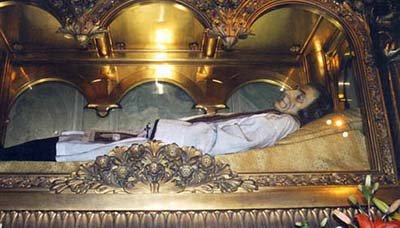
This is the body of St. John Vianney - the Cure d'Ars, as he lays in his resting place. Keep in mind, he died on August 4, 1859. There are websites, such as the one I'm linking to, that focus on the incorruptibles and their significance. Some of the photos are a bit hard to take, like the head of St. Catherine of Sienna. I would rather remember her in a more dignified way. The one of St. Bernadette is beautiful, as are some others. From livingmiracles.net, we learn some details on St. John:
Fr. Vianney was declared Venerable 13 years after his death. In 1904 when his body was exhumed and found to be incorrupt although the flesh had dried up and darkened. To this day the incorrupt body can be seen, encased in glass on a marble Altar, in Ars. In 1905 Fr. Vianney was declared Blessed. And finally in 1925 he became Saint John Marie Vianney.
I'll get you started here on the subject of incorruptibles, as it begins on livingmiracles.net, then let you jump there to see more photos and read more discussion on it:
Through history, the bodies of a considerable number of deceased Catholic Saints and other blessed persons, have not undergone the normal processes of disintegration. Without any kind mummification or embalming methods, their corpses have thus remained incorrupt, a few even after 1500 years. The accounts of incorruptible bodies are a part of Christian history from the first century right through to the 21st.
Many of those, whose bodies have been found incorrupt, had died either by violence or diseases, conditions which normally would encourage the disintegration processes rather than preserve the bodies. Some had been buried in close proximity to other bodies that decomposed normally. Some had been consigned to the bare earth. Others survived burial in such damp conditions that their clothes rotted off their intact bodies. Some had been lying in lime, water or left in the open. But apparently unaffected by exterior influences, the bodies were found preserved as if they were still alive.
Continue reading about incorruptibles
If you want to read more, there is a book by Joan Cruz on the subject.
Wednesday, August 2, 2006
Dominus Iesus - An Interview with the former Cardinal Ratzinger, now Benedict XVI
Gerald Augustinus has a series of posts today covering the declaration:
ON THE UNICITY AND SALVIFIC UNIVERSALITY OF JESUS CHRIST AND THE CHURCH
Rome, from the Offices of the Congregation for the Doctrine of the Faith, August 6, 2000, the Feast of the Transfiguration of the Lord.
(Ratzinger)I did not say that salvation can be achieved by every path. The way of conscience, the keeping of one's gaze focused on truth and the objective good, is one single way, although it can take many forms because of the great number of individuals and situations. The good is one, however, and truth does not contradict itself. The fact that man does not attain one or the other does not relativize the requirement of truth and goodness. For this reason it is not enough to continue in the religion one has inherited, but one must remain attentive to the true good and thus be able to transcend the limits of one's own religion. This has meaning only if truth and goodness really exist. It would be impossible to walk the way of Christ if he did not exist. Living with the eyes of the heart open, purifying oneself inwardly and seeking the light are indispensable conditions of human salvation. Proclaiming the truth, that is, making the light shine (not putting it "under a bushel, but on a stand"), is absolutely necessary.
ON THE UNICITY AND SALVIFIC UNIVERSALITY OF JESUS CHRIST AND THE CHURCH
The Sovereign Pontiff John Paul II, at the Audience of June 16, 2000, granted to the undersigned Cardinal Prefect of the Congregation for the Doctrine of the Faith, with sure knowledge and by his apostolic authority, ratified and confirmed this Declaration, adopted in Plenary Session and ordered its publication.
Rome, from the Offices of the Congregation for the Doctrine of the Faith, August 6, 2000, the Feast of the Transfiguration of the Lord.
He presents for us an interview which was done with the then Cardinal Ratzinger on this subject. Here is just one excerpt:
(Interviewer)But the question remains: since, as you have said, salvation can be achieved through every path, provided that one lives according to one's conscience, does mission then not lose its theological urgency? For what else can be meant by the thesis of the "Intimate and objective connection" between non-Catholic paths of salvation and Christ, if not that Christ himself makes superfluous the distinction between a "full" and "deficient" truth of salvation, since, if he is present as the instrument of salvation, he is always and logically "fully" present.
(Ratzinger)I did not say that salvation can be achieved by every path. The way of conscience, the keeping of one's gaze focused on truth and the objective good, is one single way, although it can take many forms because of the great number of individuals and situations. The good is one, however, and truth does not contradict itself. The fact that man does not attain one or the other does not relativize the requirement of truth and goodness. For this reason it is not enough to continue in the religion one has inherited, but one must remain attentive to the true good and thus be able to transcend the limits of one's own religion. This has meaning only if truth and goodness really exist. It would be impossible to walk the way of Christ if he did not exist. Living with the eyes of the heart open, purifying oneself inwardly and seeking the light are indispensable conditions of human salvation. Proclaiming the truth, that is, making the light shine (not putting it "under a bushel, but on a stand"), is absolutely necessary.
You can get to this interview on "The Cafeteria is Closed", and more on Dominus Iesus here, including insight from Pope John Paul II.
Novena to St. John Vianney: Day 6 (Purity)
St. John Vianney, Model of Purity
O holy Priest of Ars, your life was a model of purity. Your life of chastity was a source of edification to all. You said that when a soul is pure all the court of heaven looks upon it with great joy. Today we are experiencing a great disregard for the virtue of purity; it is looked upon with ridicule by worldly standards. O great St. John Vianney, more than ever before, we need your prayers and help in avoiding sins of impurity. I ask you to help Father ___________________ to keep pure in mind and in body and give good example in his speech, conduct and in his faith. Obtain for him the strength necessary to combat temptations against the virtue of purity, which could lead him away from God. Unite your prayers with those of Mary Immaculate to implore God that Father ___________________ be pure in mind and heart and preserve him from those sins which are so displeasing to God. Recite the Novena Prayer.
Novena Prayer
O holy Priest of Ars, St. John Marie Vianney, you loved God and served Him faithfully as His Priest. Now you see God face to face in heaven. You never despaired but persevered in your faith until you died. Remember now the dangers, fears and anxieties that surround Father ___________________ and intercede for him in all his needs and troubles especially console him in his most difficult moments, grant him serenity in the midst of crisis, and protect him from evil. O St. John Vianney, I have confidence in your intercession. Pray for Father ____________________ in a special way during this novena.
Source
From the St. Anthony Messenger:
John Baptiste Vianney, affectionately called the “Curé of Ars,” is the Catholic Church’s patron saint of parish priests. If you travel across the United States, chances are you will find a parish named after John Vianney (1786-1859) in almost every diocese.
He was a champion of the poor as a Third Order Franciscan and a recipient of the coveted French Legion of Honor. Vianney’s remarkable sanctity and commitment to his small rural parish in France drew over 100,000 pilgrims each year. People journeyed from all over Europe to attend his Masses or sit in his confessional where he spent up to 16 hours a day hearing penitents.
Recently, I had the pleasure of visiting France, and decided to research this unique, holy pastor. John Vianney’s parish in Ars is situated along the Rhone River, a 30-minute drive from Lyon, in France’s magnificent Beaujolais wine region. Vineyards, lovely birch trees, elms and willows line the gently rolling hills.
Pope John Paul II himself visited Ars in 1986 at the 200th anniversary of John Vianney’s birth and referred to the great saint as a “rare example of a pastor acutely aware of his responsibilities...and a sign of courage for those who today experience the grace of being called to the priesthood.”
The pope also emphasized the numerous hardships John Vianney overcame in his life to become a great priest, the first being his expulsion from the Grand Seminary in Lyon because he could not master Latin. It was only through the goodness of Father Balley, a family friend and local pastor who personally tutored Vianney, that the bishop of Lyon finally agreed to ordain him.
Read more about the Cure d'Ars in this article
O holy Priest of Ars, your life was a model of purity. Your life of chastity was a source of edification to all. You said that when a soul is pure all the court of heaven looks upon it with great joy. Today we are experiencing a great disregard for the virtue of purity; it is looked upon with ridicule by worldly standards. O great St. John Vianney, more than ever before, we need your prayers and help in avoiding sins of impurity. I ask you to help Father ___________________ to keep pure in mind and in body and give good example in his speech, conduct and in his faith. Obtain for him the strength necessary to combat temptations against the virtue of purity, which could lead him away from God. Unite your prayers with those of Mary Immaculate to implore God that Father ___________________ be pure in mind and heart and preserve him from those sins which are so displeasing to God. Recite the Novena Prayer.
Novena Prayer
O holy Priest of Ars, St. John Marie Vianney, you loved God and served Him faithfully as His Priest. Now you see God face to face in heaven. You never despaired but persevered in your faith until you died. Remember now the dangers, fears and anxieties that surround Father ___________________ and intercede for him in all his needs and troubles especially console him in his most difficult moments, grant him serenity in the midst of crisis, and protect him from evil. O St. John Vianney, I have confidence in your intercession. Pray for Father ____________________ in a special way during this novena.
Source
From the St. Anthony Messenger:
John Baptiste Vianney, affectionately called the “Curé of Ars,” is the Catholic Church’s patron saint of parish priests. If you travel across the United States, chances are you will find a parish named after John Vianney (1786-1859) in almost every diocese.
He was a champion of the poor as a Third Order Franciscan and a recipient of the coveted French Legion of Honor. Vianney’s remarkable sanctity and commitment to his small rural parish in France drew over 100,000 pilgrims each year. People journeyed from all over Europe to attend his Masses or sit in his confessional where he spent up to 16 hours a day hearing penitents.
Recently, I had the pleasure of visiting France, and decided to research this unique, holy pastor. John Vianney’s parish in Ars is situated along the Rhone River, a 30-minute drive from Lyon, in France’s magnificent Beaujolais wine region. Vineyards, lovely birch trees, elms and willows line the gently rolling hills.
Pope John Paul II himself visited Ars in 1986 at the 200th anniversary of John Vianney’s birth and referred to the great saint as a “rare example of a pastor acutely aware of his responsibilities...and a sign of courage for those who today experience the grace of being called to the priesthood.”
The pope also emphasized the numerous hardships John Vianney overcame in his life to become a great priest, the first being his expulsion from the Grand Seminary in Lyon because he could not master Latin. It was only through the goodness of Father Balley, a family friend and local pastor who personally tutored Vianney, that the bishop of Lyon finally agreed to ordain him.
Read more about the Cure d'Ars in this article
Fr. John A. Hardon - 70th Anniversary of entrance to Society of Jesus
A Special Celebration
in Honor of the
70th Anniversary of
Father John A. Hardon's
Entrance into the Society of Jesus
September 1, 1936 to September 1, 2006
When: Friday, September 1st, 2006
Where: Colombiere Jesuit Retirement Center Chapel
Schedule:
7:00 pm - Mass
8:15 pm - Rosary Procession to Father Hardon’s graveside
8:45 pm - Reception
9:00 pm - A Sharing of Remembrances
Reception is $5.00/person payable at the door.
RSVP is required for the reception.
The facility requires a minimum count 2 weeks in advance,
so please RSVP by August 18th
Call 248-548-0204 or 586-306-2780.
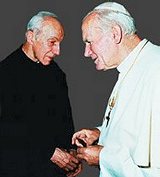
Fr. John A. Hardon was one of the finest theologians of modern times. When some theologians were weaving loopholes through theology, tossing the faithful to and fro, Fr. Hardon maintained a firm course with Holy Mother Church, guiding us all with his great catechetical books, and other materials. Here are only a few samples:
Fr. Hardon's is also founder of the Marian Catechists, which is now headed by Archbishop Rayond L. Burke.
Many of Fr. Hardon's works can be found at RealPresence.org, which I keep in my sidebar.
From an article covering his funeral by Jay McNally:
Assumption Grotto's pastor, Fr. Eduard Perrone, describes one of the remarkable things about Fr. Hardon: "I never knew that he said no to any request for his help, whether it was to give personal guidance or counsel or an opinion on some book or some project, or to hear a confession, even to say Mass for a particular petition. He always found time and would be ready to drop whatever he was working on to meet a personal need. What is extraordinary is the great volume of work that he produced with untold interruptions for personal needs. He was prodigious to the point that one would have thought there were two Fr. Hardons."
Tuesday, August 1, 2006
A Pastoral Letter from Bishop Edward Braxton
H/T to Mark Waterinckx for the email regarding a recent pastoral letter given by Bishop Edward Braxton, PhD, STD, Bishop of Belleville, IL. I have not had time to read and digest it myself. Comments are welcome in the combox, for those who do get a chance to read it.
Here is the header information and table of contents:
We Are His Witnesses:
Our Spirit-Filled Mission as the Church in Southern Illinois
Contents:
PART ONE
I. Introduction
II. The Decline of “Common Meaning”
a.) The Liturgy
b.) The Ministry of Bishops
c.) The Priesthood
d.) Women Religious
e.) The Impact of Doubt
PART TWO
I. A New Bishop
II. Our Spirit-Filled Mission
a.) Our Priests
b.) International Priests
c.) Parish Clustering
d.) Deacons, Religious, Lay Leaders, and Parish Life Coordinators
e.) Financial Resources and Stewardship
PART THREE
I. Look to Christ: In Search of Common Meaning
a.) Questions: A Spiritual Inventory
b.) A “Dialogue of the Soul”
II. Conclusion
PART FOUR
Appendix: Questions for Discussion
I'll give you just a small tidbid here, from PART 1-e
e.) The Impact of Doubt
When the shared base of common experiences, understandings, judgments, and commitments is intact in the ecclesial community, the Catholic people who live their faith quietly and sincerely day-by-day respect and confidently place their trust in those who exercise pastoral leadership and governance in the Church. They also feel comfortable with the beliefs and traditions of the faith. As Common Meaning declines however, alienation, mistrust, and doubt become inevitable.
The doubt that invades a family, a parish, a religious community, a diocese, or a nation comes in different forms. It may be operational, ideological, ethical, intellectual, or absolute.
1.) Operational doubt may be manifest when people attend Sunday Mass less frequently, when clergy or parishioners show a lack of enthusiasm or interest in new liturgical guidelines from the Vatican or the United States Conference of Catholic Bishops, when bishops, priests, religious brothers and sisters, or lay people abandon past efforts to resolve differences, when theologians dismiss the pronouncements of bishops about the orthodoxy of their writings, when bishops conclude it is not prudent to give permission for certain theologians to speak in their dioceses, or when parents decide to “home school” their children or withdraw them from leading Catholic universities and enroll them in newer small Catholic institutions that they believe are more faithful to Catholic teachings.
2.) Ideological doubt may be manifest when individuals and groups feel compelled to defend their views against their critics with a forcefulness that was not needed before. Often the tone of this defense shows an awareness that significant members of the community are questioning the definitive Church teachings or dissenting from those teachings with new intensity. If ideological doubt is deep-rooted, a vigorous defense of orthodox teaching or of novel theological ideas may delay a crisis, but it will not prevent it.
3.) Ethical doubt may be manifest when people begin to feel in a deeply emotional way that they have been wronged or violated. “Why are so many people allowed to stay ‘in the Church’ these days when they do not humbly accept her teachings as we do? Why aren’t they punished for rejecting the faith?” “How can the hierarchy continue to ignore our demands for changing the discipline of celibacy when they know the only other option is the denial of the Eucharist?” Ethical doubt can be very acrimonious and may lead to severe conflicts and intense emotional reactions. Since it is associated with feelings of having been betrayed, reason and argument are usually not immediately effective.
4.) Intellectual doubt is manifest when people begin to question the “truth” of their faith. This may be subtle or simple. A person who has not had the opportunity to study scripture seriously reads an article in Time magazine suggesting that many scripture scholars think that the star, the exotic magi, the singing angels, and the shepherds found in the Gospels of Matthew and Luke might be more symbolic of a deeper meaning and theological truth than a literal newspaper account of the birth of the Messiah. But the reader may conclude that if there were no “three kings,” then the whole story is probably not “true.” If someone concludes that, in their view, Church teaching is “wrong” on some aspect of sexual morality, intellectual doubt may prompt them to question the authority of the magisterium to teach about anything.
5.) Absolute doubt – often a combination of all the forms of doubt – can be the final blow. There may be no display of emotions, but it is manifest when formerly active Catholics become apathetic and disinterested in the life of their parish and the larger Church. They may withdraw into an interior world and “tune out” religious leaders, the sacramental life, regular prayer, and deeply held beliefs that once gave meaning to their lives. Now these beliefs are a source of pain and disappointment. A devoted pastor retires to Florida in his mid-sixties in good health to leave the “shambles of the Church” in the hands of the “liberal” priests who “have destroyed the Church he served and loved.” A seminarian who has a deep loyalty to the magisterium and the traditions of the Church “shops around” for another seminary and another diocese because he thinks the bishop, the seminary, and many of the priests in his home diocese are not faithful to the “true” Church. A Catholic woman, convinced she is called to the priesthood, joins another ecclesial community that allows the ordination of women. Absolute doubt may cause some Catholics to turn away from the Church altogether and, at the limit, embrace agnosticism, or even atheism.
In parishes where the decline of Common Meaning is widespread and the manifold forms of doubt have taken hold many individuals and groups in the Church may begin to feel at a loss; they lose their bearings. The judgments and decisions of those in positions of leadership or influence (the Vatican, bishops, religious superiors, pastors, theologians, parish councils, teachers, parents, peer groups, the media) are questioned, doubted or rejected altogether. Religious leaders, in turn, see a growing lack of cohesiveness in the communities they are called to lead and serve. New, sometimes extreme, unofficial organizations and groups are formed that set out to “reform,” “oppose,” or, “defend” the Church. These groups are usually small. However, they may claim to speak “in the name of all.”
Once the decline of Common Meaning and subsequent doubt gain influence in a community, the Church may be perceived as merely a “political institution.” People are labeled “liberals,” “conservatives,” “right-winged,” “left-winged,” “true Catholics,” even “heretics.” There is less and less talk of faith, prayer, sin, salvation, grace, the need for Confession and Communion, apology, seeking forgiveness, forgiving, and reconciliation. Spirituality all but vanishes as the focus turns to “power,” “influence,” “control,” and “winning and losing battles.” Emotions rise; disagreements disintegrate into personal attacks. Opposing groups seem unable to carry on respectful and friendly dialogue that might help clarify positions and counter-positions and amicably resolve differences. Instead, foes seem to be out to “destroy” one another by character assassination, slander, leaks, and even deliberate misstatements in the media, all in the name of “the Church.” Open confrontation is almost inevitable. In rare circumstances some may need to be reminded that it is love, not hatred that should animate the ecclesial community.
Obviously, when doubt is this strong it becomes more difficult to be a true witness to Christ. But it does not become impossible. It also becomes more urgent. These are the circumstances in which we must remind ourselves that the Risen Christ, to whom we bear witness, never abandons us individually or collectively. The Holy Spirit is ever present with “warm breath and Ah! bright wings.”
Go Read Bishop Braxton - full text
Here is the header information and table of contents:
We Are His Witnesses:
Our Spirit-Filled Mission as the Church
in Southern Illinois
A Pastoral Letter
By
The Most Reverend Edward K. Braxton, Ph.D., STD
Bishop of Belleville
June 4, 2006
Our Spirit-Filled Mission as the Church
in Southern Illinois
A Pastoral Letter
By
The Most Reverend Edward K. Braxton, Ph.D., STD
Bishop of Belleville
June 4, 2006
We Are His Witnesses:
Our Spirit-Filled Mission as the Church in Southern Illinois
Contents:
PART ONE
I. Introduction
II. The Decline of “Common Meaning”
a.) The Liturgy
b.) The Ministry of Bishops
c.) The Priesthood
d.) Women Religious
e.) The Impact of Doubt
PART TWO
I. A New Bishop
II. Our Spirit-Filled Mission
a.) Our Priests
b.) International Priests
c.) Parish Clustering
d.) Deacons, Religious, Lay Leaders, and Parish Life Coordinators
e.) Financial Resources and Stewardship
PART THREE
I. Look to Christ: In Search of Common Meaning
a.) Questions: A Spiritual Inventory
b.) A “Dialogue of the Soul”
II. Conclusion
PART FOUR
Appendix: Questions for Discussion
I'll give you just a small tidbid here, from PART 1-e
e.) The Impact of Doubt
When the shared base of common experiences, understandings, judgments, and commitments is intact in the ecclesial community, the Catholic people who live their faith quietly and sincerely day-by-day respect and confidently place their trust in those who exercise pastoral leadership and governance in the Church. They also feel comfortable with the beliefs and traditions of the faith. As Common Meaning declines however, alienation, mistrust, and doubt become inevitable.
The doubt that invades a family, a parish, a religious community, a diocese, or a nation comes in different forms. It may be operational, ideological, ethical, intellectual, or absolute.
1.) Operational doubt may be manifest when people attend Sunday Mass less frequently, when clergy or parishioners show a lack of enthusiasm or interest in new liturgical guidelines from the Vatican or the United States Conference of Catholic Bishops, when bishops, priests, religious brothers and sisters, or lay people abandon past efforts to resolve differences, when theologians dismiss the pronouncements of bishops about the orthodoxy of their writings, when bishops conclude it is not prudent to give permission for certain theologians to speak in their dioceses, or when parents decide to “home school” their children or withdraw them from leading Catholic universities and enroll them in newer small Catholic institutions that they believe are more faithful to Catholic teachings.
2.) Ideological doubt may be manifest when individuals and groups feel compelled to defend their views against their critics with a forcefulness that was not needed before. Often the tone of this defense shows an awareness that significant members of the community are questioning the definitive Church teachings or dissenting from those teachings with new intensity. If ideological doubt is deep-rooted, a vigorous defense of orthodox teaching or of novel theological ideas may delay a crisis, but it will not prevent it.
3.) Ethical doubt may be manifest when people begin to feel in a deeply emotional way that they have been wronged or violated. “Why are so many people allowed to stay ‘in the Church’ these days when they do not humbly accept her teachings as we do? Why aren’t they punished for rejecting the faith?” “How can the hierarchy continue to ignore our demands for changing the discipline of celibacy when they know the only other option is the denial of the Eucharist?” Ethical doubt can be very acrimonious and may lead to severe conflicts and intense emotional reactions. Since it is associated with feelings of having been betrayed, reason and argument are usually not immediately effective.
4.) Intellectual doubt is manifest when people begin to question the “truth” of their faith. This may be subtle or simple. A person who has not had the opportunity to study scripture seriously reads an article in Time magazine suggesting that many scripture scholars think that the star, the exotic magi, the singing angels, and the shepherds found in the Gospels of Matthew and Luke might be more symbolic of a deeper meaning and theological truth than a literal newspaper account of the birth of the Messiah. But the reader may conclude that if there were no “three kings,” then the whole story is probably not “true.” If someone concludes that, in their view, Church teaching is “wrong” on some aspect of sexual morality, intellectual doubt may prompt them to question the authority of the magisterium to teach about anything.
5.) Absolute doubt – often a combination of all the forms of doubt – can be the final blow. There may be no display of emotions, but it is manifest when formerly active Catholics become apathetic and disinterested in the life of their parish and the larger Church. They may withdraw into an interior world and “tune out” religious leaders, the sacramental life, regular prayer, and deeply held beliefs that once gave meaning to their lives. Now these beliefs are a source of pain and disappointment. A devoted pastor retires to Florida in his mid-sixties in good health to leave the “shambles of the Church” in the hands of the “liberal” priests who “have destroyed the Church he served and loved.” A seminarian who has a deep loyalty to the magisterium and the traditions of the Church “shops around” for another seminary and another diocese because he thinks the bishop, the seminary, and many of the priests in his home diocese are not faithful to the “true” Church. A Catholic woman, convinced she is called to the priesthood, joins another ecclesial community that allows the ordination of women. Absolute doubt may cause some Catholics to turn away from the Church altogether and, at the limit, embrace agnosticism, or even atheism.
In parishes where the decline of Common Meaning is widespread and the manifold forms of doubt have taken hold many individuals and groups in the Church may begin to feel at a loss; they lose their bearings. The judgments and decisions of those in positions of leadership or influence (the Vatican, bishops, religious superiors, pastors, theologians, parish councils, teachers, parents, peer groups, the media) are questioned, doubted or rejected altogether. Religious leaders, in turn, see a growing lack of cohesiveness in the communities they are called to lead and serve. New, sometimes extreme, unofficial organizations and groups are formed that set out to “reform,” “oppose,” or, “defend” the Church. These groups are usually small. However, they may claim to speak “in the name of all.”
Once the decline of Common Meaning and subsequent doubt gain influence in a community, the Church may be perceived as merely a “political institution.” People are labeled “liberals,” “conservatives,” “right-winged,” “left-winged,” “true Catholics,” even “heretics.” There is less and less talk of faith, prayer, sin, salvation, grace, the need for Confession and Communion, apology, seeking forgiveness, forgiving, and reconciliation. Spirituality all but vanishes as the focus turns to “power,” “influence,” “control,” and “winning and losing battles.” Emotions rise; disagreements disintegrate into personal attacks. Opposing groups seem unable to carry on respectful and friendly dialogue that might help clarify positions and counter-positions and amicably resolve differences. Instead, foes seem to be out to “destroy” one another by character assassination, slander, leaks, and even deliberate misstatements in the media, all in the name of “the Church.” Open confrontation is almost inevitable. In rare circumstances some may need to be reminded that it is love, not hatred that should animate the ecclesial community.
Obviously, when doubt is this strong it becomes more difficult to be a true witness to Christ. But it does not become impossible. It also becomes more urgent. These are the circumstances in which we must remind ourselves that the Risen Christ, to whom we bear witness, never abandons us individually or collectively. The Holy Spirit is ever present with “warm breath and Ah! bright wings.”
Go Read Bishop Braxton - full text
Fr. Z: In honor of the "ordination" which recently took place
Much has been in the blogosphere on the women who were "ordained" on the river. I have not wanted to focus so much on it, so as to give them the attention they are looking for, but this was hard to pass up. It appears on the blog of Fr. Zuhlsdorf, written by a guest, Tim Ferguson, and to the tune of Gilligan's Island.
Now, it would not be considerate of our Lord to spend any amount of time discussing such offensive actions, without making an act of reparation for them. Below this parody which mocks the "ordinations", is your opportunity.
An act of reparation, which we can pray daily, is this short prayer. It should be recited 3 times. On the webpage from which it comes, we read: "With the Blessed Sacrament suspended in the air, the Angel of Peace prostrated himself and recited this prayer during the third apparition to the children in 1916."
For those who know Fr. Val at Ss. Cyril & Methodius, he has really be encouraging (if not pleading from his priestly heart) that this prayer be recited 3x daily. It takes only minutes. I received it as penance one day in the confessional of one of the priests of Opus Angelorum, as I'm sure many others did. It got my attention back then, and while I sometimes forget, I try to get it in every day. An angel is a messanger from God and being that this message came from a set of apparitions approved by Holy Mother Church, I give it the utmost consideration.
FATIMA ANGEL PRAYER
Oh Most Holy Trinity,
Father, Son, and Holy Spirit,
I adore Thee profoundly.
I offer Thee the most precious Body, Blood, Soul and Divinity
of Jesus Christ, present in all the tabernacles of the world,
in reparation for the outrages, sacrileges and
indifferences by which He is offended.
By the infinite merits of the Sacred Heart of Jesus
and the Immaculate Heart of Mary,
I beg the conversion of poor sinners.
Amen.
(Recite 3x)
Now, if you really want to make an act of reparation for the offense discussed in the above parody, please head to any chapel and make a holy hour in front of the Blessed Sacrament, especially if you have access to an adoration chapel.
Now, it would not be considerate of our Lord to spend any amount of time discussing such offensive actions, without making an act of reparation for them. Below this parody which mocks the "ordinations", is your opportunity.
Today, on a boat in Pittsburgh, 12 women are pretending to get ordained. In their honor, a little riff on Gilligan’s Island has been written:
Come sit right back
and you’ll hear a tale,
a tale of some heretics
That started from a Pittsburgh port,
aboard a tiny ship.
The mate was a fan of labyrinths
The skipper was a nun
10 other women were on board
for sacramental fun.
(for sacramental fun)
The liturgy was getting rough,
The litany was long,
Invoking Lilith, Gaia too,
Seemed just a bit too wrong
(though not to Bishop Spong)
The ship set ground in a strange new world,
uncharted heresy
With lesbians And feminists
An acting deacon’s wife
Peace activists
And the rest
Here on Womanchurch Isle
So this is the tale of the priestesses
There here for a long, long time.
They’re sure to make a mess of things
And bitch and moan and whine.
No pope! No men! No canon law
Not a dime to Peter’s Pence!
Like Lollard, Hussites, Bogomils,
They’ve left out common sense.
So join us here each year my friend,
There’s sure to be more fun,
With a hearty shout, “non serviam!
My will, not Thine be done.”
An act of reparation, which we can pray daily, is this short prayer. It should be recited 3 times. On the webpage from which it comes, we read: "With the Blessed Sacrament suspended in the air, the Angel of Peace prostrated himself and recited this prayer during the third apparition to the children in 1916."
For those who know Fr. Val at Ss. Cyril & Methodius, he has really be encouraging (if not pleading from his priestly heart) that this prayer be recited 3x daily. It takes only minutes. I received it as penance one day in the confessional of one of the priests of Opus Angelorum, as I'm sure many others did. It got my attention back then, and while I sometimes forget, I try to get it in every day. An angel is a messanger from God and being that this message came from a set of apparitions approved by Holy Mother Church, I give it the utmost consideration.
FATIMA ANGEL PRAYER
Oh Most Holy Trinity,
Father, Son, and Holy Spirit,
I adore Thee profoundly.
I offer Thee the most precious Body, Blood, Soul and Divinity
of Jesus Christ, present in all the tabernacles of the world,
in reparation for the outrages, sacrileges and
indifferences by which He is offended.
By the infinite merits of the Sacred Heart of Jesus
and the Immaculate Heart of Mary,
I beg the conversion of poor sinners.
Amen.
(Recite 3x)
Now, if you really want to make an act of reparation for the offense discussed in the above parody, please head to any chapel and make a holy hour in front of the Blessed Sacrament, especially if you have access to an adoration chapel.
Abp Sheen Narrates on this film of the Old Mass....
Thanks to Fr. Z, and to Fr. Jim Tucker who made posts covering a video on YouTube in which Archbishop Sheen narrates. I had to edit this to correctly state this fact after someone brought to my attention that the Archbishop was not actually celebrating but narrating. Fr. James Keane is the one celebrating the Mass.
It's in black & white, and is almost an hour. I have not had a chance to watch it yet, but may let it run later on while I'm working in my room.
It's in black & white, and is almost an hour. I have not had a chance to watch it yet, but may let it run later on while I'm working in my room.
Novena to St. John Vianney: Day 6 (Purity)
St. John Vianney, Model of Purity
O holy Priest of Ars, your life was a model of purity. Your life of chastity was a source of edification to all. You said that when a soul is pure all the court of heaven looks upon it with great joy. Today we are experiencing a great disregard for the virtue of purity; it is looked upon with ridicule by worldly standards. O great St. John Vianney, more than ever before, we need your prayers and help in avoiding sins of impurity. I ask you to help Father ___________________ to keep pure in mind and in body and give good example in his speech, conduct and in his faith. Obtain for him the strength necessary to combat temptations against the virtue of purity, which could lead him away from God. Unite your prayers with those of Mary Immaculate to implore God that Father ___________________ be pure in mind and heart and preserve him from those sins which are so displeasing to God. Recite the Novena Prayer.
Novena Prayer
O holy Priest of Ars, St. John Marie Vianney, you loved God and served Him faithfully as His Priest. Now you see God face to face in heaven. You never despaired but persevered in your faith until you died. Remember now the dangers, fears and anxieties that surround Father ___________________ and intercede for him in all his needs and troubles especially console him in his most difficult moments, grant him serenity in the midst of crisis, and protect him from evil. O St. John Vianney, I have confidence in your intercession. Pray for Father ____________________ in a special way during this novena.
O holy Priest of Ars, your life was a model of purity. Your life of chastity was a source of edification to all. You said that when a soul is pure all the court of heaven looks upon it with great joy. Today we are experiencing a great disregard for the virtue of purity; it is looked upon with ridicule by worldly standards. O great St. John Vianney, more than ever before, we need your prayers and help in avoiding sins of impurity. I ask you to help Father ___________________ to keep pure in mind and in body and give good example in his speech, conduct and in his faith. Obtain for him the strength necessary to combat temptations against the virtue of purity, which could lead him away from God. Unite your prayers with those of Mary Immaculate to implore God that Father ___________________ be pure in mind and heart and preserve him from those sins which are so displeasing to God. Recite the Novena Prayer.
Novena Prayer
O holy Priest of Ars, St. John Marie Vianney, you loved God and served Him faithfully as His Priest. Now you see God face to face in heaven. You never despaired but persevered in your faith until you died. Remember now the dangers, fears and anxieties that surround Father ___________________ and intercede for him in all his needs and troubles especially console him in his most difficult moments, grant him serenity in the midst of crisis, and protect him from evil. O St. John Vianney, I have confidence in your intercession. Pray for Father ____________________ in a special way during this novena.
Subscribe to:
Posts (Atom)