Showing posts sorted by date for query schneider. Sort by relevance Show all posts

Monday, August 10, 2015

Bishop Schneider's latest interview - Holy Communion, SSPX


I am unable to make a full post, but want to pass along this interesting interview with Bishop Athanasius Schneider. In it, he discusses Holy Communion, and he also discusses his visits with the SSPX which has been in an irregular status with the Church, but continuing talks. 

You can find the interview in Spanish and English. This link should take you to English. Scroll up for Spanish.


QUICK NOTES

Also, I believe Fr. Perrone's first post retreat homily will be available tonight or tomorrow. I've not had time to download it, but did hear it. He speaks, in part, about his annual retreat, having spent it with the monks at Clear Creek Monastery in Oklahoma. More on that soon.

The Assumption Day Schedule is available at http://AssumptionGrotto.com

And, finally,don't forget about the great event coming up at the end of the month in Dearborn: We Humble Ourselves - Turning a Nation Back to God. Visit http://wehumbleourselves.com

Fr Perrone will be conducting the choir and orchestra for part of the event, but there are many attractions. Check out the website. 


Wednesday, February 11, 2015

Saying farewell to the ORC at Grotto; and, words from Bishop Schneider on the "New Gnosticism"


This weekend, Grotto-goers will be bidding farewell to the priests, brothers, and sisters of the Order of the Holy Cross (ORC, not OSC) who have been a part of our lives for more about 20 years.  Land donated to them in Carrollton, Ohio is the place where they will build their permanent residence here in the United States after receiving all approvals.  They have been hard at work (see updates here).  On this, Fr. Perrone wrote in a recent Grotto-News:


"…on Sunday February 15th we will bid farewell to the Order of the Holy Cross with a little reception in the gym following the 9:30 and noon Masses. Please come to express your gratitude to the priests and nuns for their presence and work in our parish over these twenty-some years."

If you want to bid farewell, come this Sunday as most or all of them based in the US will be here.

Bishop Schneider on Battling the New Gnosticism


Bishop Athanasius Schneider was ordained a priest of the ORC and there is something just published this morning I know many readers here will find of interest.

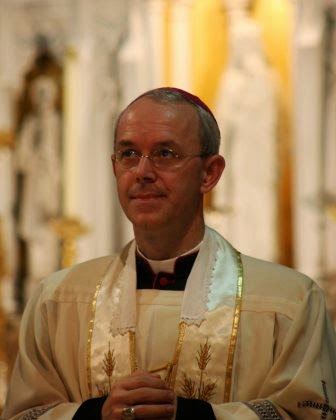
First, a note: Many of the photos you find on the web of Bishop Schneider, especially with the Little Flower in the background, were photographs I took during his 2009 visit to Detroit when spoke at the Call to Holiness Conference.  This morning I got an email from Steve Skojec at the One Peter Five site, alerting me to an article published today at that site by His Excellency.  I appreciate the attribution, the link, and the email notice he provided.

The Editor's Note that accompanies Bishop Schneider's article reads:

"Following his strongly-worded interview with Polonia Christiana in the wake of the first part of the Extraordinary Synod on Marriage and Family, we reached out to Bishop Athanasius Schneider to seek his guidance on concrete actions Catholics can take during this time of turmoil within the Church. We specifically requested his advice on what the faithful could do to resist heterodoxy and address the errors (or at least obfuscations) that seem to be issuing forth from some of the highest prelates in the Church. Though his counsel is brief, it is deeply thoughtful, and offers us a great deal of work to do. With the next meeting of the Synod less than eight months away, there is no time to waste."

Bishop Schneider is a man who knows probably some 10 languages, giving him access to much content - both contemporary and historical.  His PhD is in Patristics.   I find it interesting today that no one questions the hard-hitting boldness with which the Church Fathers spoke, or even Saint Paul for that matter, yet if a bishop today dares to do so, he is vilified and blasted as "rigid." I look at what Bishop Schneider says and I see him cut from the cloth of his namesake, Saint Athanasius.

I've read the article and it is bold, firm, and clear in articulating his thoughts, as usual.  Bishop Schneider doesn't mince words. He says what he thinks, but does not use sarcasm or condescension to get his point across - a key point for anyone wanting others who aren't in the choir to hear the message (whether they can agree or not).

Go read the brief article by His Excellency at One Peter Five: Battling the New Gnosticism.  And, on this feast day of Our Lady of Lourdes, let's ask for the intercession of the Blessed Virgin Mary.


COMMENTS ON THIS BLOG HAVE BEEN DISABLED INDEFINITELY.

For interesting news items I don't have time to blog on, check out my Twitter Feed: @TeDeumBlog

Te Deum Laudamus! Home

The obedient are not held captive by Holy Mother Church;
it is the disobedient who are held captive by the world!

- Diane M. Korzeniewski

Note: The recommended links below are automatically generated by the tool, so they are not necessarily related content.

Saturday, January 24, 2015

Why not "Spiritual Communion" for most at mega-Masses?


And the priest said to the boy: "Tarcisius, remember that a heavenly treasure has been entrusted to your weak hands. Avoid crowded streets and do not forget that holy things must never be thrown to dogs nor pearls to pigs. Will you guard the Sacred Mysteries faithfully and safely?". "I would die", Tarcisio answered with determination, "rather than let go of them". (Pope Benedict, re-telling the story of St. Tarcisius to 55,000 altar servers in Rome in August of 2010)

In the third century, St. Tarcisius - an acolyte of about 12, died a brutal death, by beating and stoning, protecting the Eucharist that hung in a small linen bag around his neck as he took Communion to prisoners. It was in the third century - a period of intense persecution of Christians and the pagan boys who beat him to death, his friends, discovered he was Christian.

Do we believe in Our Eucharistic Lord enough to die for Him like St. Tarcisius, rather than allow Him to fall into the wrong hands or to even be handled inappropriately by those whose intentions are more benign?

Even less, are we willing to abstain from Holy Communion, and make a spiritual communion, when the sheer number of people at a Mass increases the likelihood of accidents, irreverent handling out of ignorance, and intentional profanation? Abstaining in such a way would surely be painful, but it is not without graces, especially under such circumstances.  St. Thomas Aquinas pointed out one benefit of abstention.
If someone knows from experience that daily Communion increases fervor without lessening reverence, then let him go every day. But if someone finds that reverence is lessened and devotion not much increased, then let him sometimes abstain, so as to draw near afterwards with better dispositions.
Even if we do have the fervor Aquinas speaks of, I wonder if he would think it reasonable for a one-time abstention at an event so extraordinary, it makes distribution of Holy Communion difficult without risks to the Sacred Species already mentioned?

There have been outcries over distribution of Communion since these large Masses began, but with regards to authentic dialogue with our hierarchy, it is largely an "un-discussible." At least, that is how I feel about it. Many acknowledge it's a problem, but nothing ever happens to mitigate it. There are no shortage of stories of people finding the Eucharist on the ground after Mass ends, or of sources trying to sell the Consecrated Hosts online.  "Black Masses" are cropping up with increasing frequency, and in public ways.  Since it is a mockery of the Catholic Mass, it is not a "Black Mass" without the Body of Christ in the Host because they desecrate it as part of the ritual.


It's not just the Hosts we should be concerned with, but the fragments, each of which are no less the Body, Blood, Soul and Divinity of Jesus Christ than the whole.  The Church still requires Communion-plates but this is largely ignored (Redemptionis Sacramentum, 93).  I've seen particles on the Communion-plates used during Masses at my own parish.  Just think, most priests carefully sweep any remaining fragments from their own paten into the Chalice, and then drink what is left; yet, they don't use the plates when distributing. There are fragments of the Body of Christ all over our parish floors.  How can we not expect that a lot of handling of the Sacred Species during large open air Masses won't do the same?

If you think this is trivial, read the saints on it. These teachings don't change because we are in the "modern world."  They are timeless; it is we who need to change our thinking about Eucharistic reverence.

Here is St. Ephrem:
One particle from its crumbs is able to sanctify thousands and thousands, and is sufficient to afford life to those who eat of it. 

And, St. Cyril of Jerusalem, after discussing just how delicately we would treat gold-dust:
How much more carefully, then, will you guard against losing as much as a crumb of that which is more precious than gold or precious stones?  

A video US Bishops should study ahead of papal visit in 2015


What prompts my reflection is a situation you may already have learned about through other blogs or in social media.  I wanted to pray and reflect on it before deciding to post on it. When Pope Francis was in the Philippines, someone recorded part of Holy Communion where a chaotic situation resulted in people passing along the Eucharist over the heads of other people who could not reach the priest distributing, sometimes seemingly in stacks.  These are not bad people; they are badly informed people who are trying to be helpful without realizing the dangers of what they are doing with the Holy Eucharist. I think by-and-large, many would agree, that the Filipinos are among the most devout and faithful Catholics. So, this is not about them. It's a bigger issue that has been bubbling for decades.

We have time to act, here in the US, and find better ways to handle extremely large crowds with regards to Holy Communion.

Here is the video, originally provided in a Facebook post by 100% KATOLIKONG PINOY! It was then subsequently uploaded by One Peter Five to YouTube.


There was also an eye-witness account by a young Filipino blogger who was otherwise very enthusiastic by the visit of Pope Francis.  He writes:


Some of the crowd — who were at least two meters away from the ministers — cried for Holy Communion. Two or three soon called out, “Pasa-pasa nalang! (Just pass Them [the Sacred Hosts] around!)”

At first the ministers did not hear them, or probably ignored it. But the people were beginning to be noisy. Some of crowd, fortunately, said, “Uy, hindi pwedeng pasa-pasa! Komunyon yan!”

But the ministers were rather oblivious to the “debate.” Soon they DID pass around — from one grubby hand to another — the Sacred Hosts to the people who were asking for Communion. I saw one broken Host being handed on. Did the minister break It, or was It broken as It was being passed around? Worse, even the ciborium containing the Hosts was soon passed around!

Too distressed to bear the sight, I looked away…..

Other reports I've read said Communion fell to the ground and was found in mud.

Can you imagine seeing the Infant Jesus laying in the mud? That is not bread; it is Jesus.   And how we treat the Eucharist is how we witness our belief in the Real Presence to others.  What kind of witness does this give to non-Catholics in attendance, and there always some.

Archbishop Villegas Responds


A major Filipino news outlet got a response from Archbishop Villegas on what is seen in the video. I'm going to quote from the One Peter Five post, which has a translation of what was partially in Tagalog.  He addresses the criticism saying:
“Under normal circumstances, this should not have happened, but the situation in the Luneta was extraordinary, six million people.” He added: “On this occasion, it was necessary to help each other receive communion.”
We read further:
Fr. Francis Lucas, executive secretary of the CBCP Episcopal Commission on Social Communication and Mass Media, echoed this, telling GMA News Online: “For pastoral reasons since people can’t move during communion, mass passing of the host is okay.”
I'd like to know if the Congregation for Divine Worship would agree to these special "pastoral" situations and allow "mass passing of the Host" in large, papal Masses.

On what Archbishop Villegas said, as was pointed out at One Peter Five, we have to stop and reflect on the word, "necessary." We would infer from this that receiving Holy Communion at all in a gathering of six to seven million is necessary. Maybe that is what we need to discuss.  Is it really necessary for everyone to receive Communion at an extraordinarily large gathering for Mass?  We learn from the CCC:
1389: The Church obliges the faithful to take part in the Divine Liturgy on Sundays and feast days and, prepared by the sacrament of Reconciliation, to receive the Eucharist at least once a year, if possible during the Easter season. But the Church strongly encourages the faithful to receive the holy Eucharist on Sundays and feast days, or more often still, even daily.

At most we might be strongly encouraged to receive Holy Communion at a Papal Mass, if we were properly disposed, but it is not a requirement.  I return back to my original question: Are we willing to protect the Body of Christ, unto forgoing Holy Communion, if it was the most practical way to prevent what is seen in that video? Or worse, in the case of someone carrying It off for some other purpose?

Spiritual Communion


What is "spiritual communion?" Simply put, it is an interior movement in which we unite ourselves to the Eucharistic Lord when we are unable to receive.  This is something that can be done at any time and any place, but can also be done during Mass when we cannot receive for one reason or another.  Perhaps the Eucharistic fast isn't up, or you didn't make it to Confession and are aware of grave sin.  You don't skip Mass; you hear the Word of God, and when others go to Holy Communion, you make a spiritual communion. There was an excellent article in the National Catholic Register back in 2011 called, Follow the Saints: Make a Spiritual Communion. Do read it to understand it better.

Spiritual communion is not the same as Holy Communion, but it can still bring us graces when circumstances do not allow us to receive Our Eucharistic Lord.  I would think the graces would be in abundance if people accepted this on the basis that the risk was too great for accidents or profanation to distribute to such a large crowd.

Some have been outright opposed to any kind of large outdoor papal Masses.  I don't think it's necessary to go that far.  All we need to do is limit Communion to those seated in certain areas (and ensure people of all classes have access, not just big donors and dignitaries); and, ask the rest to make a spiritual communion for that day.  If the Pope could hold Mass in a major Cathedral on a Sunday when traveling, and do any outdoor Masses on weekdays or Saturday mornings, it makes it all the more easier to ask people to make a spiritual communion since these Masses are not obligatory.

Offering up spiritual communion with the sacramentally famished


Until I read the book, Dominus Est – It Is the Lord! Reflections of a Bishop of Central Asia on Holy Communion, I had not given much thought to the plight of persecuted Christians who sometimes go for weeks, months, and even many years or decades without seeing a priest or having access to the Sacraments.  These are clandestine Catholics who risk life, liberty, and other things in order to continue practicing their faith under ground as Catholics did in the days of St. Tarcisius.  Bishop Athanasius Schneider, ORC, grew up in such a climate after his family was exiled to Kazakhstan from Germany. In the beginning of the book he explains how Catholics kept their faith during those long periods without a priest behind the Iron Curtain and the risks taken by priests and lay people alike.  This was the case for about two decades after World War II.  That gripped me at the beginning of his first book on the subject.  In the image here, we see the final moments of Blessed Miguel Pro of Mexico before he was shot for just being a priest, serving Catholics practicing clandestinely.  He is famous for shouting out before a hail of bullets hit him, "Viva Cristo Rey!" (Long Live Christ the King).


There are also people in prisons around the world without access to the sacraments, as well as in places like nursing homes.  I saw first hand when my mother was in one of those places in rehab.  Faithful Catholics whose children left the faith or became lukewarm don't always think to have a priest visit their loved ones. I saw some extraordinary faith in there, and even more suffering from this spiritual neglect.  If you think life is hard when you can go to Mass every Sunday, try being laid up in a nursing home for many months or years in the  midst of this priest shortage.

This had me thinking that the bishops, the Holy Father, and others could invite people to make a spiritual communion at these large Masses begging also for graces for these people who suffer in the  midst of a sacramental famine.  To go without Holy Communion for one Mass would certainly cause some suffering, but it would make us mindful of those around the world who suffer for long periods of time without the Eucharist, Confession, and other sacraments.  This too has graces.

In closing… 


I'll close with a quote from Bishop Schneider's latest book, Corpus Christi, which is published by Gracewing in the UK and sold through the Opus Angelorum site here in the US.  I've modified the English from UK to US and added white space.

Bishop Schneider makes the point earlier in the book how defenseless Jesus is in the Eucharist.  When you consider the Infant Jesus, who was also defenseless, He is even more defenseless under the appearance of the more lowly bread and wine. It is up to us to protect Him, and to come to his defense against mishandling and profanation.  We need to pray that our bishops will see the role they play in His defense.

A new Eucharistic star is indeed, urgently needed, for the Eucharistic Body of Christ is the weakest and most defenseless being in the midst of the life of the Church. Bravely defending this Divine Poor Body surely would not receive the eulogy and the applause of world, but undoubtedly it would be applauded by the Saints, and in particular th holy "Poverello" - or poor man of Assisi, attracting abundant Divine blessings. Indeed, the restoration of the visible honor due to the Eucharistic Body of Christ would be one of the most efficacious means for the renewal of His Mystical Body, the Church.  May God grant that the hearts and minds of the Shepherds of the Church in our days may be pierced by these words of Saint Francis of Assisi: 
"I conjure all of you, brethren, with all the love of which I am capable and kissing your feet: give as much as you can of all reverence and all honor to the most holy Body of Our Lord Jesus Christ!". 
Indeed, there is nothing else and no one else greater than the Sacred Host and each of even Its most minute fragments, for the Body of Christ is the Lord Himself: "Corpus Christi enim Dominus est!"


UPDATE 1: I see Kat at the Crescat just posted on this today too.  She writes:

And then you got some Catholics, who treat the reality of Christ’s presence in the Eucharist like… well, like this.


Lookit. The only person that has to receive the Eucharist during mass is the priest. And the only time we, as lay people, are required to receive the Eucharist is once a year at Easter.
There’s nothing in the GIRM or CCC or anywhere else that says, “Hey, lets distribute the Eucharist to thousands of people all at once. What could possibly go wrong?” 
Abuses, that’s what. 
We really need to get over this idea that we deserve to receive the Eucharist at every mass, whether it’s out of a sense of entitlement or belief that we aren’t “actively participating” if we don’t. 


For interesting news items I don't have time to blog on, check out my Twitter Feed: @TeDeumBlog

Te Deum Laudamus! Home

The obedient are not held captive by Holy Mother Church;
it is the disobedient who are held captive by the world!

- Diane M. Korzeniewski

Note: The recommended links below are automatically generated by the tool, so they are not necessarily related content.

Friday, November 7, 2014

Bishop Schneider's Athanasian response to the Synod's mid-term report


Bishop Athanasius Schneider's patristics background shines in this latest interview which conveys his concerns over how the recent Synod went down, especially the interim report.  Like his namesake, he doesn't leave room for moral gymnastics.  Thanks to Polonia Christiana we have the interview in full translation from Polish.  It was a long read, but worthy of reading in it's entirety. I'm sure some on the left will exploit what he says in a way that is out of context, so don't limit yourself to excerpts. People are quoting those parts that make good soundbites, but when those are not balanced with the other things he says, they only feed the machine that will be all too quick to burn him at the cyber-stake.

As an aside, I'm glad to see so many of my original photographs of Bishop Schneider floating around the web.  I'm using several here from his visits to Detroit.  The one at top, and those similar to it you will find, was taken at Shrine of the Little Flower in Royal Oak when he spoke at the Call to Holiness Conference in 2009.  Others were taken at Assumption Grotto in 2008.

Here is the first part, below this line.


The Church and the world do urgently need intrepid and candid witnesses of the whole truth of the commandment and of the will of God, of the whole truth of Christ’s words on marriage. Modern clerical Pharisees and Scribes, those bishops and cardinals who throw grains of incense to the neo-pagan idols of gender ideology and concubinage, will not convince anyone to either believe in Christ or to be ready to offer their lives for Christ - said + Athanasius Schneider Auxiliary Bishop of the Archdiocese of Saint Mary in Astana, Kazakhstan in interview with Izabella Parowicz.

Your Excellency, what is Your Excellency’s opinion about the Synod? What is its message to families?

During the Synod there had been moments of obvious manipulation on the part of some clerics who held key positions in the editorial and governing structure of the Synod. The interim report (Relatio post disceptationem) was clearly a prefabricated text with no reference to the actual statements of the Synod fathers. In the sections on homosexuality, sexuality and “divorced and remarried” with their admittance to the sacraments the text represents a radical neo-pagan ideology. This is the first time in Church history that such a heterodox text was actually published as a document of an official meeting of Catholic bishops under the guidance of a pope, even though the text only had a preliminary character. Thanks be to God and to the prayers of the faithful all over the world that a consistent number of Synod fathers resolutely rejected such an agenda; this agenda reflects the corrupt and pagan main stream morality of our time, which is being imposed globally by means of political pressure and through the almost all-powerful official mass media, which are loyal to the principles of the world gender ideology party. Such a synod document, even if only preliminary, is a real shame and an indication to the extent the spirit of the anti-Christian world has already penetrated such important levels of the life of the Church. This document will remain for the future generations and for the historians a black mark which has stained the honour of the Apostolic See. Fortunately the Message of the Synod Fathers is a real Catholic document which outlines the Divine truth on family without being silent about the deeper roots of the problems, i.e. about the reality of sin. It gives real courage and consolation to Catholic families. Some quotations: “We think of the burden imposed by life in the suffering that can arise with a child with special needs, with grave illness, in deterioration of old age, or in the death of a loved one. We admire the fidelity of so many families who endure these trials with courage, faith, and love. They see them not as a burden inflicted on them, but as something in which they themselves give, seeing the suffering Christ in the weakness of the flesh. … Conjugal love, which is unique and indissoluble, endures despite many difficulties. It is one of the most beautiful of all miracles and the most common. This love spreads through fertility and generativity, which involves not only the procreation of children but also the gift of divine life in baptism, their catechesis, and their education. … The presence of the family of Jesus, Mary, and Joseph in their modest home hovers over you”.

Those groups of people who had been expecting a change in the Church’s teaching with regard to the moral issues (e.g. allowing divorced and remarried people to receive Holy Communion or granting any form of approval for homosexual unions) were probably disappointed by the content of the final Relatio. Isn’t there, however, a danger that questioning and discussing issues that are fundamental for the Church’s teaching may itself open doors for serious abuses and for similar attempts to revise this teaching in the future?

In fact a Divine commandment, in our case the sixth commandment, the absolute indissolubility of the sacramental marriage, a Divinely established rule, means those in a state of grave sin cannot be admitted to Holy Communion. This is taught by Saint Paul in his letter inspired by the Holy Spirit in 1 Corinthians 11, 27-30, this cannot be put to the vote, just as the Divinity of Christ would never be put to a vote. A person who still has the indissoluble sacramental marriage bond and who in spite of this lives in a stable marital cohabitation with another person, by Divine law cannot be admitted to Holy Communion. To do so would be a public statement by the Church nefariously legitimizing a denial of the indissolubility of the Christian marriage and at the same time repealing the sixth commandment of God: “Thou shalt not commit adultery”. No human institution not even the Pope or an Ecumenical Council has the authority and the competency to invalidate even in the slightest or indirect manner one of the ten Divine commandments or the Divine words of Christ: “What therefore God has joined together, let man not separate (Math 19:6)”. Regardless of this lucid truth which was taught constantly and unchangingly - because unchangeable - through all the ages by the Magisterium of the Church up to our days as for instance in “Familiaris consortio” of Saint John Paul II, in the Catechism of the Catholic Church and by Pope Benedict XVI, the issue of the admissibility to Holy Communion of the so called “divorced and remarried” has been put to the vote in the Synod. This fact is in itself grievous and represents an attitude of clerical arrogance towards the Divine truth of the Word of God. The attempt to put the Divine truth and the Divine Word to a vote is unworthy of those who as representatives of the Magisterium have to hand over zealously as good and faithful rules (cf. Math 24, 45) the Divine deposit. By admitting the “divorced and remarried” to Holy Communion those bishops establish a new tradition on their own volition and transgressing thereby the commandment of God, as Christ once rebuked the Pharisees and Scribes (cf. Math 15: 3). And what is still aggravating, is the fact that such bishops try to legitimize their infidelity to Christ’s word by means of arguments such as “pastoral need”, “mercy”, “openness to the Holy Spirit”. Moreover they have no fear and no scruples to pervert in a Gnostic manner the real meaning of these words labeling at the same time those who oppose them and defend the immutable Divine commandment and the true non-human tradition as rigid, scrupulous or traditionalist. During the great Arian crisis in the IV century the defenders of the Divinity of the Son of God were labeled “intransigent” and “traditionalist” as well. Saint Athanasius was even excommunicated by Pope Liberius and the Pope justified this with the argument that Athanasius was not in communion with the Oriental bishops who were mostly heretics or semi-heretics. Saint Basil the Great stated in that situation the following: “Only one sin is nowadays severely punished: the attentive observance of the traditions of our Fathers. For that reason the good ones are thrown out of their places and brought to the desert” (Ep. 243).

In fact the bishops who support Holy Communion for “divorced remarried” are the new Pharisees and Scribes because they neglect the commandment of God, contributing to the fact that out of the body and of the heart of the “divorced remarried” continue to “proceed adulteries” (Math 15: 19), because they want an exteriorly “clean” solution and to appear “clean” as well in the eyes of those who have power (the social media, public opinion). However when they eventually appear at the tribunal of Christ, they will surely hear to their dismay these words of Christ: “Why are you declaring my statutes and taking my covenant in your mouth? Seeing you hate instruction, and cast my words behind you, … when you have been partaker with adulterers” (Ps 50 (49): 16-18).

The final Relatio of the Synod also unfortunately contains the paragraph with the vote on the issue of Holy Communion for “divorced remarried”. Even though it has not achieved the required two third of the votes, there remains nevertheless the worrying and astonishing fact that the absolute majority of the present bishops voted in favor of Holy Communion for the “divorced and remarried”, a sad reflection on the spiritual quality of the catholic episcopacy in our days. It is moreover sad, that this paragraph which hasn’t got the required approval of the qualitative majority, remains nevertheless in the final text of the Relatio and will be sent to all dioceses for further discussion. It will surely only increase the doctrinal confusion among the priests and the faithful, being in the air, that Divine commandments and Divine words of Christ and those of the apostle Paul are put at the disposal of human decision making groups. One Cardinal who openly and strongly supported the issue of Holy Communion for “divorced and remarried” and even the shameful statements on homosexual “couples” in the preliminary Relatio, was dissatisfied with the final Relatio, and declared impudently: “The glass is half-full”, and analogously he said that one has to work that next year at the Synod it will be full. We must believe firmly that God will dissipate the plans of dishonesty, infidelity and betrayal. Christ holds infallibly the rudder of the boat of His Church in midst of such a big storm. We believe and trust in the very ruler of the Church, in Our Lord Jesus Christ, who is the truth.

Go read the rest at Polonia Christiana.  He was just getting warmed up.

Parting shot: Bishop Schneider's daily ring - the Miraculous Medal.


Books in English by Bishop Athanasius Schneider, ORC can be found online here.


COMMENTS ON THIS BLOG HAVE BEEN DISABLED INDEFINITELY.

For interesting news items I don't have time to blog on, check out my Twitter Feed: @TeDeumBlog

Te Deum Laudamus! Home

The obedient are not held captive by Holy Mother Church;
it is the disobedient who are held captive by the world!

- Diane M. Korzeniewski

Note: The recommended links below are automatically generated by the tool, so they are not necessarily related content.

Saturday, August 2, 2014

Catholic Virtual Wars 12: Mocking and ridicule of bishops - a failure in communication…


There are lots of ways to try to change the hearts of bishops where one thinks change is needed.  Some feel certain bishops are going out of their way to hinder the use of the extraordinary form Mass. In some dioceses, this may be true.  But, one sure way to fail at driving change, is to publicly mock and ridicule, "the bishops." It doesn't matter if it's done in a general way, or by name.  Such behavior will lead only to a self-fulfilling prophecy when those bishops, and ordinary people, think all traditionalists are cranks who can't seem to find 1 Corinthians 13:4-8 if it was taped to the inside of the 1962 hand missal.  St. Francis de Sales makes the point:

One of the most evil dispositions possible is that which satirises and turns everything to ridicule. God abhors this vice, and has sometimes punished it in a marked manner. Nothing is so opposed to charity, much more to a devout spirit, as contempt and depreciation of one's neighbour, and where satire and ridicule exist contempt must be. (St. Francis de Sales, Introduction to the Devout Life)

How much more offensive to God it must be when the target of contempt is a bishop?  Oh, people inform me all the time that St. Thomas Aquinas said we can fraternally correct a prelate, even in public, if what he says or does presents a danger to the faith.  But, I wonder how many have read it in context of all that he wrote on the subject?  And, kvetching is not fraternal correction. Aquinas lays down some boundaries that are somewhat inconvenient to the trigger-happy.  When composing or sharing something online we should also be mindful of canon 1373.

If you want to compound the failure in communication, simply gin up the  crowd-anger by mixing in other complaints in a condescending and abrasive manner on passionate subjects like Communion-in-the-hand. Hit a triple by showing public scorn for particular bishops by including the most undignified pictures of them in the narrative; and, don't forget to present every word and action in the most unfavorable light. Toss out the traditional practice of making excuses for others to protect their dignity. In this way opinion of them is lowered in the eyes of others.  Consider how Our Lord treated Judas.  St. Augustine points out something worthy of pondering...:

Of this patience Himself afforded and showed an example, when, before the passion of His Body, He so bore with His disciple Judas, that ere He pointed him out as the traitor, He endured him as a thief; and before experience of bonds and cross and death, did, to those lips so full of guile, not deny the kiss of peace.


One can advocate for more extraordinary form Masses or ending Communion in the hand, or any other subject that brings out strong emotions, but it ought not be made with all the tact of bison in a ballroom.  In fact, the more sensitive the issue, the greater the need for restraint in how it is discussed - if progress is desired.  If we want people to hear what we have to say on these topics, we have to cease the condescension, mockery, ridicule, and abrasiveness. It's not necessary. In fact, it is counterproductive, no matter how entertaining it may be to the choir. When we die, God won't ask us how well we entertained others; but, He might have something to say about our sins against charity. Venting is not a virtue; it's a vice.  More from St. Francis de Sales:

A brave man can easily bear with contempt, slander and false accusation from an evil world; but to bear such injustice at the hands of good men, of friends and relations, is a great test of patience.

Read that whole section from St. Francis de Sales. It will have you heading into Adoration to meditate rather than desiring to commiserate at the usual watering holes that leave you feeling hopeless, bitter, and angry.  See also what St. Alphonsus says about anger.

How to advocate for a good cause


Bishop Athanasius Schneider has been traveling the world, and writing books,(1) discussing how we can increase reverence for the Eucharist interiorly and exteriorly.  He does so in the most respectful way, very mindful of the dignity of those he addresses and speaks about.  His is a mission love - love for God that is manifest in the dignified way he speaks about the subject, about his concerns, and about people.  Anyone who has heard Bishop Schneider speak can sense that love.  He is not abrasive; he does not put on airs; he does not make use of put-downs and ridicule.  He explains and teaches, constantly proposing with gentleness and meekness. Sometimes he is firm on a point, but his most firm expressions are gentle and loving.  Knowing Bishop Schneider from his visits to Detroit, I can attest that his gentle and meek manner has everything to do with the fact that he is aware people have a free will and can accept or reject what he teaches.  This is prudence in action.

If you want to help Bishop Schneider, then follow his gentle and meek way of advocating.  If you want to harm his mission and cause a good many bishops, priests, and people in general to reject the discussion altogether, and turn against it, then go ahead and mock and ridicule them publicly.

I've seen people use Bishop Schneider's interviews and quotes to browbeat other Catholics over Eucharistic reverence.  I've seen people use the words of Cardinal Burke likewise, as well as Pope Benedict XVI.  I've never heard any of them speak the way that I see others sometimes quote them.  All this does is get people to tune out what they have to say. It never ceases to amaze me that anyone would think that quoting them in vinegar-laced airs would convince others to hear their words. It is so contradictory and unorthodox to promote reverence for the Eucharist or, for the EF Mass, by abrasive and condescending means.

Let's all remember to pray for our bishops and priests.  Where our public, and private, respectful discussion cannot make headway, prayers can.  We have to be mindful, that what God doesn't will, He permits.  If the thing we want doesn't come when we want, despite respectful discussion and prayer, then it is best to leave it in God's hands.

"We can have the most beautiful liturgy in the world, and not have love... It's just for show.... As we seek our way forward...not to be angry and embittered, but people filled with the joy of the Gospel, in love with Our Lord Jesus, and sharing that with our brothers and sisters..." - Archbishop Alexander K. Sample at first Pontifical Mass in EF as Archbishop of Portland. 

Refrain from anger, and forsake wrath.
    Do not fret—it leads only to evil.
Psalm 37:8


When will they learn?


More Catholic Virtual War Series posts:


(1) Both of Bishop Schneider's books, now in English, can be purchased here, including his latest book, Corpus Christi.


COMMENTS ON THIS BLOG HAVE BEEN DISABLED INDEFINITELY.

For interesting news items I don't have time to blog on, check out my Twitter Feed: @TeDeumBlog

Te Deum Laudamus! Home

The obedient are not held captive by Holy Mother Church;
it is the disobedient who are held captive by the world!

- Diane M. Korzeniewski

Note: The recommended links below are automatically generated by the tool, so they are not necessarily related content.

Saturday, July 26, 2014

Venerable Archbishop Sheen on "Misunderstanding the World"


One thing I like about Archbishop Sheen is his approach to discussing the faith.  While he cracks a joke now and then (and is truly funny at times), he's not condescending or bitter when talking about problems in the Church.  He's very matter-of-fact about it all.  When you hear people quoting Archbishop Sheen, or others like Fr. Hardon, and even Bishop Schneider or Cardinal Burke, watch how they quote them.  We should all convey their teachings the way they have been conveyed by them.   Find originals and read, watch, and listen for yourself.  Here is one such example.

A short time ago, I made another post discussing some apps and online sources for finding audio and video of Archbishop Sheen.  I completed listening to a roughly 30 minute talk he gave, opening a retreat he was giving.

The specific talk to which I just listened, twice, is called, "Misunderstanding the World." (You can find other talks from, "A Retreat for Everyone" online.)

This talk took place sometime after Vatican Council II.  In the talk, he discusses the confusion over the word, "World" and says this confusion resulted in chaos, especially among the clergy and religious orders, but also among the laity.  He explains early in his talk that people were becoming worldly.  Their attitudes towards the world were changing. And, at the same time, the Church began to interact with the world and the world with the Church.

In the beginning he speaks about the Church entering the world; and, the world entering the Church.  To illustrate the first point he looks at how popes were crowned from 1914 on through Pope Paul VI.  I'll let you hear it in the audio rather than try to summarize.  After he explains it as he sees it, he asks the question: "Do you see the movement -  the Church going into the world?"

Then he shifts into showing how the world was coming into the Church (once again here, we don't have much context yet into the word, "world." This comes later).  To illustrate this next part, he makes use of the bishops at major councils.  400 years ago, at the Council of Trent, he says it was all Mediterranean, European, and Latin.  Fast forward to Vatican Council I (1870), and it was unchanged.  He explains, there was still, not a single bishop from Africa or Asia.  Fast forward to Vatican Council II (1962-65) and he says over 60% were from North and South America, Africa, and Asia. I was thinking about how this happened at a point in time when intercontinental transportation was making real progress and not limited to ships which led to long travel times.  It all seems to fit into God's plan.

At that last council he said it was not uncommon to hear people say that the Church needed to go out into the world.  He then says, "…and they were indeed right [pause]… but, what is the world?"

Sheen explains that Scripture has two meanings of the word, "world." In the first case, it refers to the cosmos, to creation (he quotes from John, Chapter 1 and John 3:16).  The second meaning of the word, "world," is a spiritual organization without God.  He goes on to explain that when they had heard the Church was going out into the world, they had not made the distinction.  "The result," he says, "was chaos among the clergy, in religious orders, and among the laity."  Some people went to one of two extremes - on one side, he labels, "the psychotics;" and, on the other side, "the neurotics."  He says the psychotics believe that 2 and 2 equal 5 while the neurotics believe 2 and 2 is 4, but they are mad about it.

That is just the beginning of this great talk. Later he goes in to the problem with dialogue retreats and conferences where he says people might feel like they are accomplishing something because they are talking, but it comes at a cost.  I agree with him.  he called them passé, but I think these things are still happening.

I hope you will take time to listen to it, perhaps more than once.  See the link near the beginning of my post.

You can find the whole set of talks from this "Retreat For Everyone " at Amazon in a CD or online at the link I provided near the top of this post.

I'd like to know the year this retreat was recorded so if anyone knows, email me at TeDeumBlog (at) gmail (dot) com.  I closed my comment box indefinitely some months ago for a number of reasons, chief among them, no time to moderate and discuss.  Most people are discussing in social media like Facebook and elsewhere anyway.


For interesting news items I don't have time to blog on, check out my Twitter Feed: @TeDeumBlog

Te Deum Laudamus! Home

The obedient are not held captive by Holy Mother Church;
it is the disobedient who are held captive by the world!

- Diane M. Korzeniewski

Note: The recommended links below are automatically generated by the tool, so they are not necessarily related content.

Tuesday, July 15, 2014

Karaganda, Kazakhstan diocese is vacant after Bishop Kaleta resigns

This is a somewhat newsworthy item for those of us familiar with Bishop Athanasius Schneider, ORC, since he is one of a handful of bishops in the small country of Kazakhstan.

Bishop Janusz Kaleta has resigned.  He has had charge of the diocese of Karaganda since 2011, where Bishop Schneider served as auxiliary bishop (2006-2011).  Source: VIS-News


- accepted the resignation from the pastoral care of the diocese of Karaganda, Kazakhstan, presented by Bishop Janusz Wieslaw Kaleta, in accordance with canon 401 para. 2 of the Code of Canon Law.

Bishop Kaleta was is only 49.  Here is paragraph 2 under CIC 401 on resignations.
§2 A diocesan Bishop who, because of illness or some other grave reason, has become unsuited for the fulfilment of his office, is earnestly requested to offer his resignation from office.

Whatever the reason, we should pray for Bishop Kaleta.

Vacant See and a Handful of Bishops


With regards to the Diocese of Karaganda, which is now vacant, you can count on one hand the number of bishops in Kazakhstan.  Unless someone is transferred to Kazakhstan, or there is a new bishop elevated from among priests working there, I suspect after 8 years serving as an auxiliary bishop, Bishop Schneider may be headed back to his old diocese.  He was in charge of the project to build a cathedral there (see interview here and news story on the dedication to of Our Lady of Fatima). Just prior to that, he was transferred to the metropolitan See of Astana.  

An interesting side note, was that in 2008, Kazakhstan saw the first priestly ordination of a native of the country, at least in modern times.

More on the Church in Kazakhstan here. 


COMMENTS ON THIS BLOG HAVE BEEN DISABLED INDEFINITELY.

For interesting news items I don't have time to blog on, check out my Twitter Feed: @TeDeumBlog

Te Deum Laudamus! Home

The obedient are not held captive by Holy Mother Church;
it is the disobedient who are held captive by the world!

- Diane M. Korzeniewski

Note: The recommended links below are automatically generated by the tool, so they are not necessarily related content.

Friday, July 11, 2014

Day of Recollection this Sunday at Grotto; and, Bishop Schneider's book, "Corpus Christi


The Order of Canons Regular of the Holy Cross, through their apostolate, Opus Angelorum, will be giving their annual, summer Day of Recollection at Assumption Grotto, this Sunday.  After the Noon Mass there is a Eucharistic Procession to the outdoor grotto where the Rosary is prayed, weather permitting (otherwise there is Exposition in the church with Rosary).  The parish has grilled meats, along with the usual donuts and coffee, each Sunday, with only a few exceptions.  With the conference set at 2:00, it gives a little time to spend having a quick meal.  

You can read more about Opus Angelorum here and visit the Opus Angelorum website here

This is an opportune time to mention that Bishop Athanasius Schneider's latest book, Corpus Christi, is being distributed here in the U.S. by them. I know they have stacks of it in the convent, so if you come, look for it on their table with other books.  If you want to order the book, you can do so online.  Here is a report about the book from Catholic News Agency before it was available in English.

They also have many of their talks recorded.  One I frequently recommend is, "On Holy Silence" (scroll down). You can see many other titles by scrolling, and by clicking on the sections in the side bar for other subject areas.  


The Grotto News - Assumption Grotto's weekly bulletin, is out (these are only online in PDF form for a limited time so do a save-as on it if you want to keep it).   With Fr. Perrone away on his July vacation, you can read Fr. John's column.  In it, he has a reminder about the Preparation for Total Consecration According to St. Louis de Montfort.  I'm sure books will be available in the Grotto gift shop for that.  In fact, Sunday will be a good time to browse with the Day of Recollection taking place at 2:00.

Help is also needed for our feast day and the bulletin has a chart showing where you can help.


For interesting news items I don't have time to blog on, check out my Twitter Feed: @TeDeumBlog

Te Deum Laudamus! Home

The obedient are not held captive by Holy Mother Church;
it is the disobedient who are held captive by the world!

- Diane M. Korzeniewski

Note: The recommended links below are automatically generated by the tool, so they are not necessarily related content.

Wednesday, July 2, 2014

Bishop Athanasius Schneider on St. Philip Neri


The Brompton Oratory uploaded, yesterday, a sermon given there by Bishop Athanasius Schneider, ORC, back on May 26, 2014 on St. Philip Neri:

Saint Philip Neri, received the title ‘the Apostle of Rome’. This title means that he contributed through his saintly life and priestly ministry to the restoration of Christian life in Rome in a measure comparable to the work and to the spirit of the Apostles. Our Saint is known also as the ‘Saint of joy’….


*Photo at top taken at the 2009 Call to Holiness Conference in Detroit at the Shrine of the Little Flower in Royal Oak. 

For interesting news items I don't have time to blog on, check out my Twitter Feed: @TeDeumBlog

Te Deum Laudamus! Home

The obedient are not held captive by Holy Mother Church;
it is the disobedient who are held captive by the world!

- Diane M. Korzeniewski

Note: The recommended links below are automatically generated by the tool, so they are not necessarily related content.

Monday, February 17, 2014

Retiring bishops, priests and all those empty rectory rooms...


An article in the Newark Star Ledger (h-t Deacon Kandra) has people talking about what is considered modest living for a bishop heading into retirement.  I don't know the circumstances surrounding this, or if it is going to be a retirement home for a number of clerics, but it is raising a lot of questions.  The article starts out...

The 4,500-square-foot home sits on 8.2 wooded acres in the hills of Hunterdon County. With five bedrooms, three full bathrooms, a three-car garage and a big outdoor pool, it’s valued at nearly $800,000, records show. 
But it’s not quite roomy enough for Newark Archbishop John J. Myers. 
Myers, who has used the Franklin Township house as a weekend residence since the archdiocese purchased it in 2002, is building a three-story, 3,000-square-foot addition in anticipation of his retirement in two years, The Star-Ledger found. He will then move in full-time, a spokesman for the archbishop said. 
The new wing, now just a wood frame, will include an indoor exercise pool, a hot tub, three fireplaces, a library and an elevator, among other amenities, according to blueprints and permits filed with the Franklin Township building department. 
The price tag, the records show, will be a minimum of a half million dollars, a figure that does not include architectural costs, furnishings and landscaping.

Who pays?


So that it is known, unlike most religious order priests, diocesan priests do not take a vow of poverty.  However, there is prudential judgment and being the best possible witness for the Gospel.  If it looks rich, and sounds rich, what kind of perception does it yield in a reasonable person?  And, from where does this money come?

Myers’ spokesman, Jim Goodness, said the addition will have no impact on archdiocese finances, saying the cost will be largely borne by the sale of other church-owned properties. Donors also have contributed to the project, Goodness said. 
He declined to identify the properties to be sold or provide the amount of the private donations.
"There are not expected to be any expenses that can not be met by other real estate transactions, and it will remain an asset of the archdiocese," Goodness said. "It is not a personal asset."

Properties sold?  That's a pretty sensitive expression these days with parishes closing.

Now, this is interesting...

According to guidelines issued by the U.S. Conference of Catholic Bishops, all dioceses must provide a residence for retired bishops. The guidelines don’t specify, however, what kind of residence is required.

There should be some kind of guidelines, no?  I don't think a diocese should pay for anything beyond a modest residence in a modest part of town, no disrespect intended. Maybe after all of the facts come out in this case, the Myers retirement residence will prove to be modest.  I hope so.

Rectories as Retirement Havens?


Much beloved Fr. Val before he died,
with the visiting Bishop Athansius Schneider,
at Ss Cyril & Methodius in Sterling Heights
a few  years back.
Here's a novel idea and a great way to save both clerics and dioceses money.

How many empty rectory rooms are there in each diocese?  And, how many retired priests in a given diocese would be willing to live in those rooms for a very low cost? By that, I mean a reasonable cost for added utility use, food, services, etc.

I have seen a few elderly priests living at two different parishes in recent years and it was a grand arrangement.  These priests could celebrate Mass privately, or publicly (as they felt up to it); they heard confessions likewise and offered spiritual direction.  In fact, these priests seemed to love the kind of freedom pastors do not have because of administration and other duties.

These priests are, or were, beloved fixtures in their communities.  I've known of other retired priests who lived in rectories who were not engaged with the parish community.  Maybe they were involved with other things, or burned out like others who enter retirement and need a change. They should be free to participate in parish life as they wish and are able, or not at all.

I know some bishops have retired to rectories. Is this not a good use of diocesan money, to give a parish a modest sum of money to take in a retired bishop?

Once again, I understand that diocesan priests and bishops do not take a vow of poverty, but rectory living in most parishes is hardly poverty. The key word is freedom - freedom to participate or not.  However, I think rectory living could be encouraged by the USCCB in their guidelines.  What is the cost of putting Archbishop Myers in a rectory room within the diocese, or even in another diocese that is willing to take him in?  He wouldn't get a jacuzzi, but he would have a bath tub like the rest of us.

I do know that some retired priests are living in poverty. Maybe Archbishop Myers is planning on taking some of them into this big place he is building.  I digress. Could we ease the suffering of retired priests living in poverty by giving them one of those empty rooms in a big rectory with lots of empty rooms, for a lower cost than what they pay now? It would be good for the faithful to witness Holy Church doing everything possible in this regard, to aid her retired priests.  Charity starts at home.

Consider that if a priest wants to move from one state to another in retirement, how many places he could choose from to live, if he could find a pastor willing to open the door. Maybe a cleric wants to be near an elderly sibling or other family members who cannot accommodate him; or, perhaps he simply cannot afford to be there because of living costs.

I know some will talk about ideological and even theological differences between priests, and we know that some are very orthodox while others are quite heterodox.  No one says there shouldn't be some kind of compatibility, and freedom on the part of a pastor to approve or disapprove.  When we aren't talking heterodoxy being involved, it's good to keep in mind that pearls are created in friction.  I'm willing to bet that a pastor like Fr. Ben at Ss Cyril & Methodius benefited from his relationship with Fr. Val, and vice versa. We can get set in our ways living alone and being around others brings opportunities to practice mortification - a word most never hear about anymore.  We become one another's hair shirts.

I suspect God would bless priests, parishes, and dioceses for such arrangements.  I know many whose lives were forever altered by Fr. Val Rykowski, and other elderly priests like him who, despite their age and frailty, serve as spiritual fathers to many in retirement.

As an aside, I understand that March 1st is the anniversary of Fr Val's death.  It is an act of mercy to pray for the dead and not avoid doing so on the presumption they area already in heaven.  Fr. Val would be the first to tell people to pray for him.

Comments:


I've had my say, what say you?  I'd be interested to hear from priests whether this could work and what the perceived obstacles would be.


Updates


For interesting news items I don't have time to blog on, check out my Twitter Feed: @TeDeumBlog

Te Deum Laudamus! Home

The obedient are not held captive by Holy Mother Church;
it is the disobedient who are held captive by the world!

- Diane M. Korzeniewski

Note: The recommended links below are automatically generated by the tool, so they are not necessarily related content.

Saturday, February 15, 2014

Pope Francis on "adagio-complainers," and lambs who act like wolves


We all know that dissenting Catholics, especially those in prominent positions with big platforms like universities, especially clerics, are the typical image we have of a wolf.  But, Pope Francis draws our attention to another kind of wolf - the lamb who acts like a wolf.

Here are the main points from the homily of Pope Francis yesterday. There are three points:


Commenting on the day’s first reading, taken from the Acts of the Apostles, Pope Francis reflected on the nature of Christian identity, noting that a Christian is first of all someone who is “sent”: the Lord sends his disciples out into the world to proclaim the Gospel, so a Christian is a disciple “who walks, who always moves forward”. A Christian who stands still “is sick”, the Pope said, because the first marker of Christian identity is the capacity “to walk even where there are difficulties, to go beyond those difficulties”.

Okay, so he is hitting one of his main points, that the laity must start to pull their weight on the evangelization front.

He continues:


A second feature of Christian identity, the Pope continued, is that a Christian “is a lamb, and must retain this identity”: the Lord sends us out “as lambs among wolves”. Some would suggest using strength against those wolves, the Pope continued, but we must remember David when he fought the Philistine: “they wanted to dress him up in all of Saul’s armour and he couldn’t move, he wasn’t himself, he wasn’t humble”, so in the end he took his catapult and he won the battle. Sometimes temptation leads us to think: “This is difficult, these wolves are smart and I’ll be smarter than them”. But as long as you’re a lamb, the Lord will defend you, while if you’re a wolf, He won’t defend you, He will leave you alone. 

This reminds me of a point I have raised often, that we cannot defend Jesus Christ with the sword.  Jesus rebuked Peter for that (John 18:1-11).  As I pointed out in a post some months ago, we should see the sword as a tool that cuts out sin and imperfections from ours own lives, not something by which we forcefully bring others into compliance.  God doesn't force us to go against our free will so we should not use this method with others.

We can lose sight of the fact that there is nothing happening around us that God doesn't already know about. Just as he could have sent a legion of angels to free Jesus from the Cross, the same could be done for us.  Yet, it is with meekness and gentleness that we must proceed, mindful that the best evangelization efforts are those where virtue leads the way, and we remain blameless in every regard.  Of course, this means learning about virtue and the way of perfection. Knowledge of the faith is not enough and if we neglect that other side, we can evangelize with a nasty streak that can push others away, rather than draw them.

Consider how we see people discussing the need to increase reverence for the Eucharist. Some will promote distribution of Holy Communion on the tongue and kneeling with a bitter sarcasm that sometimes even mocks others who receive in the hand while standing - a valid and popular method of reception.  Because it is popular and valid does not mean we ought not talk about changes. I myself am an advocate of returning to Communion being distributed on the tongue while kneeling.  However, I am also an advocate of the method used by Bishop Athanasius Schneider, ORC.  He proposes and invites people by appealing to their intellect and hearts.  This shepherd talks to lambs like a lamb and the end result is that they do not scatter when he speaks.  It is a mode of delivery that is pure and because it is pure, it allows the Holy Spirit to do the real work.  I've known people who cannot bring themselves to agree with Bishop Schneider, yet they say they will think about what he says.  Bishop Schneider's approach is one that respects the free will of others. He is mindful that he cannot force others to accept what he is teaching.  People who use caustic methods to advance a cause do harm to the very thing they are promoting.


The Holy Father talks about the last kind of identity:

A third feature of Christian identity, Pope Francis went on, is the “Christian style”, which is joy. Christians, he said, “are people who exult because they know the Lord and they bring the Lord”. It is not possible, the Pope said, to walk as Christians without joy, to walk as lambs without joy. Even in the face of challenges, in the face of difficulties, in the face of our own mistakes and sins, “there is the joy of Jesus, which always forgives and helps”. Those Christians whose “tempo” of life is “adagio-complaining” are not helping the Lord or the Church, the Pope said: that is not the style of the disciple.

Here, I believe he is talking about people who are slow (adagio) to get involved because they allow themselves to be overwhelmed with difficulties, or with their own sinfulness.  They would rather sit around and complain.  This is not only harmful to themselves, but it is harmful to evangelization efforts as this is the face others see.

He finishes with this admonition:

On the feast of the two Christian disciples, Cyrill and Methodius, we must reflect on the nature of Christian identity, Pope Francis concluded: a Christian is a man or a woman who never stands still, who always walks, who walks as a lamb, and walks with joy. Through the intercession of these Saints, Patrons of Europe, may the Lord grant us the grace to live as Christians who walk as lambs, with joy.

Beautiful.


For interesting news items I don't have time to blog on, check out my Twitter Feed: @TeDeumBlog

Te Deum Laudamus! Home

The obedient are not held captive by Holy Mother Church;
it is the disobedient who are held captive by the world!

- Diane M. Korzeniewski

Note: The recommended links below are automatically generated by the tool, so they are not necessarily related content.