Thursday, December 20, 2012

Full Mass and Confession Schedule for Christmas Season at Assumption Grotto


Here is the full Christmas Season schedule, now linked on the Assumption Grotto website


2012-13 Christmas Season Mass and Confession Schedule

Confession Schedule

Saturday, December 22nd
10:00 a.m. until 11:00 a.m.
2:30 p.m. until 3:30 p.m.
It is not advisable to delay Confession until Sunday, the 23rd
No confessions will be heard December 24th or 25th


Mass Schedule


Monday, Christmas Eve, December 24th
7:30 a.m. (This is an Advent Mass and does not fulfill the Christmas Mass obligation)
4:00 p.m. Christmas Vigil Mass (Assumption Grotto Men’s Schola)
12:00 Midnight Tridentine Solemn High orchestral Mass (Haydn’s Lord Nelson Mass)
Tuesday, Christmas Day, December 25th6:30 a.m., 9:30 a.m. (Tridentine Latin without choir), 12:00 noon
There will not be a 4:00 p.m. Mass on Christmas Day.
Saturday December 297:30 a.m. Mass (not a Sunday Mass)
4:00 p.m. Mass (for Sunday)
Sunday, December 306:30 a.m.
9:30 Tridentine Latin Mass (Haydn’s Lord Nelson Mass)
12:00 noon
Monday, December 31st7:30 a.m. (This Mass does not fulfill the Mass obligation for January 1st)
4:00 p.m. Mass
11:00 p.m. Mass with Exposition of the Blessed Sacrament, Te Deum, Veni Creator Spiritus and rosary; an optional pot luck New Year celebration follows in the gym
Tuesday, January 1st6:30 a.m.
9:30 Tridentine Latin Mass (no orchestra)
12:00 noon
There will not be a 4:00 p.m. Mass on New Year’s Day.
Saturday, January 5th7:30 a.m. (This Mass does not fulfill the Mass obligation for Sunday)
4:00 p.m. Mass
Sunday, January 6th, Epiphany6:30 a.m Mass
9:30 a.m. Latin new rite Mass
12:00 noon Solemn High Tridentine Latin Orchestral Mass (Haydn’s Lord Nelson Mass)


For interesting news items I don't have time to blog on, check out my Twitter Feed: @TeDeumBlog

Te Deum Laudamus! Home

The obedient are not held captive by Holy Mother Church;
it is the disobedient who are held captive by the world!

- Diane M. Korzeniewski

Note: The recommended links below are automatically generated by the tool, so they are not necessarily related content.

St. Bernard on the Blessed Virgin Mary and the Annunication


In today's Office of Readings was this beautiful reflection on the Blessed Virgin Mary and the Annunciation by St. Bernard, Abbot.

In our poorly catechized world, many do not understand the significance of Mary's fiat - her "yes" to the Angel Gabriel's message.  God gives to all of us free will.  Judas was free to choose greed in his pursuit of 30 pieces of silver for Jesus.  Adam and Eve had free will, but chose it to disobey God on something as seemingly benign as eating fruit from a tree. God told them, "no," without giving a reason and all they had to do was accept his command on faith, but they chose their own reasoning.

Mary was given a choice. She was young and had no idea what it would bring.  This was not a command, but a proposal - one that she accepted.  She could have said, "no," but she did not.

Here is St. Bernard...


Second reading 
From a homily In Praise of the Virgin Mother by Saint Bernard, abbot 
The whole world awaits Mary’s reply 
You have heard, O Virgin, that you will conceive and bear a son; you have heard that it will not be by man but by the Holy Spirit. The angel awaits an answer; it is time for him to return to God who sent him. We too are waiting, O Lady, for your word of compassion; the sentence of condemnation weighs heavily upon us.The price of our salvation is offered to you. We shall be set free at once if you consent. In the eternal Word of God we all came to be, and behold, we die. In your brief response we are to be remade in order to be recalled to life. 
Tearful Adam with his sorrowing family begs this of you, O loving Virgin, in their exile from Paradise. Abraham begs it, David begs it. All the other holy patriarchs, your ancestors, ask it of you, as they dwell in the country of the shadow of death. This is what the whole earth waits for, prostrate at your feet. It is right in doing so, for on your word depends comfort for the wretched, ransom for the captive, freedom for the condemned, indeed, salvation for all the sons of Adam, the whole of your race. 
Answer quickly, O Virgin. Reply in haste to the angel, or rather through the angel to the Lord. Answer with a word, receive the Word of God. Speak your own word, conceive the divine Word. Breathe a passing word, embrace the eternal Word. 
Why do you delay, why are you afraid? Believe, give praise, and receive. Let humility be bold, let modesty be confident. This is no time for virginal simplicity to forget prudence. In this matter alone, O prudent Virgin, do not fear to be presumptuous. Though modest silence is pleasing, dutiful speech is now more necessary. Open your heart to faith, O blessed Virgin, your lips to praise, your womb to the Creator. See, the desired of all nations is at your door, knocking to enter. If he should pass by because of your delay, in sorrow you would begin to seek him afresh, the One whom your soul loves. Arise, hasten, open. Arise in faith, hasten in devotion, open in praise and thanksgiving. Behold the handmaid of the Lord, she says, be it done to me according to your word.


For interesting news items I don't have time to blog on, check out my Twitter Feed: @TeDeumBlog

Te Deum Laudamus! Home

The obedient are not held captive by Holy Mother Church;
it is the disobedient who are held captive by the world!

- Diane M. Korzeniewski

Note: The recommended links below are automatically generated by the tool, so they are not necessarily related content.

Wednesday, December 19, 2012

Belmont Abbey, Wheaton College with temporary win on HHS mandate in Federal Court


From the Becket Fund which is handling many cases on the HHS mandate front:
For Immediate Release: December 18, 2012 
Media Contact: Emily Hardman, 202.349.7224

Washington, D.C. — Today, a federal appeals court in Washington, D.C. handed Wheaton College and Belmont Abbey College a major victory in their challenges to the HHS mandate. Last summer, two lower courts had dismissed the Colleges’ cases as premature. Today, the appellate court reinstated those cases, and ordered the Obama Administration to report back every 60 days—starting in mid-February—until the Administration makes good on its promise to issue a new rule that protects the Colleges’ religious freedom. The new rule must be issued by March 31, 2013.

“The D.C. Circuit has now made it clear that government promises and press conferences are not enough to protect religious freedom,” said Kyle Duncan, General Counsel of the Becket Fund for Religious Liberty, who argued the case. “The court is not going to let the government slide by on non-binding promises to fix the problem down the road.”

The court based its decision on two concessions that government lawyers made in open court. First, the government promised “it would never enforce [the mandate] in its current form” against Wheaton, Belmont Abbey or other similarly situated religious groups. Second, the government promised it would publish a proposed new rule “in the first quarter of 2013” and would finalize it by next August. The administration made both concessions under intense questioning by the appellate judges. The court deemed the concessions a “binding commitment” and has retained jurisdiction over the case to ensure the government follows through.

“This is a win not just for Belmont Abbey and Wheaton, but for all religious non-profits challenging the mandate,” said Duncan. “The government has now been forced to promise that it will never enforce the current mandate against religious employers like Wheaton and Belmont Abbey and a federal appellate court will hold the government to its word.”

Continue reading at The Becket Fund... 


For interesting news items I don't have time to blog on, check out my Twitter Feed: @TeDeumBlog

Te Deum Laudamus! Home

The obedient are not held captive by Holy Mother Church;
it is the disobedient who are held captive by the world!

- Diane M. Korzeniewski

Note: The recommended links below are automatically generated by the tool, so they are not necessarily related content.

Sunday, December 16, 2012

Gaudete! Rejoice!

Rose-colored vestments will be seen today in some parishes.
This is a 2008 file photo from the 9:30 AM Mass on Gaudete Sunday.


The Third Sunday in Advent, Gaudete Sunday, takes it's name from the first word in today's Introit.
Gaudete in Domino semper: iterum dico gaudete. Modestia vestra nota sit omnibus hominibus: Dominus enim prope est. Nihil solliciti sitis: sed in omni oratione petitiones vestrae innotescant apud Deum. -- Benedixisti, Domine, terram tuam: acertisti captivitatem Iacob. V.: Gloria Patri et Filio et Spiritui Sancto. Sicut erat in principio et nunc et semper, et in saecula saeculorium. Amen. Gaudete in Domino semper: iterum dico gaudete. Modestia vestra nota sit omnibus hominibus: Dominus enim prope est. Nihil solliciti sitis: sed in omni oratione petitiones vestrae innotescant apud Deum.

Rejoice in the Lord always: again I say, rejoice. Let your modesty be known to all men: for the Lord is nigh. Be nothing solicitous: but in every thing by prayer let your petitions be made known to God. -- (Ps. 84. 2). Lord, Thou hast blessed Thy land: Thou hast turned away the captivity of Jacob. V.: Glory to the Father and to the Son and to the Holy Ghost. As it was in the beginning, is now, and ever shall be, world without end. Amen. Rejoice in the Lord always: again I say, rejoice. Let your modesty be known to all men: for the Lord is nigh. Be nothing solicitous: but in every thing by prayer let your petitions be made known to God.

The Tridentine Latin Missal Project site also gives us this at the top of the page for today's propers:

On this day the Church urges us to gladness in the middle of this time of expectation and penitence: the coming of Jesus approaches more and more. St. John, the holy precursor, announces to the Jews the coming of the Savior. "The Savior," he says to them, "lives already among us, though unknown. He will soon appear openly." Now is the time for fervent prayers and for imploring Jesus to remain with us by His mercy. Let us prepare the way for Him by repentance and by a worthy reception of the Sacraments. All the prayers of this Mass are filled with that which the Church wishes our souls to be possessed at the approach of the Savior. 

For interesting news items I don't have time to blog on, check out my Twitter Feed: @TeDeumBlog

Te Deum Laudamus! Home

The obedient are not held captive by Holy Mother Church;
it is the disobedient who are held captive by the world!

- Diane M. Korzeniewski

Note: The recommended links below are automatically generated by the tool, so they are not necessarily related content.

Friday, December 14, 2012

Select Quotes from St. John of the Cross on his Feast Day


I would like to wish a blessed feast of St. John of the Cross to all of my brothers and sisters in Carmel. I will leave you with select quotes taken from a compilation at this site.

These first quotes come from the Ascent of Mt. Carmel:
Bk. 3. Ch. 5. #1. Moral good consists in the control of the passions and the restruction of the inordinate appetites. The result for the soul is tranquility, peace, repose, and moral virtue. The soul cannot control the passion without forgetting and withdrawing from the sources of these emotions. Disturbances never arise in a soul unless through the apprehensions of the memory. #3. The soul must go to God by not comprehending rather than by comprehending and it must exchange the mutable and comprehensible for the Immutable and Incomprehensible. 

Bk. 3. Ch. 6. #3. Distress and worry ordinarily makes things worse and even does harm to the soul itself. The endurance of all with equanimity not only reaps many blessings but also helps the soul to employ the proper remedy.

This one goes with the one in my side bar.  

Bk. 3. Ch. 7. #2. The more importance given to any clear apprehensions (visions, locutions, sentiments), natural or supernatural, the less capacity the soul has for entering the abyss of faith, where all else is absorbed.

A couple more... 

Bk. 3. Ch. 15. #1. The aim is union with God in the memory. #2. Images will always help a person toward union with God, provided he allows himself to soar – when God bestows the favor – from the painted image to the living God. 
Bk. 3. Ch. 20. #3. Cares do not bother the detached man.

These are from the Dark Night of the Soul

Ch. 11. From time to time the soul sees this flame and this enkindling grow so greatly within it that it desires God with yearning of love. #2. This love is not as a rule felt at first, but only the dryness and emptiness. The soul then experiences a habitual care and solicitude with respect to God. This Divine love begins to be enkindled in the spirit. #4. The soul enters the night of spirit in order to journey to God in pure faith, which is the means whereby the soul is united to God.

Ch. 12. #2. The first and principal benefit caused by the arid and dark night of contemplation: the knowledge of oneself and of one’s misery. #3. The soul learns to commune with God with more respect and more courtesy. #4. God will enlighten the soul, giving it knowledge, not only of its lowliness and wretchedness, but of the greatness and excellence of God. He cleanses and frees the understanding that it may understand the truth. #7. From the aridities and voids of this night of the desire, the soul draws spiritual humility. #8. The soul is aware only of its own wretchedness – and esteems neighbors.

Ch. 13. It might possibly now lose, through defective use, what before it lost through excess. #3. The soul loses the strength of its passions and concupiscence and it becomes sterile because it no longer consults its likings. #5. It practices patience and longsuffering. #6. Four benefits of the dark night: delight of peace, habitual remembrance and thought of God, cleanness and purity of soul, and the practice of the virtues. #10. Often God communicates to the soul, when it is least expecting it, the purest spiritual sweetness and love, together with a spiritual knowledge which is sometimes very delicate (and cannot be perceived by sense). 
Ch. 18. #4. Ordinarily that which is of the greatest profit – namely, to be ever losing oneself and becoming as nothing – is considered the worst thing possible, and that which is of least worth, which is for the soul to find consolation and sweetness, is considered best.

From the Spiritual Canticle:

Prologue. #2. Mystical wisdom, which comes through love, need not be understood distinctly… for it is given according to the mode of faith, through which we love God without understanding Him. 

Stanza 1, #12. Pay no attention to anything which your faculties can grasp. You should never desire satisfaction in what you understand about God, but in what you do not understand about Him Never stop with loving and delighting in your understanding and experience of God, but love and delight in what is neither understandable nor perceptible of Him.

From the Living Flame of Love

Stanza 1, #19. God wars against all the imperfect habits of the soul and, purifying thesoul with the heat of His flame, He uproots these habits from it and prepares it so that at last He may enter it and be united with it by His sweet, peaceful and glorious love, as is the fire when it has entered the wood.

#29. Death is the ‘old man,’ namely, the employment of the faculties – memory, understanding and will – and the use and occupation of them in things of the world, and the occupation of the desires in the pleasure afforded by created things. All this and the exercise of the old life, which is the death of the new, or spiritual life… In this new life, when the soul has reached the perfection of union with God, all the desires and faculties of the soul… are changed into Divine operations. #30. Understanding is not the understanding of God. The will has now been changed into the life of Divine love. The memory has in its mind the eternal years. The desire now tastes and enjoys Divine food, being now moved by the delight of God. 

#57. When God brings the soul into that emptiness and solitude where it can neither use its faculties nor make any acts, it sees that it is doing nothing and strives to do something. Therefore it becomes distracted and full of aridity and displeasure. 

[2nd redaction] Stanza III. #34. Any kind of thought or meditation or pleasure would impede and disturb the soul and would introduce noise into the deep silence which the soul should observe in order to hear the deep and delicate voice in which God speaks to the heart in this secret place. #35. When the soul is led into silence, it must forget even the practice of loving advertence… it must practice that advertence only when it is not conscious of being brought into solitude or interior rest or forgetfulness. #36. Pure contemplation consists in receiving. 

For interesting news items I don't have time to blog on, check out my Twitter Feed: @TeDeumBlog

Te Deum Laudamus! Home

The obedient are not held captive by Holy Mother Church;
it is the disobedient who are held captive by the world!

- Diane M. Korzeniewski

Note: The recommended links below are automatically generated by the tool, so they are not necessarily related content.

Wednesday, December 12, 2012

Snapshot: Pope Sends Series of 3 Tweets


The Holy Father sent out a series of three tweets this morning (around Noon in Rome) using his new Twitter handle @Pontifex (https://twitter.com/Pontifex).  I will note that about 15 minutes before did that there were just over 675,000 followers and, as you can see in my snapshot, he added some 15,000 when I began that post a few minutes ago. When I just went to grab his homepage URL, it was up almost another 5000. 

The Holy Father is tweeting in 8 languages.  You can see the other accounts here.  https://twitter.com/Pontifex/following

If you want to follow the Pope just open up a free Twitter.com account and follow him!  

Those on Twitter may want to subscribe to my lists of bishops.  I have broken them off into two separate lists - US and Non-US.  If you subscribed previously, you may want to double-check that you weren't dropped when I renamed it.  There are 20 US bishops tweeting and I have a list of 8 Non-US bishops. That list sticks mainly with those bishops who use at least some english.  Tweet me if I am missing anyone.  I added Pope Benedict to both lists.  By looking at the members of each list, you can follow individually, as well.  The beauty of following a list is that you can see in one click, the latest tweets by members of that list. 


I'm considering a third list of Non-US bishops that are in other languages.  

Here is video captured by Rome Reports of the Pope sending out his first Tweet. 


For interesting news items I don't have time to blog on, check out my Twitter Feed: @TeDeumBlog

Te Deum Laudamus! Home

The obedient are not held captive by Holy Mother Church;
it is the disobedient who are held captive by the world!

- Diane M. Korzeniewski

Note: The recommended links below are automatically generated by the tool, so they are not necessarily related content.

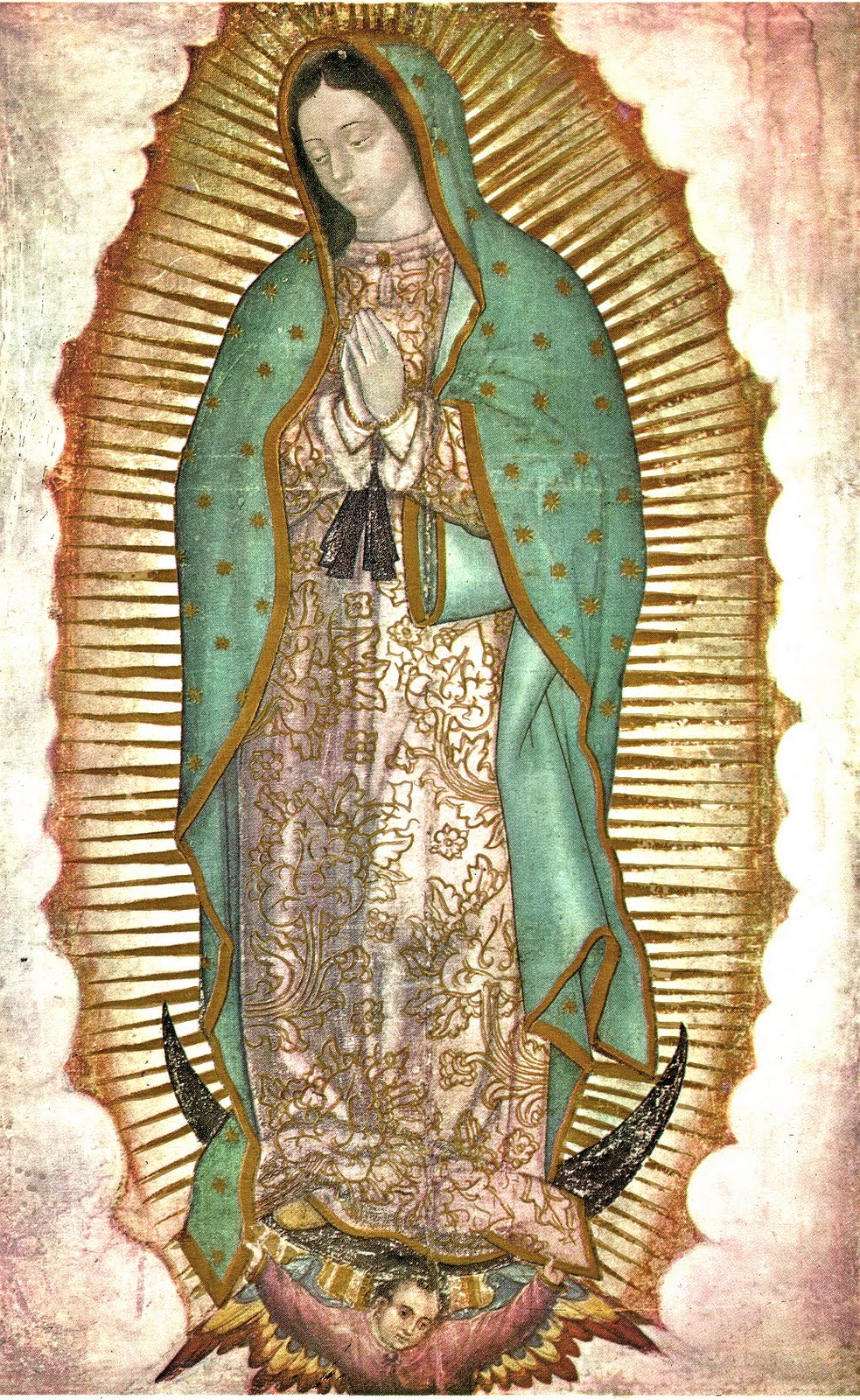
Feast of Our Lady of Guadalupe


Today we celebrate the great feast of Our Lady of Guadalupe - patroness of the Americas.  This is really an incredible story. It involves a phenomenon that is approved by the Church.  From Sancta.org:

Mesoamerica, the New World, 1521: The capital city of the Aztec empire falls under the Spanish forces. Less than 20 years later, 9 million of the inhabitants of the land, who professed for centuries a polytheistic and human sacrificing religion, are converted to Christianity. What happened in those times that produced such an incredible and historically unprecedented conversion?

Go here and read the answer and brief introduction, then click around from the home page to learn much more.   


Also, read why Our Lady of Guadalupe is often seen at pro-life rallies and vigils.

Our Lady of Guadalupe, pray for us!

For interesting news items I don't have time to blog on, check out my Twitter Feed: @TeDeumBlog

Te Deum Laudamus! Home

The obedient are not held captive by Holy Mother Church;
it is the disobedient who are held captive by the world!

- Diane M. Korzeniewski

Note: The recommended links below are automatically generated by the tool, so they are not necessarily related content.

Friday, December 7, 2012

Assumption Grotto offering Several Immaculate Conception Day Masses

While Father Z and Ed Peters debate whether one Mass can count for two obligations when a holy day of obligation falls on the eve of a Sunday, I offer here the Mass schedule for Assumption Grotto for the Solemnity of the Immaculate Conception, which is tomorrow, December 8th. 
  • 6:30 AM      9:30 AM    NOON


I didn't ask, but I'm assuming the 9:30 will be using the 1962 Missal as it does on Sundays.

 On  the Archdiocese of Detroit website is this:

FOR IMMEDIATE RELEASE


Dec 6, 2012 Feast of the Immaculate Conception


WHAT: A holy day of obligation for all Catholics, the Feast of the Immaculate Conception celebrates the conception of the Blessed Virgin Mary in the womb of Saint Anne, and recognizes that our Blessed Mother was sinless from the first moment of her life.


WHO: Check your parish for Mass times. Scripture readings for the feast day can be found on the U.S. Bishops’ website at http://www.usccb.org/bible/readings/120812.cfm.


WHEN: Saturday, December 8, 2012


WHERE: Celebrated by Catholics throughout the United States and the world.


For interesting news items I don't have time to blog on, check out my Twitter Feed: @TeDeumBlog

Te Deum Laudamus! Home

The obedient are not held captive by Holy Mother Church;
it is the disobedient who are held captive by the world!

- Diane M. Korzeniewski

Note: The recommended links below are automatically generated by the tool, so they are not necessarily related content.
Wednesday, December 5, 2012

What is the real status of the National Catholic Reporter in the Catholic Church?

Bishop Charles H. Helmsing, Bishop of Kansas City - St. Joseph (MO) in 1968
with Pope Paul VI


Every time another controversy erupts on the web over something at the National Catholic Reporter's (NCR) website, reasonable people ask why they are still using the Catholic name.  I believe this was addressed by the responsible bishop in 1968, but few know about it. Perhaps it's because it is buried. But why?

Some years ago I stumbled upon what appears to be an official condemnation of the National Catholic Reporter by Bishop Charles H. Helmsing of Kansas City-St. Joseph (Mo) diocese, which is the geographical diocese of the NCR.   His charge was that the paper was heretical.  In that same statement the bishop publicly demanded that NCR cease using the Catholic name.  The statement is written in a way that might make some cringe today, but I'll take frank any day over ambiguous which is the delight of the Angel of Darkness.  There must be a chapter on such things in C.S. Lewis', The Screwtape Letters.

I am copying full text of that statement in this post.  In the past, I kept linking to something obscure only to find the domain expired and it was forever lost.  The text below comes from the following webpage, where you will also find newspaper articles related to the statement: http://greenspun.com/bboard/q-and-a-fetch-msg.tcl?msg_id=00Cofv 

One more important point: Please don't confuse the dissenting National Catholic Reporter with the other NCR, the faithful National Catholic Register.

Here is the statement.  After you read it, I will have some additional thoughts and questions below.

Following is the text of a statement issued by Bishop Charles H. Helmsing of Kansas City - St. Joseph (Mo) Diocese. The statement pertains to the National Catholic Reporter, which is published in the diocese and is an outgrowth of its diocesan newspaper 
The Catholic Reporter, formerly the official newspaper of the Kansas City - St. Joseph, was begun by my predecessor under a policy of editorial freedom. That policy of editorial freedom [I] endorsed on my appointment as bishop of Kansas City - St. Joseph. When the National Catholic Reporter was launched, that original policy of editorial freedom was announced as basic to the new publication. 
At all times it was presumed that the policy of editorial freedom was none other than that legitimate liberty declared and defended by the Second Vatican Council in its Declaration on Religious Liberty, further defined in the conciliar Decree on Communications, and, likewise, defended in the Constitution on the Church in the Modern WorldIt could not imply that pseudo-freedom from man's obligations to his Creator, Redeemer and Sanctifier in vogue under the standard of the 19th century liberalism. It could not imply, as a conciliar declaration on religious liberty clearly states, freedom in the moral order. As Cardinal Koenig pointed out in his recent address to editors, there is a legitimate freedom of opinion to be exercised by the Catholic press so long as it is absolutely loyal to the Church's teachings. If an editor is to merit the name "Catholic," he must remember "to think with the Church." 
As long as the Catholic editor carries the name Catholic, he can never forget that he is a teacher of Christ's revelation. What he writes necessarily touches on faith -- that gift of the Holy Spirit which "we carry in earthen vessels" and by which we accept Christ, the Word of God Incarnate, and His revelation. 
The Catholic editor must manifest a reverence which must shine through in his attitude and in his every expression. The Gospel is clear on the destructive effects of ridicule, for example, in recounting of the taunts hurled at Simon Peter: "You also were with Jesus of Nazareth," and their effects on him who, once converted, was to confirm his brethren. 
As the editors of the National Catholic Reporter know, I have tried as their pastor, responsible for their eternal welfare, and that of those whom they influence, to guide them on a responsible course in harmony with Catholic teachings. When private conferences were of no avail, as is well known, I had to issue a public reprimand for their policy of crusading against the Church's teachings on the transmission of human life, and against the Gospel values of sacred virginity and dedicated celibacy as taught by the Church. 
NOW, AS a last resort, I am forced as bishop to issue a condemnation of the National Catholic Reporter for its disregard and denial of the most sacred values of our Catholic faith. Within recent months the National Catholic Reporter has expressed itself in belittling the basic truths expressed in the Creed of Pope Paul VI; it has made itself a platform for the airing of heretical views on the Church and its divinely constituted structure, as taught by the First and Second Vatican Councils. Vehemently to be reprobated was the airing in recent editions of an attack on the perpetual virginity of the Blessed Virgin Mary and the virgin birth of Christ, by one of its contributors.  
Finally, it has given lengthy space to a blasphemous and heretical attack on the Vicar of Christ. It is difficult to see how well instructed writers who deliberately deny and ridicule dogmas of our Catholic faith can possibly escape the guilt of the crime defined in Canon 1325 on heresy, and how they can escape the penalties of automatic excommunication entailed thereby. 
In fairness to our Catholic people, I hereby issue an official condemnation of the National Catholic Reporter. Furthermore, I send this communication to my brother bishops, and make known to the priestsreligious and laity of the nation my views on the poisonous character of this publication. 
As a bishop, a member of the college of bishops, and one in union with the head of the college, Christ's Vicar on earth, I proclaim with my brother bishops that the Church is, indeed, always in need of reform. This reform is a matter of putting on the mind of Christ, as St. Paul declared, through our contemplation of Christ in His teachings and through our loyalty to the teachings of the Church so painstakingly expressed in recent years in the constitutions, decrees and declarations of the Second Vatican Council. 
The status of the world when our Lord came was a deplorable one. We are not surprised that the status of man, wounded by original sin, remains deplorable as long as he does not heed the voice of Christ and his authoritative teacher, his Church. Sociological studies, according to modern techniques, can help us appreciate the status quo -- the exact thinking and acting and attitudes of our people. For this we are grateful. But it is a total reversal of our Divine Lord's policy to imagine for a moment that the disclosure of attitudes through such surveys becomes the norm of human conduct or thinking. 
Christ and His apostles preached first and foremost penance, metanoia, the change of mind and heart. The Church continues to do so today, but it finds itself increasingly more frustrated in its teaching of the ideals of our Lord by the type of reporting, editorializing and ridicule that have become the week-after-week fare of the National Catholic Reporter. 
IN AS MUCH as the National Catholic Reporter does not reflect the teaching of the Church, but on the contrary, has openly and deliberately opposed this teaching. I ask the editors in all honesty to drop the term "Catholic" from their masthead. By retaining it they deceive their Catholic readers and do a great disservice to ecumenism by being responsible for the false irenicism of watering down Catholic teachings. 
I further ask the editors and the board of directors, for the love of God and their fellow men, to change their misguided and evil policy; for it is evident to me that they have already caused untold harm to the faith and morals not only of our laity, but of too many of our priests and religious. 
I make this statement with apostolic freedom as given by our Lord to His followers; I make it conscious of the heavy burden that is mine as a bishop, as one enjoined by the Holy Spirit through the pen of St. Paul: "Reprove, entreat, rebuke in all patience and doctrine; for there will come a time when they will not endure the sound doctrines; but having itching ears, will heap up to themselves teachers according to their own lust, and they will turn away their hearing from the truth and will turn aside rather to fables." (2 Tim. 4:2-4)
----------------
Notes:
The underline and bold attributes have been applied to the text for emphasis.
A single underline denotes a capitalization not in the original copy.
The [I] is what probably was under a small (2 space) blank spot on the original copy.
The original had "II Tim. 4." instead of "(2 Tim. 4:2-4)"
Bishop Charles H. Helmsing Hierarchy info here


ADDITIONAL THOUGHTS


1) If that statement is legitimate, should it not be displayed on the Diocese of Kansas City-St. Joseph website? The language may seem harsh, but it leaves no doubt in anyone's mind that anything published at NCR is not reliable.

2) Why is NCR included in the list of clients on Twitter (under NCRonline) of the Catholic News Service (CNS), which is the reporting arm of the U.S.  Conference of Catholic Bishops? Also noteworthy is that while sources like NCR, which have worked against the bishops and the Church, are in that client list, faithful and popular sources like EWTN, Catholic News Agency, Catholic Culture, and the National Catholic Register, among others, are not in the list, even though articles by, and interviews with, US bishop can be found there.  I think the USCCB needs someone with enough media savvy to look through all of these details, and through that list of clients. A faithful, knowledgable Catholic shouldn't need a 1968 condemnation of the NCR to know it is wrong to promote anything from that site.  While John Allen may write some excellent and solid articles, Catholics who are not properly formed, wandering around that site after reading his column, will find many ways to be led astray. 

3) The US bishops need to be clear about their position on sources using the Catholic name illegitimately.  Now that sources are not bound by geographical location and are viewed internationally, the USCCB's website should have a page with a list of sites that have been the subject of bishops' statements.  A diocese would send a link for the official notice that is on the diocesan website and it would be added to an alphabetical list at the USCCB's website.  Such a list could mitigate the media's use of certain sources which are known for their attacks on Catholic teaching.  It would be a one-stop shop for everyone to see which sites, originating out of the US, are not reliable. I'm talking strictly dogmatic and doctrinal matters here, not matters of style.


For interesting news items I don't have time to blog on, check out my Twitter Feed: @TeDeumBlog

Te Deum Laudamus! Home

The obedient are not held captive by Holy Mother Church;
it is the disobedient who are held captive by the world!

- Diane M. Korzeniewski

Note: The recommended links below are automatically generated by the tool, so they are not necessarily related content.

Tuesday, December 4, 2012

Report: Medjugorje Commission report due the end of this month...


UPDATE: Yesterday, Edward Pentin reported, in the National Catholic Register, that Fr. Federico Lombardi, Vatican spokesman, stated it is not imminent and that the commission's report must spend some time at the Congregation for the Doctrine of the Faith.

From Catholic Culture:

A Vatican commission studying the alleged apparitions at Medjugorje will release its findings by the end of this year, a French magazine has reported.

La Vie says that the Vatican commission, established by Pope Benedict XVI and chaired by Cardinal Camillo Ruini, will present its report to the Pontiff by the end of December. The French magazine did not cite any authority for its story, but in February an Italian publication made the same report. That earlier report quoted Cardinal Vinko Puljic of Sarajevo as saying that “we need to finish this year.”

Read the rest on Medjugorje Commission at Catholic Culture along with links.

When it says the report will be presented to the Pontiff, that doesn't necessarily mean the Holy Father will issue a statement this year.  However, if the report does go to the Holy Father by years end, it will not be long before he speaks.  The question is, would it be more like January or say, in March, or later? The date chosen by the Holy Father always has significance.  I have long suspected, as I'm sure many of you have, that it will come on a Marian feast day of some kind, be that the Mother of God or the Annunciation, or other.  I always thought it would be great to have it on the day that the Church celebrates the Blessed Virgin Mary's birthday: September 8th (but I would not want to wait that long if the Pope would reveal his thoughts publicly, sooner).  Many in the Medjugorje movement have been celebrating it on August 5th:

September 8 can be viewed as Our Lady’s ‘official’ birthday celebrated by the Church. But for followers of Our Lady’s messages from Medjugorje there is another date in the calendar put aside for celebrating the Gospa’s birthday – August 5, best considered as Our Lady’s ‘private’ birthday. This was revealed to the visionaries very early on in the history of the Medjugorje apparitions.
• Mention of this date was also made by Fr René Laurentin and published the same year in his book, Is the Virgin Mary Appearing at Medjugorje? He wrote:  
At the end of May 1984, Jelena and Mirjana, with whom I spoke on June 10, had received from the Virgin a call to celebrate August 5 as the 2,000 birthday of her birth. The feast was to be celebrated by two days of fasting and a day of celebration... The three days of fast (they added one) ended in a day of intense prayer in the Church and on the hill (of apparitions). There were many conversions and confessions. One of the priests said to me: “I will remember this day more than my 20 previous years as a confessor.” According to the young people (the visionaries), Mary had said who had heard confessions that day would have great joy... 

Some may not see the significance of such a seemingly innocent thing - that the Blessed Virgin Mary would call for her birthday to be celebrated on a day other than the one celebrated liturgically by the whole Church.  This sets up a conflict for theologians discerning the alleged apparition.  The diocese of Mostar-Duvno, when discussing Tomislav Vlasic in the context of Medjugorje said this:

On 22 August 1984, Fr. VlaÅ¡ić wrote to Bishop Žanić informing him that the Madonna’s 2000th birthday was to be held that same year on 5 August! No important ecclesiastic person took this news seriously and neither did Bishop Žanić nor the Holy See. However, during 1984, on 4 and 5 August, a large group of people gathered in Medjugorje to “celebrate” the Madonna’s “birthday”.
The bottom line is that the bishop could not authorize a change in dates for something that is on the universal liturgical calendar.  It's hard to fathom that Mary would ask for such a thing.  The Church looks for harmony in Church teaching and liturgical matters out of messages from alleged apparitions. It is clearly lacking in this case. When the people follow, against the Church, in observing a day not recognized by the Church, that is all the more significant.

Regardless of what side of the issue one is on, we should all desire that truth prevail.  There is nothing wrong with hoping for a positive outcome. I personally do not feel this is likely using basic reason.  No apparition has been approved while ongoing, but many have been condemned as not supernatural while ongoing.

The Church does not approve things happening now because tomorrow something could happen that would prove the thing false and ruin her credibility on such things. The fact that a decision is coming, says something with regards to timing and the fact that the alleged apparitions continue.

There is always the chance that the Holy Father could maintain the status quo, but offer further clarification and guidelines on things like pilgrimages.  However, I am doubtful of this only because it seems unlikely to go through several years of commission work just to maintain status quo. Moreover, Pope Benedict XVI is a co-worker of truth, and a man who has proven time and again, he will not avoid doing right by truth even in the face of potential adverse consequences.  We saw this with the Maciel case.

The case of Medjugorje could have a greater impact than that of Maciel, if Pope Benedict says nothing supernatural is happening, only by the sheer volume of supporters.  I think that is why he is so careful in taking his time since the commission began and why we need to patient a little while longer.  For example, if there is no support for authenticity after a long look at details (not just good fruits, but bad fruits, and how specific events stack up against sound theology), the Pope not only needs to speak the truth, but he needs to do so in a way that will keep as many followers as possible within the fold.  For this reason, we must all be patient and pray.  I trust the Holy Father on this.

I know, personally, many followers of Medjugorje and most of them know my position which I share with the local bishop of Mostar.  I will say this much about those people: They are some of the most faithful Catholics I have met in many respects.  Most of them go to daily Mass, or when they can; they pray the Rosary daily; they spend time in Adoration (and are responsible to some extent for many Adoration chapels around the US); they value Confession and use it frequently; and, they love the Church, her teachings, and the Holy Father.  I believe most will accept the judgment of Pope Benedict XVI.  But, I am aware of some who have expressed online that their belief in the "Gospa of Medjugorje" comes before anything the Pope has to say, if it is not positive.  Sadly, if even 1% reject a possible negative decision, or a fraction of 1%, that is a big number given the millions with an attachment or following to Medjugorje.

Attachment is a key word here.  My father gave me some cogent advice as a child when he was duped by private revelations that would later prove false.  Don't become attached to any such phenomena until the Church gives a definitive judgment. It's okay to be hopeful, but very cautious. Becoming attached sets us up to reject the judgment of the Church and that is why the Angel of Darkness will tolerate people engaging in pious practices, vocations and the like.  In the end, Satan hopes people reject the Church's judgment, ultimately putting them in a position to interiorly join him in saying, "non serviam." Discernment isn't just about good fruits, it's about the full package, most especially those connected to actual events.  One can find all over the web contrasting views of events, some by well known theologians.  In the end, the Holy Father is the final arbiter and the theologian who matters most.

So, pray.  Pray that we all accept the judgment of the Holy Father.  Despite my disbelief about authenticity, I am willing to open myself to any and all new information and thoughts Pope Benedict XVI may offer on Medjugorje.


For interesting news items I don't have time to blog on, check out my Twitter Feed: @TeDeumBlog

Te Deum Laudamus! Home

The obedient are not held captive by Holy Mother Church;
it is the disobedient who are held captive by the world!

- Diane M. Korzeniewski

Note: The recommended links below are automatically generated by the tool, so they are not necessarily related content.

Pope joins Twitter under @Pontifex handle


This may be one more reason to get a free Twitter account, even if it is only to follow key Catholic sources... like the Pope!  Yes. His Holiness has officially joined Twitter under the handle, @Pontifex. He hasn't tweeted yet, as it indicates, but that is forthcoming on December 12, the Feast of Our Lady of Guadalupe.

It was just released a little under 24 hours ago and he already has over 350,000 followers and climbing fast.

With Twitter, you can do a search by keyword or even by name.  When looking at a search of tweets made with @Pontifex by anyone, you can see that the Holy Father has his share of detractors (warning: some of it is vile).  I don't see him getting worked up over it.  If anything, by these attacks he knows that the Holy Spirit has come to rest on him! (1 Peter 4:14)

Jimmy Akin has a post explaining what Pontifex means and why the Holy Father may have chosen it.  I  myself saw it as a way to allow the account to continue through multiple popes rather than making people re-follow another pope by his personal name.  It seems Jimmy is of similar mind.

About that Twitter account you haven't made but are thinking about.  It's easy.  Just go to Twitter.com and follow the prompts.  Here is a set of instructions and tips from Twitter that you might find helpful.  You don't have to tweet or re-tweet (share) anything.  You can simply follow other accounts so their tweets show up in your stream.  You can even do this privately.  There is an area where you can see what anyone says about you through your Twitter handle.  You can reply, but it's often better to just ignore them.

You can easily block someone who is not friendly, or block followers who are following just to get you, and your followers to follow them.  Got that?  People fish for gullible types on Twitter who will follow them and click their links, some of which are suspicious.  Just don't click them.   I tend to go through my follower list and if I see inappropriate content in their feed, or if it looks like they are just trying to make sales and clicks, I block them.  One way to find other accounts to follow is to look at who others are following.

I like both Facebook and Twitter for different reasons, but I do like them both.

Twitter is where you catch news before it's news along with things that never make the news.  It's where you see what is happening now at a glance.  If it's really big news you will see it being tweeted and re-tweeted so that becomes a sort of intensity barometer.  I will check my Twitter feed a few times per day and if anything big is happening, it will show up there before it hits most networks.  If you follow a lot of Catholic sources, like I do, you will find great news and articles easily just by looking at what is being tweeted and re-tweeted among those you are following.  I follow mostly faithful sources, but I also follow some that aren't so faithful, if only to keep tabs on what they are pedaling. Twitter restricts characters to 140.  It allows for links, which are shortened.

Facebook allows for dialogue in a way that Twitter doesn't, but I find it less reliable in terms of finding out what is happening now.  You can reply to someone in Twitter, but it is very cumbersome to dialogue that way, with the character limit.  Things can get misunderstood.


For interesting news items I don't have time to blog on, check out my Twitter Feed: @TeDeumBlog

Te Deum Laudamus! Home

The obedient are not held captive by Holy Mother Church;
it is the disobedient who are held captive by the world!

- Diane M. Korzeniewski

Note: The recommended links below are automatically generated by the tool, so they are not necessarily related content.

Monday, December 3, 2012

Assumption Grotto Christmas Mass Schedule

I have already had some inquiries about which Masses will be in the extraordinary form (1962 Misal). The usus antiquior, as it is often referred to, will be celebrated at the orchestral Masses noted below.  There are more questions about the full Mass and Confession schedule, and whether the orchestral Masses will be Solemn High Masses.  As soon as I have it, I will provide an update.  Watch the Assumption Grotto homepage too.


For interesting news items I don't have time to blog on, check out my Twitter Feed: @TeDeumBlog

Te Deum Laudamus! Home

The obedient are not held captive by Holy Mother Church;
it is the disobedient who are held captive by the world!

- Diane M. Korzeniewski

Note: The recommended links below are automatically generated by the tool, so they are not necessarily related content.

Sunday, December 2, 2012

Video: Interview with Archbishop Charles Brown, Nuncio to Ireland

I have not had as much time for browsing Catholic blogs and sites so I have probably missed a number of things. I'm even behind on some of my email, so my apologies if I've neglected anyone.

Thanks to Andrew Rabel, my attention was drawn to this nearly 30 minute interview of Archbishop Charles Brown, the new Nuncio to Ireland. Archbishop Brown is American and has a rather interesting path to his current position. It included time working for then Cardinal Ratzginer at the CDF.

Fr. Rosica of Salt & Light TV in Canada did this interview, which you can see below.


For interesting news items I don't have time to blog on, check out my Twitter Feed: @TeDeumBlog

Te Deum Laudamus! Home

The obedient are not held captive by Holy Mother Church;
it is the disobedient who are held captive by the world!

- Diane M. Korzeniewski

Note: The recommended links below are automatically generated by the tool, so they are not necessarily related content.

First Sunday of Advent


From today's Office of Readings is something from Saint Cyril of Jerusalem

Second reading From a catechetical instruction by Saint Cyril of Jerusalem, bishop On the twofold coming of Christ

We do not preach only one coming of Christ, but a second as well, much more glorious than the first. The first coming was marked by patience; the second will bring the crown of a divine kingdom.

In general, whatever relates to our Lord Jesus Christ has two aspects. There is a birth from God before the ages, and a birth from a virgin at the fullness of time. There is a hidden coming, like that of rain on fleece, and a coming before all eyes, still in the future. At the first coming he was wrapped in swaddling clothes in a manger. At his second coming he will be clothed in light as in a garment. In the first coming he endured the cross, despising the shame; in the second coming he will be in glory, escorted by an army of angels. We look then beyond the first coming and await the second. At the first coming we said: Blessed is he who comes in the name of the Lord. At the second we shall say it again; we shall go out with the angels to meet the Lord and cry out in adoration: Blessed is he who comes in the name of the Lord.

The Savior will not come to be judged again, but to judge those by whom he was judged. At his own judgment he was silent; then he will address those who committed the outrages against him when they crucified him and will remind them: You did these things, and I was silent.

His first coming was to fulfill his plan of love, to teach men by gentle persuasion. This time, whether men like it or not, they will be subjects of his kingdom by necessity. The prophet Malachi speaks of the two comings. And the Lord whom you seek will come suddenly to his temple: that is one coming.

Again he says of another coming: Look, the Lord almighty will come, and who will endure the day of his entry, or who will stand in his sight? Because he comes like a refiner’s fire, a fuller’s herb, and he will sit refining and cleansing.

These two comings are also referred to by Paul in writing to Titus: The grace of God the Savior has appeared to all men, instructing us to put aside impiety and worldly desires and live temperately, uprightly, and religiously in this present age, waiting for the joyful hope, the appearance of the glory of our great God and Savior, Jesus Christ. Notice how he speaks of a first coming for which he gives thanks, and a second, the one we still await.

That is why the faith we profess has been handed on to you in these words: He ascended into heaven, and is seated at the right hand of the Father, and he will come again in glory to judge the living and the dead, and his kingdom will have no end.

Our Lord Jesus Christ will therefore come from heaven. He will come at the end of the world, in glory, at the last day. For there will be an end to this world, and the created world will be made new.

For interesting news items I don't have time to blog on, check out my Twitter Feed: @TeDeumBlog

Te Deum Laudamus! Home

The obedient are not held captive by Holy Mother Church;
it is the disobedient who are held captive by the world!

- Diane M. Korzeniewski

Note: The recommended links below are automatically generated by the tool, so they are not necessarily related content.

Wednesday, November 28, 2012

Pope Benedict on, "Blessed are those who mourn..."


If you are feeling down about evil in the world, then you are in mourning, says Pope Benedict. In his first book, Jesus of Nazareth, he explains how you should feel comforted.

I'm behind on many things.  It may come as a surprise that, despite my best intentions, I have never read Pope Benedict's first two books on Jesus of Nazareth.  Newly released now is the third book, Jesus of Nazareth: The Infancy Narratives.

I have never been a big reader, but I find myself lamenting what I am losing by not reading. So, I'm reading more, especially using a Kindle which makes it easy to take many books with me everywhere I go.

The internet age made it easier for us to have access to current events faster than we could in the past.  When focus on current events is not moderated and goes to excess, it can leave us feeling depressed, down, and overwhelmed.  We are then left without tools to deal with the stress of some of those current events. One of the things sacrificed, is wholesome reading of sound classics like, The Confessions: Saint Augustine of Hippo (Ignatius Critical Editions) or, The Screwtape Letters by C.S. Lewis.  I'm sure I'm not the only one to have neglected reading the Jesus of Nazareth series by Pope Benedict. I can give you a litany of excuses, but they remain a litany of excuses. One could read for just 15 minutes per day and make headway.

I declared war on my own pre-occupation with current events.  I started reading the first book. With that, I want to share some quotes with you, to show how we can learn to cope with current problems by reading, and reflecting on sound writing, rooted in Scripture.  Given the way immorality and greed are advancing, this section of the Pope's first book on Jesus of Nazareth gave me great comfort and I hope it will also put you at ease.


Pope Benedict, in Chapter 4 of his first book, Jesus of Nazareth, when discussing the Beatitudes - specifically, "Blessed are those who mourn...," opened my eyes to something.  Let's start here (emphasis mine in bold):


Let us go back to the second Beatitude: “Blessed are those who mourn, for they shall be comforted” (Mt 5:4). Is it good to mourn and to declare mourning blessed? There are two kinds of mourning. The first is the kind that has lost hope, that has become mistrustful of love and of truth, and that therefore eats away and destroys man from within. But there is also the mourning occasioned by the shattering encounter with truth, which leads man to undergo conversion and to resist evil. This mourning heals, because it teaches man to hope and to love again. Judas is an example of the first kind of mourning: Struck with horror at his own fall, he no longer dares to hope and hangs himself in despair. Peter is an example of the second kind: Struck by the Lord’s gaze, he bursts into healing tears that plow up the soil of his soul. He begins anew and is himself renewed. (Ratzinger, Joseph (2007-05-15). Jesus of Nazareth (p. 86). Random House, Inc.. Kindle Edition. )

He doesn't stop there.  The Holy Father wants to make sure we get it, so he digs back into the Old Testament:


Ezekiel 9:4 offers us a striking testimony to how this positive kind of mourning can counteract the dominion of evil. Six men are charged with executing divine punishment on Jerusalem—on the land that is filled with bloodshed, on the city that is full of wickedness (cf. Ezek 9:9). Before they do, however, a man clothed in linen must trace the Hebrew letter tau (like the sign of the Cross) on the foreheads of all those “who sigh and groan over all the abominations that are committed in the city” (Ezek 9:4). Those who bear this mark are exempted from the punishment. They are people who do not run with the pack, who refuse to collude with the injustice that has become endemic, but who suffer under it instead. Even though it is not in their power to change the overall situation, they still counter the dominion of evil through the passive resistance of their suffering—through the mourning that sets bounds to the power of evil (Ratzinger, Joseph (2007-05-15). Jesus of Nazareth (pp. 86-87). Random House, Inc.. Kindle Edition.)

If you suffer today because of evil in the world, then you are in mourning.  We Christians are in many battles these days.  In some countries, it's not just a battle with immorality, but a battle that could end in the loss of life and other forms of physical suffering on top of the emotional and spiritual forms.  Here in America, we find ourselves losing liberty. This threat is rooted in the dominion of evil which wants us to go along with immorality.

You can't watch prime-time television without seeing everyone sleep with everyone else (not their spouse) and the mechanisms are in place to encourage ill-catechized Catholics to accept it all.  Then comes the abortion push (because everyone is sleeping with everyone else). Abortion is readily dismissed by many who profess to believe in God, including Catholics.   But, if you dwell in these terrible things you risk falling into hopelessness and despair. People who have faith are not disquieted by those who have no faith; they pray for them, secure in God's peace.  St. Teresa of Avila, who suffered much said, "Let nothing disturb you." This doesn't mean we should be passive and not engage others in the public square, for example.  It means if we find ourselves falling into hopelessness, it's time to pause and pray.


Pope Benedict continues to drill his point home...

Tradition has yielded another image of mourning that brings salvation: Mary standing under the Cross with her sister, the wife of Clopas, with Mary Magdalene, and with John (Jn 19:25ff.). Once again, as in the vision of Ezekiel, we encounter here the small band of people who remain true in a world full of cruelty and cynicism or else with fearful conformity. They cannot avert the disaster, but by “suffering with” the one condemned (by their com-passion in the etymological sense) they place themselves on his side, and by their “loving with” they are on the side of God, who is love. This “com-passion” reminds us of the magnificent saying in Saint Bernard of Clairvaux’s commentary on the Song of Songs (sermon 26, no. 5): “Impassibilis est Deus, sed non incompassibilis”—God cannot suffer, but he can “suffer with.” At the foot of Jesus’ Cross we understand better than anywhere else what it means to say “blessed are those who mourn, for they shall be comforted.” Those who do not harden their hearts to the pain and need of others, who do not give evil entry to their souls, but suffer under its power and so acknowledge the truth of God—they are the ones who open the windows of the world to let the light in. It is to those who mourn in this sense that great consolation is promised. The second Beatitude is thus intimately connected with the eighth: “Blessed are those who are persecuted for righteousness’ sake, for theirs is the kingdom of heaven” (Mt 5:10). (Ratzinger, Joseph (2007-05-15). Jesus of Nazareth (p. 87). Random House, Inc.. Kindle Edition.)

Pope Benedict wraps up his message quite neatly in the next paragraph:


The mourning of which the Lord speaks is nonconformity with evil; it is a way of resisting models of behavior that the individual is pressured to accept because “everyone does it.” The world cannot tolerate this kind of resistance; it demands conformity. It considers this mourning to be an accusation directed against the numbing of consciences. And so it is. That is why those who mourn suffer persecution for the sake of righteousness. Those who mourn are promised comfort; those who are persecuted are promised the Kingdom of God—the same promise that is made to the poor in spirit. The two promises are closely related. The Kingdom of God—standing under the protection of God’s power, secure in his love—that is true comfort. (Ratzinger, Joseph (2007-05-15). Jesus of Nazareth (pp. 87-88). Random House, Inc.. Kindle Edition. )

Wow! Just wow!  The Holy Father really knows how to package something.

If you have never read the Jesus of Nazareth series, I encourage you to start.  At times, some of it may be difficult to follow. Read through those parts slowly. Or, set it down and come back to it the next day. And, if you still don't get it, move forward.  These kinds of books are not meant to be read once. Like with Scripture, what God doesn't bless you to grasp today, He may grant you that understanding the next day or next year.

I like to highlight and send select, short quotes up to Twitter and Facebook when reading from my Kindle Fire.  If you are following there, you might find these in my feeds, but it is often later at night that I read.


For interesting news items I don't have time to blog on, check out my Twitter Feed: @TeDeumBlog

Te Deum Laudamus! Home

The obedient are not held captive by Holy Mother Church;
it is the disobedient who are held captive by the world!

- Diane M. Korzeniewski

Note: The recommended links below are automatically generated by the tool, so they are not necessarily related content.